

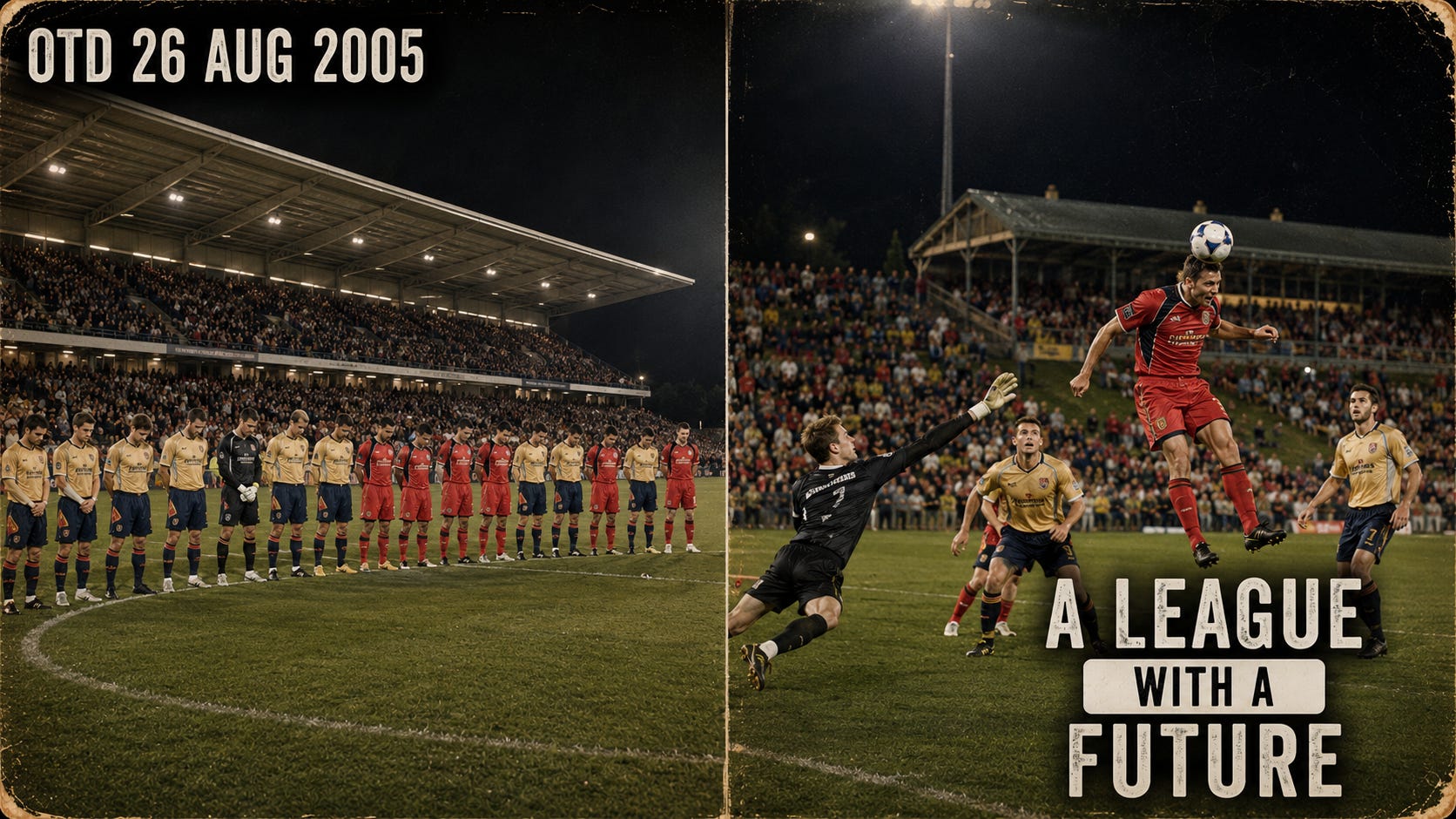
It is August 26, 2005, in Newcastle, New South Wales, and before kickoff more than 13,000 people stand for a minute’s silence for Johnny Warren, former Socceroos captain, broadcaster and tireless evangelist for the Australian game, who had died nine months earlier. Nineteen minutes into Newcastle Jets against Adelaide United, Ross Aloisi crosses and Carl Veart heads past Liam Reddy for the first goal in A-League history; Adelaide win 1-0. Thousands of kilometres west, Noel Spencer’s strike gives Central Coast Mariners a 1-0 win over Perth Glory. Two matches, two away wins, and after years of crisis, Australian club football has a new national league.
Football in Australia was never new: the Socceroos first played New Zealand in 1922, and after the Second World War, migration from Britain and Europe transformed the club game, as Italian, Greek, Croatian and Serbian communities built clubs, rivalries and players. But nationally there was a problem of belonging. A federation joined FIFA in 1963, Australia repeatedly tried to join Asia and was refused, and in 1966 it helped found Oceania instead. That created a strange life: too strong for Oceania, yet forced again and again through one brutal intercontinental playoff to reach a World Cup. Australia made it in 1974, then lost that last-gate lottery to Scotland, Argentina, Iran and Uruguay in turn.
Domestically, Australia had been a pioneer. The National Soccer League, founded in 1977, was one of the country’s first truly national leagues, and it produced real clubs and players. But it never stopped changing, and underneath it the finances rotted. Across 26 years, 43 teams took part and collectively lost roughly 140 million Australian dollars. By the early 2000s the administration of the game itself was in crisis, mired in reviews, infighting and debt. Then came the Crawford Review of April 2003, with 53 recommendations, and the return of Frank Lowy, the Westfield co-founder and NSL pioneer, to head a new interim board. Soccer Australia was wound up, and John O’Neill, fresh from running Australian rugby’s 2003 World Cup, became chief executive.
Then they built a league almost from a blank sheet. From October 2003 a task force led by Andrew Kemeny asked what an Australian professional league should look like. They studied Major League Soccer, Japan’s J-League, even the relationship between England’s FA and its Premier League, then adapted it to Australia. Eight clubs with big geographic identities, from Sydney and Melbourne to Perth, Newcastle and a New Zealand side. No promotion or relegation. A 1.5-million-dollar salary cap, with one marquee player exempt. Three under-20s per squad, 21 rounds and then finals, four weekend matches in separate kickoff slots. Fox Sports signed on, Hyundai paid 10 million dollars over four years for naming rights, and Sydney FC landed the ultimate marquee in Dwight Yorke. It borrowed MLS economics, J-League city-building and Australian caps and finals, a deliberate break from the NSL model on foundations the older clubs had laid.
The first season worked. More than a million people attended, at an average of 11,627; Adelaide United finished top, and Sydney FC won the Grand Final through a Steve Corica goal. Then, less than three months later, Australia beat Uruguay on penalties to reach a World Cup for the first time in 32 years. It is tempting, and wrong, to give the young league all the credit: that golden generation of Kewell, Cahill, Viduka and Schwarzer was already in Europe. The A-League was not their maker; it was part of the same reset, alongside new governance and, on January 1, 2006, Australia’s long-sought move from Oceania into the AFC, and with it real qualifiers against Japan, Korea and Iran.
Watch the Socceroos pathway. At the 2006 World Cup only two of 23 players were based in the A-League, and two again in 2010; by 2014 it was seven. The more revealing figure came in 2022: of the 26-man squad, only six had never played in the A-League at all. Twenty had passed through it. That may be the league’s real contribution. It cannot out-pay Europe to keep its best at home, so it develops them, sells them abroad, and sometimes brings them home. At the 2026 World Cup, five of Australia’s 26 were domestically based: the league is part of the pathway, not the destination. Australia has grown far more stable too, rising from 58th in the world at the end of 2004 to a peak of 14th, winning the 2015 Asian Cup and qualifying for six straight World Cups.
At club level there are real peaks: Adelaide reached the 2008 Asian Champions League final, Western Sydney Wanderers won it in 2014, and Central Coast Mariners took the AFC Cup in 2024. But Australian clubs are no Asian superpower, ranked tenth across the confederation at the end of 2024-25. Asia raised the ceiling and also exposed the gap. The league itself remains complicated: it has survived and become vital for youth development, with under-21s playing a record 18 percent of minutes in 2024-25, yet average attendance was 8,788 and, 21 years on, promotion and relegation still has not arrived. So did the A-League fix Australian football? No, too neat. But it gave the game what the NSL no longer could: a durable national professional platform. Asia is now Australia’s football home, and Oceania its neighbourhood, and the league Johnny Warren was mourned in front of is still, two decades later, here.
---
🎧 Listen on Spotify, Apple Podcasts, Amazon Music, Overcast, iHeart, and YouTube.
📩 Got an episode idea? otd@17lawsguy.com
Yesterday: 25 August 1928, football by numbers.
Tomorrow: 27 August 1960, and episode 300, as a great Manchester derby is beaten by the weather.