

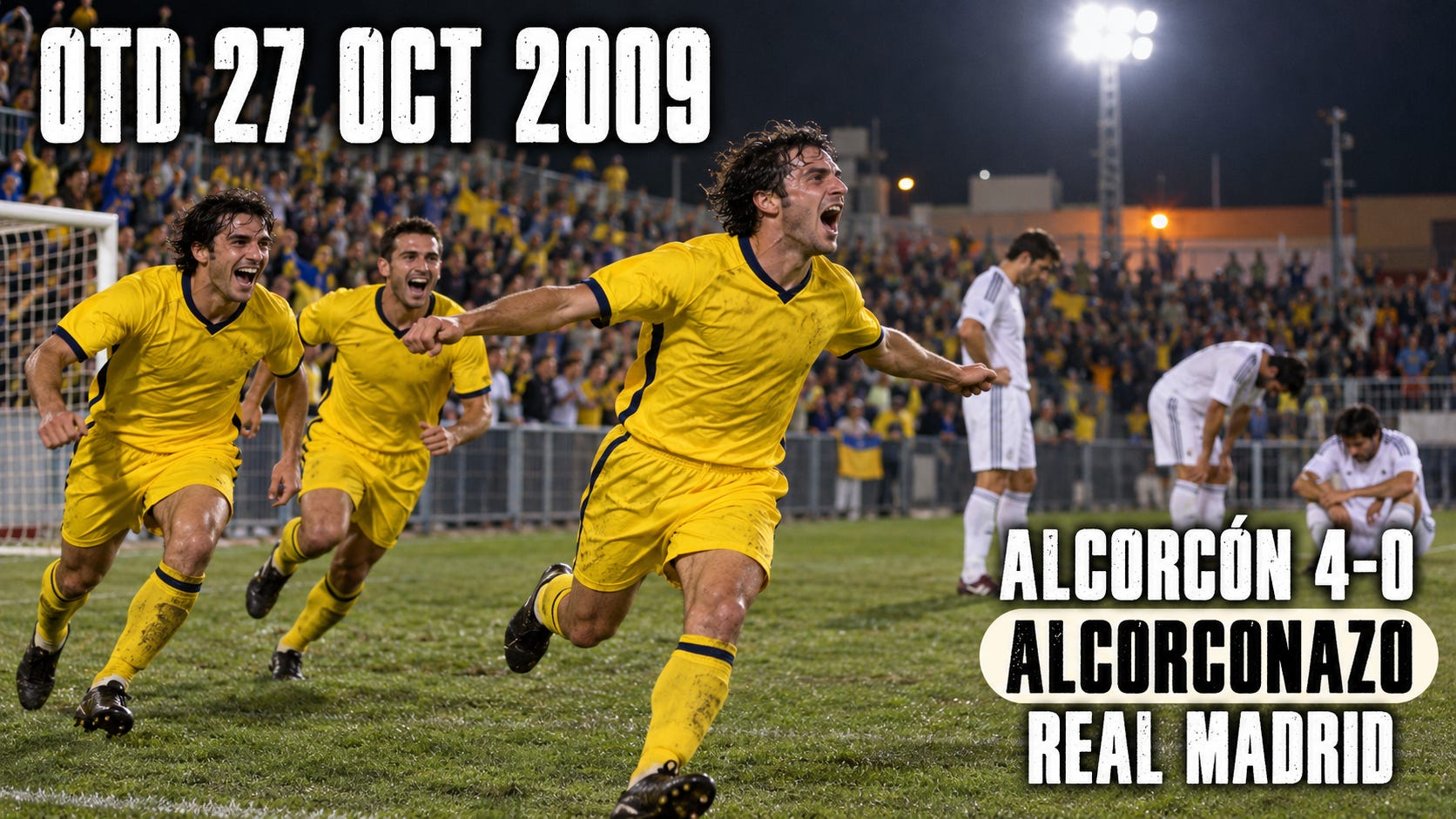
Some results are surprises. Some become a language.
On October 27, 2009, third-tier AD Alcorcón beat Real Madrid 4-0 in the first leg of a Copa del Rey tie. The score was so preposterous, and the mismatch between the clubs so vast, that Spanish football did not leave it as a line in a results database. It made a noun of it: the Alcorconazo.
The suffix mattered. Spain had long understood a catastrophe large enough to acquire an -azo: the Maracanazo, Uruguay’s World Cup win over Brazil at the Maracanã in 1950, was the archetype. An Alcorconazo was not simply Madrid losing away to a lower-division side. It was a humbling on a municipal ground against a club from the southern Madrid suburbs, delivered to a newly rebuilt Galáctico team that had spent about €254 million that summer.
Alcorcón did not sneak a 1-0. It were 3-0 up at halftime, added a fourth after the interval, and could honestly wonder whether they had left the door open for an even more ridiculous score. Real won the return 1-0 at the Bernabéu. The tie ended 4-1. The word survived.
How Did We Get Here?
The Copa del Rey was made for the possibility of such a night, even if its long history also explains why it is so hard to produce. The competition began in 1903 as the Campeonato de España, following the Coronation Cup of 1902. It has changed names with Spain’s political eras: Copa del Rey under Alfonso XIII, Copa de la República in the 1930s, Copa del Generalísimo under Franco, and then Copa del Rey again. The names changed; the essential promise endured. Knockout football could put the country’s different football worlds on the same path.
Yet the cup’s roll of honor is not democratic. Barcelona now have 32 wins, Athletic Club 24 and Real Madrid 20. The three clubs account for 76 of 123 wins. Athletic’s place is particularly instructive: cup football is not merely Barcelona and Madrid ownership, but it is dominated by institutions built to sustain long runs, deep squads and enormous expectation. Real and Barcelona do not arrive in the Copa thinking of it as a pleasant diversion. They arrive thinking it belongs in their cabinet.
That dominance has always coexisted with the cup’s peculiar ability to embarrass the powerful. League football rewards depth over months. The Copa concentrates risk. A poor surface, an unfamiliar ground, a hostile stand close to the pitch and a goalkeeper having the best night of his life can make the usual hierarchy look suddenly theoretical. The big club also brings a different burden. Its opponent can spend all week preparing for one match; the favorite is often calculating rotation, a weekend league fixture and a Champions League calendar. The smaller club sees a chance to write its greatest sentence. The bigger one sees a task it must finish before the evening becomes inconvenient.
The 2009 draw amplified all those tensions. Madrid were still shaping a new project under Pellegrini. They had opened the season without the settled rhythm that lets a favorite absorb a difficult away cup tie. Alcorcón, by contrast, had a clear reference point: disrupt the visitors, attack with conviction and give the Santo Domingo a reason to believe before doubt returned. Anquela’s side did not play as though waiting for Madrid’s mistake. They pressed the possibility of an advantage, and then treated the advantage as something that could grow.
That is precisely why the losing occasions lodge in memory. A routine league defeat can be absorbed into a 38-match season. In the cup, a weak night is a plot. The 2009-10 edition still used two legs at this stage, which should have made the elite side safer. There would be a return match at the Bernabéu. Alcorcón would have to produce not merely one good evening but a margin Madrid could not overcome.
Alcorcón were not a village team or an accidental invitee. They were a serious Segunda División B club, then Spain’s third level, managed by Juan Antonio Anquela and playing at the Santo Domingo, a compact municipal ground. But the comparison with Madrid was still dizzying. Alcorcón’s crowd was under 3,000. Madrid had returned Florentino Pérez to the presidency, brought in Cristiano Ronaldo, Kaká, Karim Benzema and Xabi Alonso, and set about rebuilding a team meant to dominate Spain and Europe.
The visitors did not field a reserve team of anonymous academy players. Manuel Pellegrini selected Raúl and Benzema in attack, with Guti, Rafael van der Vaart, Lassana Diarra, Álvaro Arbeloa, Raúl Albiol and Jerzy Dudek among the recognizable names. Cristiano Ronaldo and Kaká were absent, and Xabi Alonso did not travel, but that qualification cannot do much work. A Madrid side containing that much senior talent was supposed to manage a tie against third-tier opposition.
Instead, Alcorcón played as though the gulf in reputation had been reversed. Borja Pérez scored in the 16th minute. Arbeloa turned the ball into his own net. Ernesto Gómez made it 3-0 before halftime. Pellegrini replaced Guti at the break, an episode that added its own public glare. In the 52nd minute, Borja scored again. The scoreboard read Alcorcón 4, Real Madrid 0, and the expected script had been not merely interrupted but destroyed.
The score explains the word. A one-goal defeat can be filed under a bad lineup, a heavy pitch, a goalkeeper’s night or the strange authority of the cup. A four-goal defeat gives the smaller club authorship. Alcorcón were not beneficiaries of a late deflection or a penalty shootout; they outscored Madrid four times in open match time and defended the lead. Even the resulting rhetoric had a practical consequence. Madrid’s return leg was no longer a formality but an emergency, and every failed chance at the Bernabéu made the first night more permanent.
Madrid did win the second match, through Van der Vaart, but only 1-0. Alcorcón advanced 4-1 on aggregate. Pellegrini’s tenure continued, although the defeat became part of the pressure that surrounded him throughout the season. For Alcorcón, the tie was not a cup final or a promotion, but it gave the club a permanent place in the country’s football vocabulary. Their ground, players and manager were suddenly known far beyond their normal map.
Why did it land harder than other cup shocks? First, the division gap was real. Second, the opponent was Real Madrid, not merely a comfortable top-flight team. Third, the timing magnified it: Pérez had just relaunched the Galáctico project at extraordinary expense. And fourth, the score removed the usual escape hatch. This was not an injustice, a single freak goal or an away-goals calculation. It was 4-0.
So What?
Calling it the greatest Copa del Rey shock is inevitably a judgment, not a mathematically provable fact. The cup has delivered smaller clubs’ eliminations of major ones before and since. Real Unión, from the third tier, eliminated Real Madrid in 2008 on away goals. Toledo beat Madrid in 2000-01. Alcoyano eliminated a Madrid side in 2021 after extra time, despite playing much of the match with ten men. Barcelona have their own scars: Getafe turned a 5-2 first-leg deficit into a 4-0 second-leg win in the 2007 semi-final, while lower-division opponents have repeatedly made the giants suffer.
But those results illuminate, rather than diminish, Alcorcón’s claim. Real Unión and Toledo won knockout ties; neither produced a 4-0 first-leg dismantling of a freshly assembled global superteam. Alcoyano’s 2-1 was magnificent, but it required extra time and came in a one-off tie in which Madrid had rotated heavily. Getafe’s 4-0 was a seismic comeback, but Getafe were a first-division club and Barcelona had already taken a huge lead in the tie. Alcorcón’s result combined the division gap, the opponent, the scoreline and the cultural afterlife. It is the Copa upset most people can name with one word.
The term also had a life beyond that one fixture. Spanish football enjoys naming its traumas and shocks, because the name stores both the result and the feeling. A club can lose a match; it takes something much bigger to suffer an -azo. Once Alcorcón had supplied one, every subsequent Real Madrid wobble in the cup was measured against it. The 2021 Alcoyanazo and later headlines invoking an Albacetazo show the same linguistic reflex. They are descendants of a word that says: this was not supposed to happen, and everyone knows it.
There is a useful distinction here. A famous upset is not necessarily the most lopsided result, and a huge score is not necessarily the best upset. Cup folklore combines distance between the teams, the stakes of the competition, the manner of the performance and what happens afterward. Wigan beating Manchester City in the 2013 FA Cup final carried a different kind of grandeur because it took a trophy. Hereford’s win over Newcastle in 1972 became immortal because it carried a non-League ground, mud and a goal every English supporter seems to know. Alcorcón’s claim rests on the completeness of the humiliation: it was a third-tier club, a four-goal lead, a tie rather than a one-off friendly, and Real Madrid’s inability to repair it at home.
It also came before the social-media era had turned every minor tremor into a global clip within seconds. The newspapers, radio stations and sports television of Spain had time to agree on the enormity, repeat the score and settle on a name. That gave the Alcorconazo a strangely durable shape. It was a front page, a dressing-room crisis, a lottery number and a joke that could be revived whenever Madrid appeared vulnerable. A word lasted longer than most of the players’ careers.
Cup history elsewhere has its own sacred vocabulary. England has Hereford United 2-1 Newcastle United in 1972, Ronnie Radford’s mud-and-thunder equalizer turning a non-League victory into FA Cup folklore. Germany, too, has its nights when a lower-division side can make a reigning European champion look ordinary. France has Calais reaching the 2000 Coupe de France final from the fourth tier. Italy’s Coppa Italia has historically been more guarded by seeding and late entry, but its knockouts still allow the giant’s identity to become the story when it fails. The Netherlands and Belgium keep producing their own giant killings because their domestic cups still give part-time or lower-league teams a door into national attention.
The romantic version of this story says the cup is an equalizer. It is not. The richest clubs enter with deeper squads, sports science, more travel resources and the ability to replace a bad performance with elite substitutes. Many competitions now also protect their biggest names. Premier League and Championship clubs enter the FA Cup in the third round; the four Spanish Supercopa clubs enter the Copa del Rey only at the round of 32; Italy’s leading Serie A teams can enter late under a seeded bracket. The structure reduces the number of hazards that an elite club must survive before the television-friendly stages.
There is a counter-movement in Spain. Since the 2019 reform, most Copa ties are single matches, lower-ranked clubs are generally drawn at home, and the tournament has actively sought the sort of winter evening that made the old cup special. That has made elimination more immediate and helped produce recent shocks. It is a better machine for the surprise than the two-legged 2009 format, even if the biggest clubs’ later entry keeps the path selective.
So the romance has not vanished. It has become more engineered, and therefore a little more fragile. A lower-league club can now receive one enormous home night, but it may meet an elite opponent only after the competition has already filtered many of the smallest teams away. The old ideal was not simply that everyone could win. It was that everyone could meet someone they had no right to beat, and that one match could change the story of a town.
Alcorcón did more than use that opening. It made a permanent case for why cups matter. The club had no realistic route to matching Madrid’s budget, global audience or Champions League history. It did have 90 minutes, a stadium full of believers and a team coherent enough to punish a larger club that was not ready. For one night, football’s hierarchy was not suspended by sentiment. It was suspended by four goals.
That is the final difference between a cupset and an Alcorconazo. A cupset alters a draw. An Alcorconazo alters the language in which the draw is remembered.
Three Things to Take Away
1. Alcorcón were a third-tier side when they beat Real Madrid 4-0 on October 27, 2009. Madrid recovered only a 1-0 win in the return, so Alcorcón advanced 4-1 on aggregate.
2. The scale of the scoreline made this more than a normal upset. Alcorcón led 3-0 at halftime against a Madrid team containing Raúl, Benzema, Guti, Van der Vaart, Arbeloa and Albiol.
3. Alcorconazo endures because it captures the cup’s best promise: a small club can meet a giant on one extraordinary night and leave the giant with a new word for humiliation.
On This Day
On October 27, 2009, Alcorcón beat Real Madrid 4-0 in the Copa del Rey. The return match changed the tie by only one goal. Spanish football kept the original score and gave it a name: the Alcorconazo.
Have a football memory, a correction or a story that belongs here? Write to otd@17lawsguy.com.
Yesterday: *The Goal That Condemned a Referee* — Álvaro Ortega, América de Cali 3-2 Independiente Medellín, 26 October 1989.