

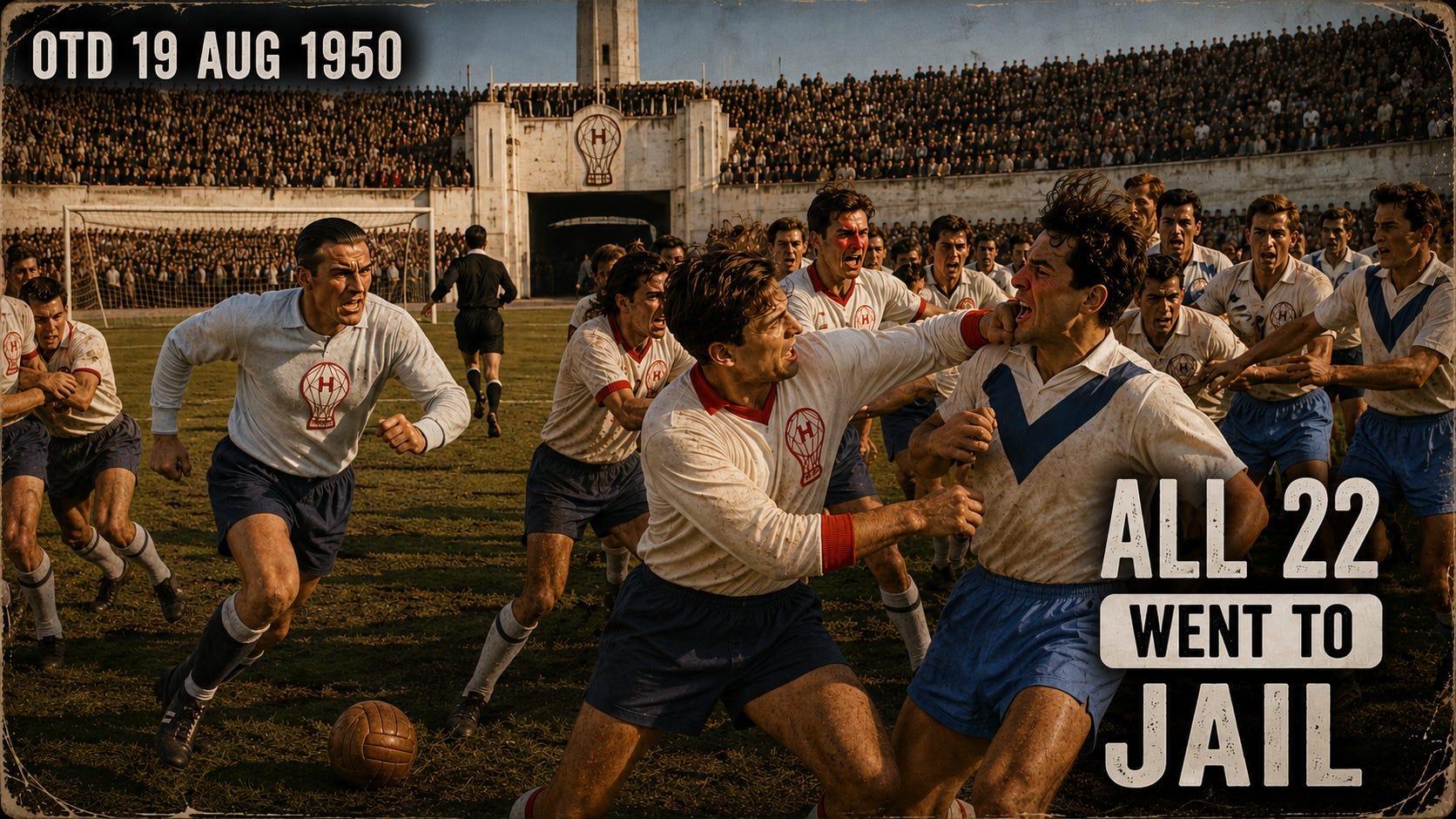
Buenos Aires, August 19, 1950. Huracán against Vélez Sarsfield, five minutes left, Vélez leading 3-1. A free kick near the Huracán area brings two players together, Pablo Mallegni of Vélez and the Huracán defender Lino Badin, and they begin trading punches. Then Huracán’s goalkeeper, Héctor Ricardo, sprints the length of his half to join in. Within moments the pitch at Parque Patricios is not a football match but a brawl, all twenty-two players swinging at one another, with trainers, masseurs and assorted staff piling in behind them. The fight lasts around five minutes. And when the police finally restore order, they do something almost unheard of: they arrest every player on the field.
To appreciate the absurdity, you have to know what Argentine football had already tried. The game had been professional since 1931, and it was a fiercely physical culture, with dismissals for rough play and the occasional police involvement long before this afternoon. By the late 1940s the violence around matches had grown serious enough that the association reached for a remarkable fix: it imported referees from Britain, hoping foreign officials would bring stronger, more independent control. By 1950 fourteen British referees were working in Argentina. One of them, an Englishman named John Meade, was in charge at Parque Patricios. The game he had been brought in to control was about to become completely uncontrollable.
The season around it was turbulent too. The great players’ strike of 1948 had helped drive talent abroad, with Pedernera, Di Stéfano, Rossi and others heading to Colombia. Back home, Vélez sat sixth but harbored ambitions, their side including a twenty-three-year-old named Osvaldo Zubeldía, who would one day build the great Estudiantes team that won three straight Copa Libertadores titles. On this day, he was simply one of the men about to be arrested. Huracán, meanwhile, were fighting near the bottom, having barely survived relegation the year before. Title hopes on one side, survival pressure on the other, and a match already described in the contemporary press as played in a climate of violence.
The football had been tense throughout. Huracán scored early, Vélez levelled through José Menéndez, who scored again after the break, before Carmelo Nápoli made it 3-1 with about ten minutes to go. Then came the free kick, the punches, the goalkeeper’s charge, and the collapse of order. When it was over the players separated and sat on opposite sides of the pitch, waiting for the referee to restart the match. But Meade had gone. He and his assistants had retreated during the chaos, and fifteen minutes passed before an interpreter appeared to announce that the match was suspended, Vélez 3, Huracán 1, at eighty-five minutes.
Then the truly extraordinary part. The federal police decided this was no longer merely a football matter and detained all twenty-two players, taking them first to a police station and then, after midnight, to the municipal detention facility at Villa Devoto. Opponents who had been trying to hurt each other an hour earlier now spent the night as fellow prisoners. Club directors negotiated, families gathered, and on Sunday evening, after almost a full day behind bars, the players were released. Football was not finished with them. The association’s disciplinary tribunal suspended every one of the twenty-two, with Huracán bans running as high as fifteen matches, and stood the referee down for a round. Both clubs, forced to field patched-up teams, saw their seasons unravel.
The obvious question is whether this was unique. Twenty-two players arrested after one match is extraordinary, but Argentine football has since found ways to top even that. In 2011, a lower-division match between Claypole and Victoriano Arenas produced a mass brawl and thirty-six red cards, still the highest reported total in a senior game. And this is not an Argentine monopoly: earlier in 2026, a state championship final in Brazil ended with twenty-three red cards issued after a fight. Football has built ever more sophisticated machinery to control violence, cards, tribunals, video, retrospective bans, and still no regulation has invented a switch that turns emotion off at the final whistle.
Which leads somewhere uncomfortable and current. The 2026 World Cup final, which Spain won 1-0 after extra time, ended with a mass altercation among players and staff, and FIFA opened formal proceedings. Argentine writers reached for the concept of aguante, a culture of endurance and refusing to retreat, to explain it, while carefully noting that similar behavior appears everywhere football is played. That is the real lesson of a night in Villa Devoto seventy-six years earlier. Football can impose a single written code on the whole planet. What it cannot do is make billions of people feel the game in exactly the same way, and the gap between the written rule and the unwritten one is where these afternoons keep happening.
---
🎧 Listen on Spotify, Apple Podcasts, Amazon Music, Overcast, iHeart, and YouTube.
📩 Got an episode idea? otd@17lawsguy.com
Yesterday: 18 August 2004, Brazil and Haiti in O Jogo da Paz.