

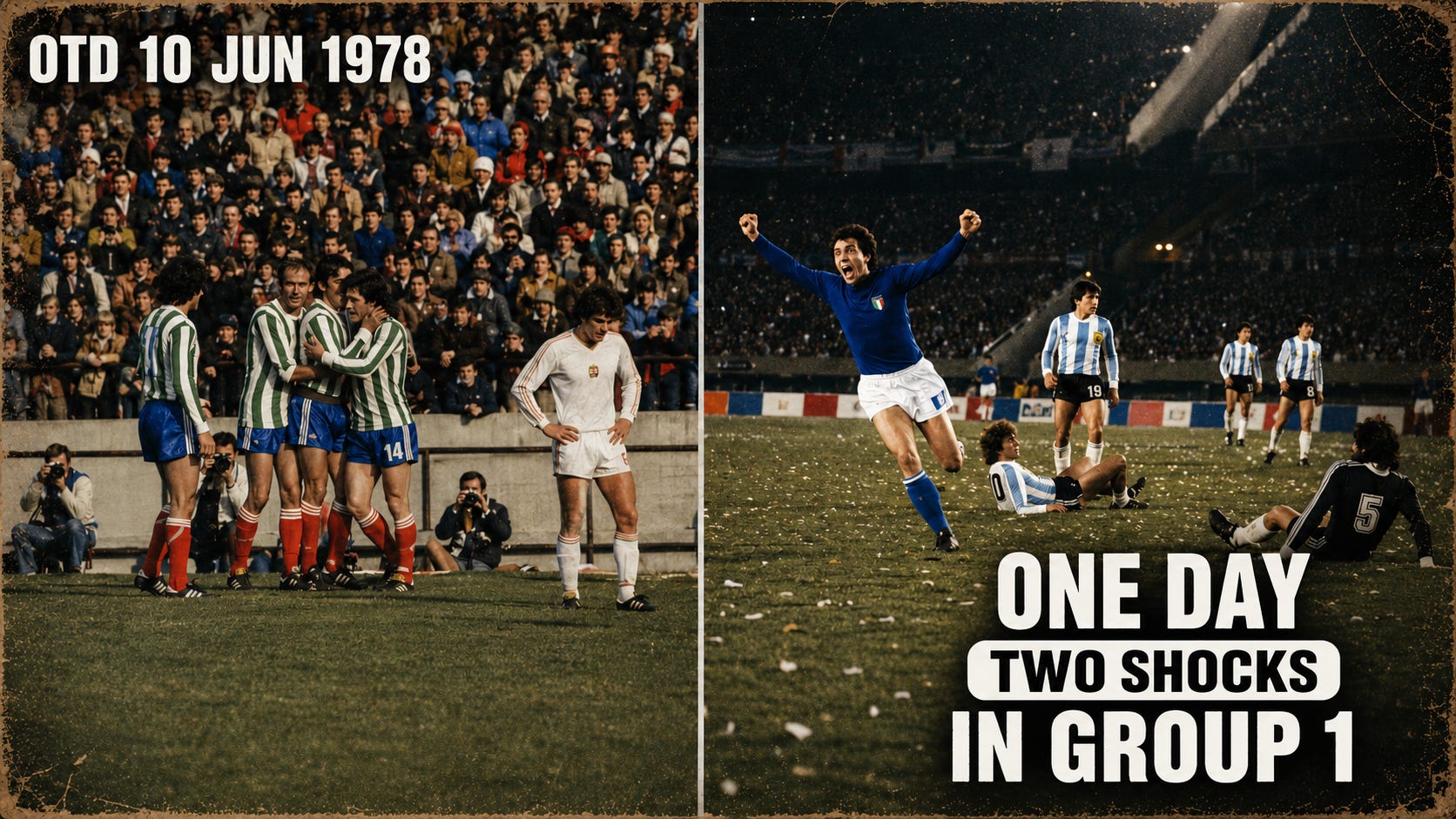
It is 10 June 1978, in Argentina, and the World Cup is giving Group 1 two very different kinds of drama on the same day.
In Mar del Plata, France and Hungary arrive for their final group match both wearing white. So France end up playing a World Cup match not in blue, not in white, but in green-and-white striped shirts borrowed from a local club. And in Buenos Aires, Argentina lose 1-0 to Italy at the Monumental, a result that sends the hosts out of the capital and off to Rosario. One day, two matches, one kit farce, and one relocation that quietly shapes the road to a World Cup title.
How did we get here? Group 1 in 1978 was brutal, and loaded with politics. Argentina were hosts, under the enormous pressure of a tournament staged by the military junta, with the Monumental functioning as a national theatre. Italy were Italy: world champions in 1934 and 1938, with Zoff, Gentile, Scirea, Tardelli, Rossi and Bettega. Hungary were a faded giant, still carrying World Cup weight. And France were back at a World Cup for the first time since 1966, a young Platini hinting at the great side to come.
By the final day, the table was already settled. Italy and Argentina were through; France and Hungary were out. So France against Hungary was a dead rubber. Except it became one of the great kit stories in World Cup history.
In 1978, much of the world still watched on black-and-white television, so shirt contrast mattered: dark against light, clear silhouettes. FIFA’s plan was simple. Hungary in white, France in blue. But the instruction did not travel properly through the French delegation, and France arrived in Mar del Plata without their blue shirts, which were back in Buenos Aires, roughly 400 kilometers away. Hungary were in white. France were in white. Nobody could kick off.
The solution was gloriously improvised. A local club, Atletico Kimberley of Mar del Plata, played in green-and-white stripes, and their shirts were rushed to the stadium. Even that was not simple: the shirts had no World Cup numbers, so some had to be ironed on, and a few French players ended up with mismatched numbers on shirt and shorts. Kick-off was delayed about 45 minutes. Then Les Bleus, now les verts et blancs, went out and played well. Lopez scored in the 22nd minute, Berdoll in the 37th, Zombori pulled one back for Hungary, and Rocheteau restored the two-goal lead a minute later. Four first-half goals. France 3, Hungary 1. They were out of the World Cup, but they had won the strangest kit day in their history.
France were not the first to borrow. In 1934, Austria wore Napoli’s pale blue in a third-place match and lost. In 1950, Mexico borrowed blue-and-white from Cruzeiro and lost. In 1958, Argentina borrowed yellow from IFK Malmo and lost. France in 1978 became the fourth classic case, with one difference: they won. After 1978, FIFA tightened kit administration into the machine it is today, with colors assigned and contrast checked weeks in advance. Which is exactly why the Kimberley story now feels like an antique. Not because people were careless, but because World Cup logistics had not yet become a science.
Now the second drama. While the shirts were being sorted in Mar del Plata, Argentina and Italy met at the Monumental, River Plate’s great stage, where Argentina had already played their first two group games. Both teams were through, but Italy had the better goal difference, so Argentina needed to win to top the group. The prize was emotional as much as sporting: the group winner stayed in Buenos Aires, the runner-up went to Rosario, and several Argentina players, including captain Daniel Passarella and goalkeeper Ubaldo Fillol, called the Monumental home. Italy did not care about any of that. They cared about winning. Midway through the second half, Roberto Bettega scored. Italy 1, Argentina 0. The Monumental went quiet in the way only a huge stadium can, and Argentina were relocated to Rosario.
On paper, a punishment. In practice, something stranger. Rosario, at the tighter, hotter Gigante de Arroyito, embraced Menotti’s side. Argentina beat Poland 2-0, with Mario Kempes finally scoring his first goals of the tournament, drew 0-0 with Brazil, and then beat Peru 6-0, a result whose rumors and politics still sit uneasily inside the story of 1978. That scoreline sent Argentina back to the Monumental for the final, where they beat the Netherlands 3-1 after extra time to become world champions. The Italy defeat had not derailed them. It had rerouted them, from Buenos Aires to Rosario and back, from setback to title.
There is a haunting coda. Argentina have barely returned to Rosario since. The one official World Cup qualifier they played there came in September 2009: Brazil won 3-1, in Lionel Messi’s hometown, with Diego Maradona coaching. Argentina have not played there since.
That is why 10 June 1978 matters. Not for tactics or technique, but as a reminder that World Cups are shaped by logistics as much as talent: shirts, television, travel, stadium assignments, and the people who make all of it work.
🎙️ THE PODCAST GOES DEEPER. The full episode has more on the earlier borrowed-kit cases (Austria, Mexico, Argentina), the deliberate kit departures like Costa Rica at Italia 90, the full Group 1 sequence. That is the 10-minute version.
---
🎧 Listen on Spotify, Apple Podcasts, Amazon Music, Overcast, iHeart, and YouTube.
📩 Got an episode idea? otd@17lawsguy.com
Yesterday: 9 June 1938, Cuba’s Only World Cup Win.
Tomorrow: 11 June 1933, the first qualifier in World Cup history.