

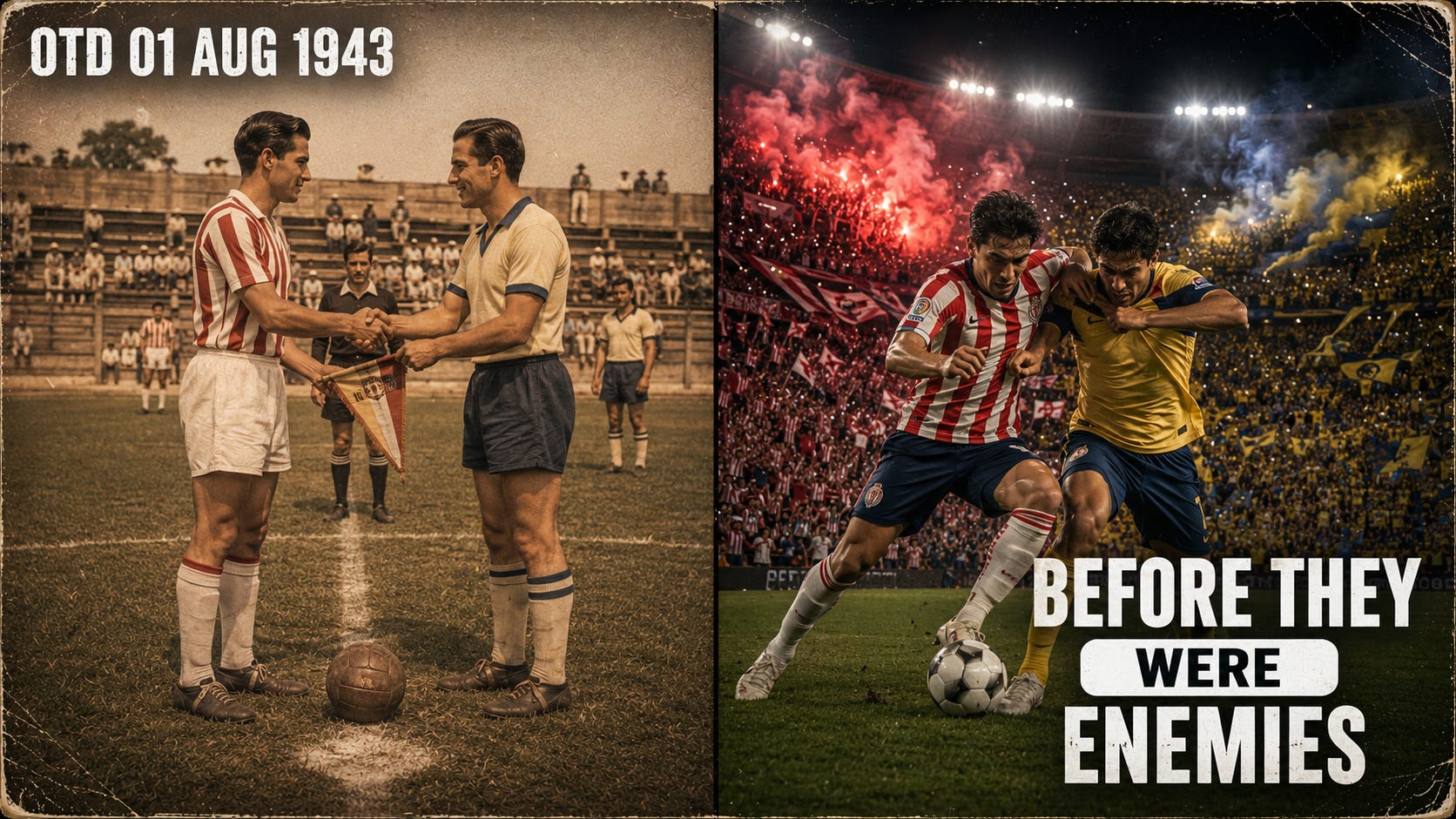
It is August 1, 1943. Parque Oblatos. Guadalajara against Club América. Copa México. And for the first time in official competition, these two clubs meet. Guadalajara win 1-0. That is the score, but not yet the meaning, because this is not yet El Súper Clásico. Not yet Mexico’s national football argument. Not yet Chivas against América as identity, class, capital, and pride. On this day, it is just the first official match. The rivalry comes later. But it starts here.
The game arrived in Mexico through British industrial and expatriate networks, and by 1902 there was an organized championship with clubs like Orizaba, Pachuca, and Reforma. The Mexican federation was founded in 1927, and the national team formed its identity through the 1928 Olympics and the 1930 World Cup. But domestically the game stayed regional. Mexico City had its league, Guadalajara had its football world. So for years América and Guadalajara could both exist without becoming a national rivalry.
Club América was founded in Mexico City in 1916 by students. The name was chosen because the club was founded on October 12, the day tied to Columbus reaching the Americas in 1492, and América soon became one of the great early Mexican clubs. Guadalajara was older, founded in 1906 by Edgar Everaert and others as Club Unión, becoming Club Deportivo Guadalajara in 1908, and taking on the identity that would define it forever: Jalisco, red and white stripes, and eventually the all-Mexican player tradition. That tradition became essential, because Chivas is not only a club. It is an argument: Mexican football can be built with Mexican players. That would matter enormously once América became the opposite pole.
By the early 1940s the old amateur and regional structures were no longer enough, and the professional First Division began in 1943. That is the key institutional turn. A national professional league meant the country’s strongest clubs now met regularly, and once that happened, rivalries could stop being local and become national. Before the first league season, the Copa México gave us the first official América-Guadalajara meeting on August 1, 1943, at Parque Oblatos, Guadalajara winning 1-0. But the two clubs were not yet bitter enemies. They were pioneers in the same new national football world. The seed was in the ground; the superstructure of rivalry had not been built.
The rivalry became real only when both clubs became symbols, and that happened in the late 1950s. Guadalajara won their first professional title in 1957 and kept winning, becoming El Campeonísimo, the great all-Mexican dynasty, Jalisco pride turned into a selection policy. Then América changed too. In 1959, Emilio Azcárraga Milmo, linked to Telesistema Mexicano, bought the club, and América became money, media, ambition, capital, and provocation.
Then Fernando Marcos lit the fuse. After América won in Guadalajara in 1959, he said, in essence, that América does not come to Guadalajara to win, that is routine. That is the kind of sentence that creates decades. Chivas answered on the field, the newspapers leaned in, and the fans understood the roles: Guadalajara versus Mexico City, Mexican-only versus the club that buys stars, popular identity versus establishment image. Now it was El Clásico Nacional.
The matches acquired a memory bank. América beat Guadalajara 7-2 in 1944; Guadalajara answered with a 7-0 in 1956. The rivalry was never only close games; it was humiliation, revenge, scorelines that became family arguments. Then the finals and eliminations: the 1983 semi-final brawl, the 1984 Final del Siglo that América won, Chivas eliminating América on the way to the Apertura 2006 title. Classics do not just decide trophies. They deny futures.
And the rivalry travels: league matches, Liguillas, friendlies in the United States, CONCACAF meetings. Millions follow it across the United States, where for Mexican and Mexican-American supporters América-Chivas can be a family line, a migration line, a weekend identity. América sells greatness through power. Chivas sells it through identity. That is why the fixture still works, not because both clubs are always at their peak, but because when they play, Mexico gets to argue with itself.
🎙️ THE PODCAST GOES DEEPER. The full episode has the 1943 professional turn, Azcárraga buying América, and the Fernando Marcos line that lit the fuse. That’s the 10-minute version.
---
🎧 Listen on Spotify, Apple Podcasts, Amazon Music, Overcast, iHeart, and YouTube.
📩 Got an episode idea? otd@17lawsguy.com
Yesterday: 31 July 1971, Halifax, the Watney Cup, and the warning.
Tomorrow: 2 August 1952, the Magical Magyars win Olympic gold and announce themselves to the world.