

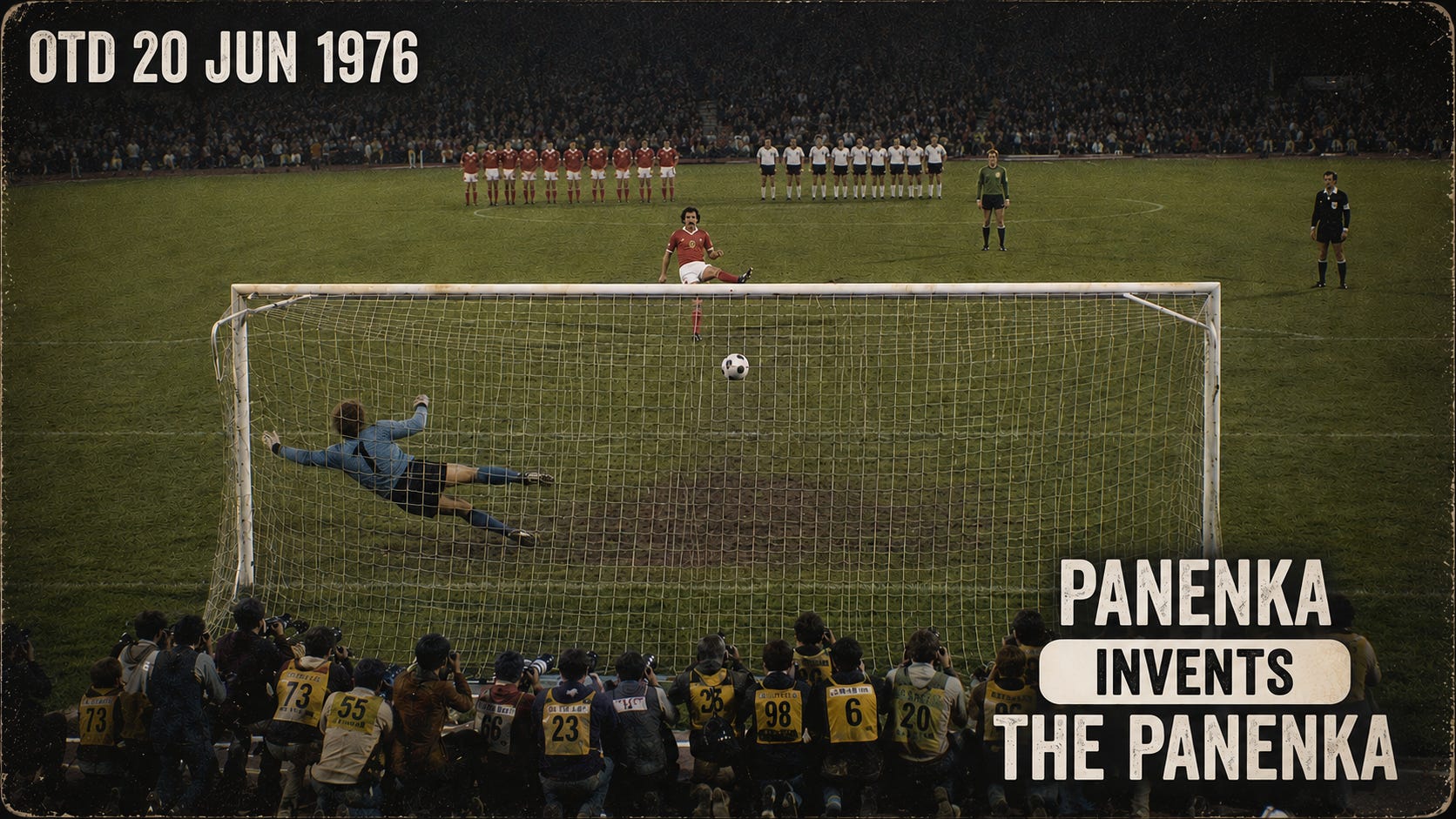
It is 20 June 1976, in Belgrade, at the Red Star Stadium. Czechoslovakia against West Germany, the European Championship final. Two-two after extra time, and now a penalty shootout. West Germany have just missed. Antonín Panenka walks forward. If he scores, Czechoslovakia are European champions. In goal: Sepp Maier, world champion, European champion, three straight European Cups, one of the best goalkeepers on earth. Panenka runs up fast. Maier dives left. And Panenka chips the ball softly down the middle and into the net. Czechoslovakia win the European Championship, and a man from Bohemians Prague gives football a word: Panenka.
How did we get here? Start with the penalty itself. It entered the Laws of the Game in 1891, and for decades was imagined as power and nerve: pick a side, hit it hard, do not miss. There were tricks, of course - like a penalty can even become a pass - but it was still usually a duel of force. Then came the shootout. Football had spent decades deciding drawn knockout matches by replays, lots or coins, and even Euro 1968 still lived in that old world, Italy reaching the final on a coin toss. Around 1970 the shootout became football’s modern solution, but not everywhere at once, and in 1976 it was still new enough to feel strange. The European Championship itself was still small: just four teams in the finals.
Czechoslovakia arrived with pedigree the West had not watched closely. World Cup finalists in 1934 and 1962, part of the Battle of Bordeaux in 1938, they had fought through a tough qualifying path, topping a group with England and beating the Soviet Union. Their football world was Eastern Bloc football, state and factory clubs, the names less familiar to Western audiences: Ivo Viktor, Anton Ondruš, Zdeněk Nehoda, and Panenka, the elegant attacking midfielder from Bohemians. West Germany were something else entirely: reigning European champions from 1972 and reigning world champions from 1974, with Maier, Beckenbauer, Vogts, Bonhof, Hoeneß, and Bayern fresh off three straight European Cups. A giant.
Both semi-finals went to extra time, Czechoslovakia beating the Netherlands 3-1 in the rain, West Germany beating Yugoslavia 4-2 after Dieter Müller’s hat-trick off the bench. So when the final arrived, extra time almost felt inevitable. A shootout did not. The plan, by Panenka’s later recollection, had been a replay if the final stayed level. A few hours before kickoff, West Germany asked if penalties could settle it instead, their players reportedly already having holidays booked. Czechoslovakia, the underdogs, agreed. Why not? A shootout might be their best chance.
Now, Panenka. He was not a global superstar. He played for Bohemians Prague, not Bayern or Real Madrid, and in communist Czechoslovakia players did not move west in their prime, nor was the league broadcast across Western Europe. His trick began after training, taking penalties against his Bohemians goalkeeper Zdeněk Hruška for beer and chocolate. He kept losing. So he started thinking like a gambler: goalkeepers wait, then dive, so what if the kicker waits too, and the ball goes gently through the space the keeper has abandoned? He tried it in training, then friendlies, then league matches. But Sepp Maier did not know that. The Iron Curtain was also a scouting curtain.
Now the final. Czechoslovakia started brilliantly: Ján Švehlík in the 8th minute, Karol Dobiaš in the 25th. 2-0. But these were the Germans of Beckenbauer and Schön, and they did not disappear. Dieter Müller pulled one back, and with the match almost gone, Bernd Hölzenbein equalized in the 89th. 2-2. Extra time produced no winner. So the new mechanism took over. Masný scored, Bonhof scored, Nehoda scored, Flohe scored, Ondruš scored, Bongartz scored, Jurkemik scored. 4-3 Czechoslovakia. Then Uli Hoeneß blazed his over the bar. And now Panenka could win it.
He later said he was one thousand percent certain. That is absurd, and maybe necessary, because if Maier stood still, Panenka would look like a fool, and if the ball drifted too high, he would be the man who threw away a European title. In a communist system, he hinted, failure might have meant more than sporting embarrassment. He ran. He chipped. Maier dived. The ball floated. Goal. Czechoslovakia 5, West Germany 3 on penalties. European champions.
This was huge: Czechoslovakia beating the reigning world and European champions in a final, for a continental title. It remains their only European Championship. And Panenka became its image, which was both blessing and curse. He was a superb footballer, 59 caps, a creator and free-kick taker, but one kick swallowed the rest. He stayed at Bohemians through his best years, finally allowed abroad in 1981 (which, in that system, meant Austria and Rapid Wien). Globally, he is the penalty.
When did Panenka become the word? Not instantly everywhere. In Italy the style is often called a cucchiaio, a spoon, but by the 2000s, especially after Zidane’s chip in the 2006 World Cup final, English-language football clearly used Panenka as the name. By then he was not only a man. He was a category, and it kept growing: Totti, Zidane, Pirlo, Sergio Ramos, Hakimi. But the Panenka has a second life: disaster. When it fails, it fails loudly. Pirlo has missed one, Sergio Agüero apologized for one, and at this year’s Africa Cup of Nations final Brahim Díaz had a Panenka-style penalty saved and said his soul hurt. That is the risk. A hard penalty can be missed and understood. A Panenka can be missed and mocked. But that is also why it matters. It is not just a technique. It is a declaration: I can control my body, my nerves, the goalkeeper’s instincts, and the meaning of this moment. Panenka did that in the biggest moment of his life, against Sepp Maier, to win a European Championship.
🎙️ THE PODCAST GOES DEEPER. The full episode has more on the history of the penalty and the shootout, Czechoslovakia’s Eastern Bloc football world, the semi-finals, the beer-and-chocolate origin of the trick, the Iron Curtain scouting blind spot, the shootout kick by kick, and the long line of Panenkas since, glorious and disastrous. That is the 10-minute version.
---
🎧 Listen on Spotify, Apple Podcasts, Amazon Music, Overcast, iHeart, and YouTube.
📩 Got an episode idea? otd@17lawsguy.com
Yesterday: 19 June 1960, Peñarol and the First Libertadores Crown.
Tomorrow: 21 June 1970, Brazil, Pelé, and the greatest team.