

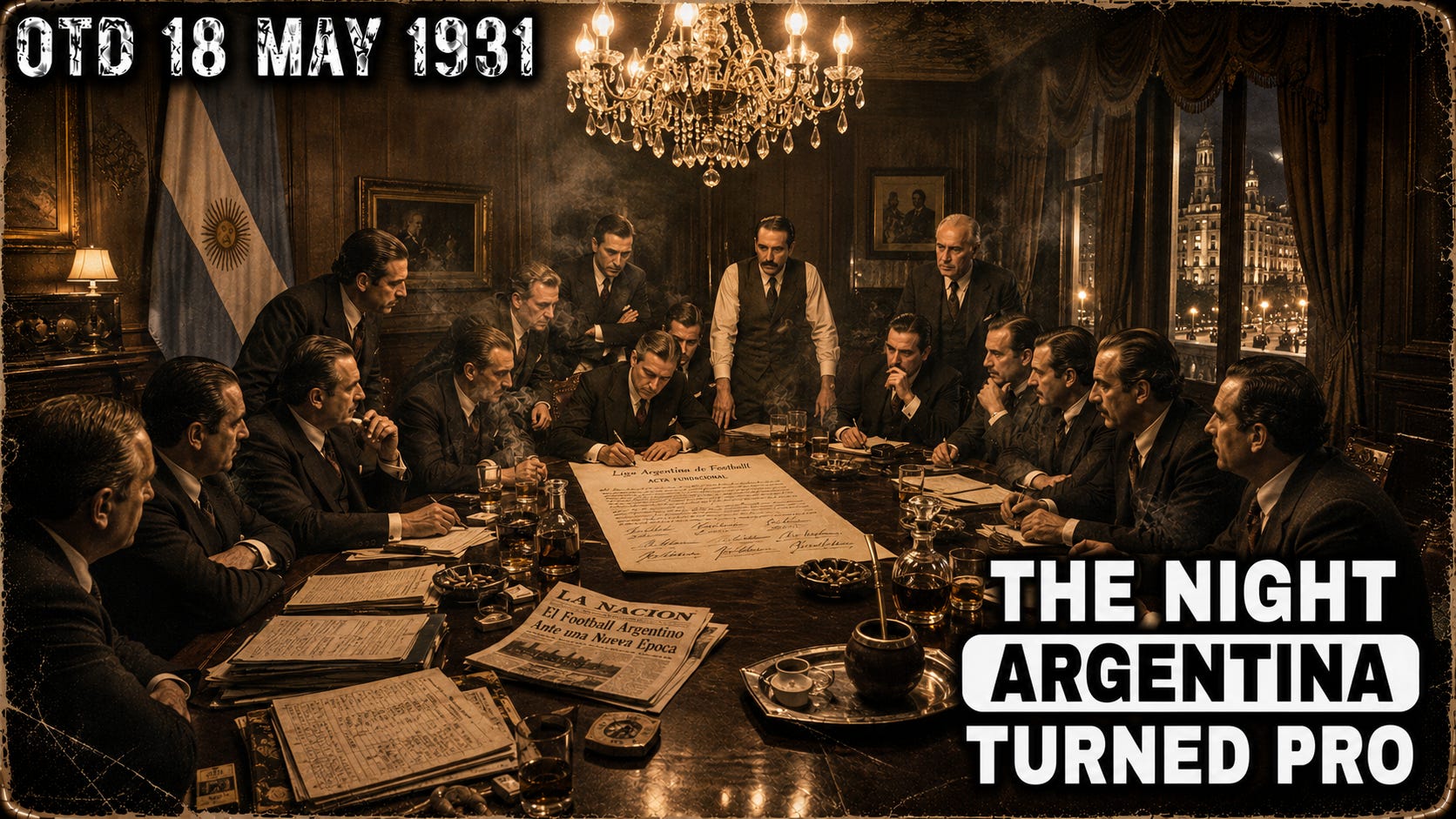
It is 18 May 1931. Buenos Aires. Eighteen clubs break away and form the Liga Argentina de Football.
The ball will not roll in the new professional championship until 31 May. But this is the boardroom date. The rupture date.
The day Argentine football stops pretending.
Players are being paid. Crowds are too big. Transfers are too valuable. The amateur fiction has collapsed.
And from this split — messy, dissident, controversial — comes the professional league that will produce Boca, River, La Máquina, Los Profesores, the Big Five, Estudiantes’ rebellion, Maradona, Messi, and Argentina’s modern football identity.
This is the day Argentine professionalism begins.
Argentina and Uruguay had built each other through football: first internationals, cup matches, steamers across the river, newspapers, grudges, imitation, escalation.
Uruguay got the symbolic head start. Olympic gold in 1924. Olympic gold again in 1928, beating Argentina in the final replay. Then the first World Cup in 1930, in Montevideo, and again Argentina lost to Uruguay in the final.
Argentina were not weak. They had extraordinary players, huge crowds, fierce clubs and a deep football culture. But their institutions were repeatedly messy. Rival associations, breakaways, amateur codes, player disputes — the game was growing faster than its governance.
Meanwhile, Buenos Aires football was bursting out of old amateur clothes.
The game had begun with British schools, railways and clubs. The first recorded match in Argentina was in 1867. Alexander Watson Hutton helped build the early association structure in the 1890s. Alumni became the great amateur symbol. Then football became popular: barrios, workers, immigrant families, packed grounds, clubs that no longer looked like British social circles but like urban identities.
And by the late 1920s, “amateur” no longer meant what it claimed to mean.
Players received jobs, bonuses, gifts, expenses. Clubs charged at the gate. Newspapers sold copy. Radio was arriving. Big clubs needed talent and could pay for it, openly or not.
So the argument became impossible to avoid. Should football remain an amateur moral project? Or should it admit what everyone already knew?
In May 1931, the old Asociación Amateurs Argentina de Football tried to get ahead of the crisis by starting its championship on 10 May. It was a disaster. Low crowds. Missing players. Teams patched together with youngsters. Some matches could not be played because the footballers were not there.
The strike had won.
And on 18 May, the break came. The major clubs founded the Liga Argentina de Football: Boca Juniors, River Plate, Independiente, Racing, San Lorenzo, plus Huracán, Vélez, Estudiantes, Gimnasia, Lanús, Platense, Quilmes, Atlanta, Argentinos Juniors, Chacarita, Ferro, Talleres de Remedios de Escalada and Tigre.
It was dissident. It was not the old official amateur body. But it had the crowds, the players and the money. The official league could continue on paper. The professional league had the future.
On 31 May, the first professional round began. Boca drew 0-0 with Chacarita. River beat Atlanta 1-0. San Lorenzo beat Tigre 4-2. Estudiantes beat Talleres 3-0.
The season settled into a simple double round-robin: 18 clubs, 34 matches, two points for a win.
The first professional champion was Boca Juniors. They finished five points ahead of San Lorenzo. It was a huge moment for the club of La Boca, the workers, the port, the crowd.
But the team everyone talked about was Estudiantes. Los Profesores. Miguel Ángel Lauri, Alejandro Scopelli, Alberto Zozaya, Manuel Ferreira and Enrique Guaita. A forward line of teachers, not because they were professors in classrooms, but because they taught football lessons.
Zozaya became the league’s top scorer. Estudiantes scored and scored and scored.
And then came the absurd Lanús match. On 30 August, Estudiantes led Lanús 8-0 after only 23 minutes of the second half. The superiority was so complete that Lanús captain Edmundo Piaggio asked referee Lorenzo Martínez to end the match. Martínez consulted Estudiantes’ captain. And the game was stopped early.
That is professional football arriving with full Argentine theatre: goals, humiliation, pity, pride, and a referee deciding that, yes, maybe enough was enough.
The split created the modern Argentine football economy. Players could now be paid directly. Clubs could compete openly for talent. River soon became “Los Millonarios” because of the money they spent, especially on Bernabé Ferreyra. The Big Five — Boca, River, Independiente, Racing and San Lorenzo — became not merely big clubs, but a title oligopoly.
For decades, the Big Five dominated. From the beginning of professionalism until 1967, no club outside that group won the professional league.
Then the structure changed. The Metropolitano and Nacional formats opened a door. And as we discussed two days ago in episode 197, Estudiantes walked through it. First non-Big-Five professional champion in 1967. Then Copa Libertadores in 1968. Then 1969. Then 1970.
So 1931 leads to 1967 in a very direct way. The professional league creates the aristocracy. The later format change creates the rebellion.
And the league became a factory for the national team. Argentina’s World Cup wins in 1978, 1986 and 2022 do not come from nowhere. They come from a culture where clubs produce players under enormous pressure, where football is daily identity.
That began, officially, with the moment the game stopped lying to itself, on this day in 1931.
🎙️ The full episode (linked above) has more — including the parallel amateur league that limped on for four years, the 1934 World Cup humiliation (Argentina sent an amateur squad, lost 3-2 to Sweden), the 1934 unification that created the modern AFA, and the modern paradox of an Argentine league that no longer dominates globally because Europe buys its best players too early. The whole arc is in the audio.
---
🎧 Also available on Apple Podcasts, Amazon Music, Overcast, iHeart, and YouTube.
📩 Got an episode idea? otd@17lawsguy.com
Yesterday: 17 May 1989 — Atlético Nacional, Danubio and Narco Terror.
Tomorrow: episode 200. 19 May 1968 — Iran beats Israel and claims Asia.