

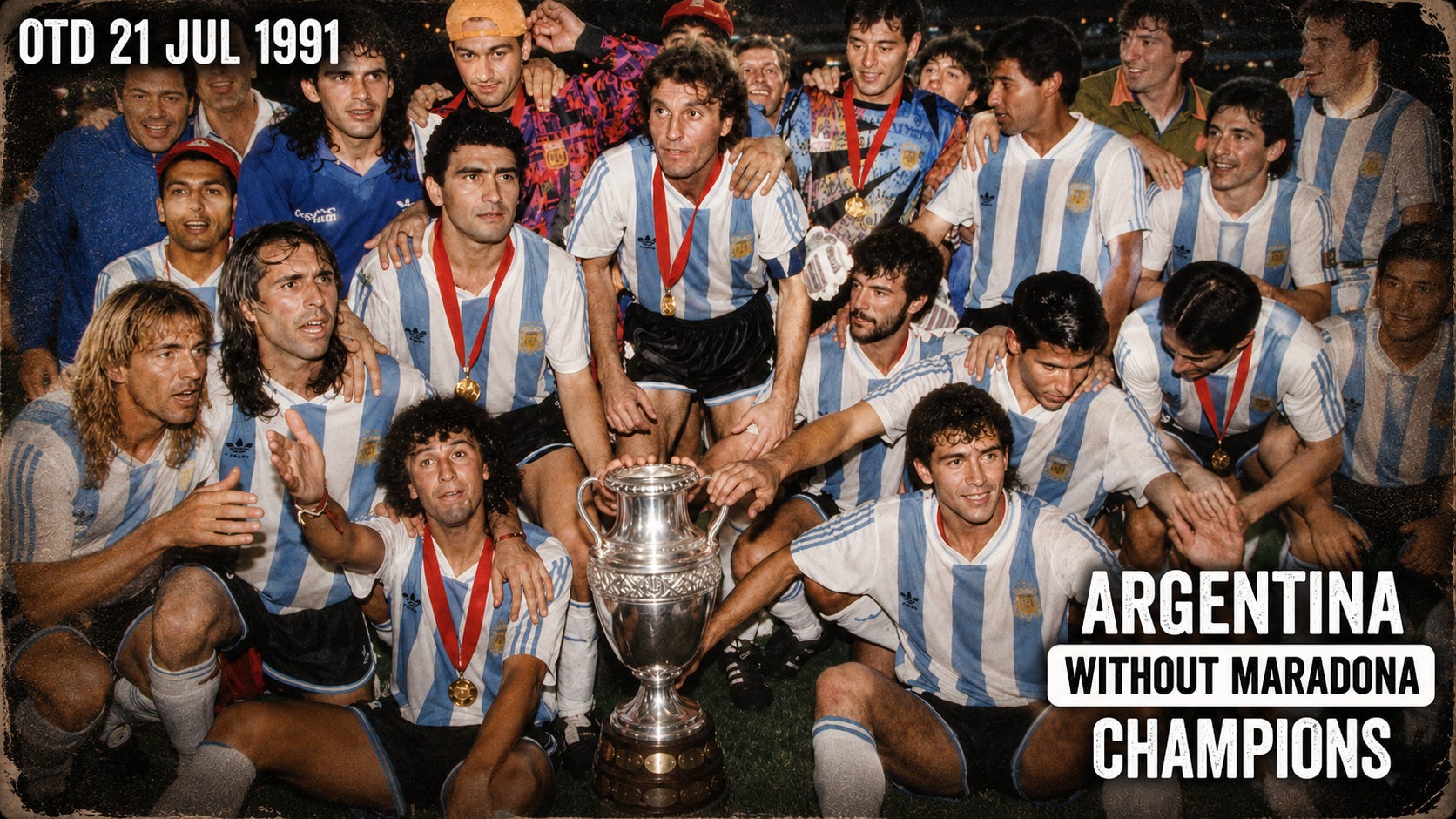
It is July 21, 1991. Santiago. The Estadio Nacional. Argentina against Colombia, and Argentina are ninety minutes from something they have not done since 1959: win the Copa América.
That sentence is stranger than it sounds. Argentina had not disappeared from world football. They won the World Cup in 1978, won it again in 1986, and reached the final in 1990. But the Copa? Nothing. Near misses, arguments, format changes, and in 1987, as hosts and world champions, with Maradona, a semi-final defeat to Uruguay. The old world was creaking.
And now they are doing it without Diego Maradona.
In March 1991, Maradona tested positive for cocaine after Napoli against Bari. He was suspended in April, with the ban running deep into 1992. So Argentina entered the Copa América without the player who had defined them for a decade, and with a new coach: Alfio Basile. Coco. A former hard defender, a Racing man, a personality with charm, superstition, and enough street knowledge to understand Argentine football’s emotional weather. He kept continuity: Goycochea, Ruggeri as captain, Caniggia. And he changed the energy. Simeone is 21. Batistuta is 22. Leonardo Rodríguez becomes the creative connector. There is movement, freshness, a little less Maradona-or-nothing.
The group stage becomes a sweep. Venezuela 3-0, with two from Batistuta. Chile, the hosts, beaten 1-0 by a Batistuta goal in the 81st. Paraguay 4-1. Peru 3-2 with a rotated side. Four matches, four wins, eleven goals.
Then the final round, old Copa style, no final, a mini-league: Argentina, Brazil, Chile, Colombia. And on July 17, the match that tells everybody the new Argentina are real. Darío Franco scores in the first minute and again in the fortieth; Batistuta adds one just after half-time; a wild, hard, edgy match ends 3-2 with five players sent off. Argentina beat Brazil. That matters in any year. It matters far more when Argentina are trying to prove they have a spine without number 10.
Two days later, rain turns Argentina against Chile into something closer to water polo. 0-0. So July 21 becomes decisive: Brazil beat Chile 2-0 earlier in the day, meaning a draw with Colombia would hand Brazil the title on goal difference. Argentina have to win, against a Colombia of Valderrama, Higuita, and De Ávila, a generation growing into one of the great South American stories of the decade.
Eleventh minute: Leonardo Rodríguez finds the space, Simeone scores. Nineteenth minute: Rodríguez again, ball to Batistuta, finish. His sixth of the tournament, the top scorer, the explosion that sends him from Argentine promise to Fiorentina and the wider world. Colombia do not go quietly: De Ávila pulls one back in the seventieth, and for twenty minutes a draw is still fatal. That is where this team shows the other side of the Basile project. Not just goals. Nerve. Ruggeri organizing, Goycochea behind him, Simeone covering ground, Caniggia the out ball, Batistuta threatening every counter.
Final whistle. Argentina are champions: six wins, one draw, no defeats, and a 32-year drought over.
The absence of Maradona is the headline, but the collective is the point. Leonardo Rodríguez is named player of the tournament, not because he is Maradona, but because he is not: a different rhythm, a conductor, a way to play. For almost a decade, Argentina’s emotional grammar had been one question: what does Diego do? In Chile, the sentence changes. Winning without him does not make Maradona smaller. It makes Argentina larger.
Basile’s cycle wins the Copa again in 1993, plus the 1992 King Fahd Cup and the 1993 Artemio Franchi Trophy, before ending in another Maradona rupture at USA 94. And then the drought returns, all the way to Messi, Di María, and the Maracanã in 2021. Which is why 1991 is not a forgotten title between Maradona and Messi. It is the hinge: the moment Argentina discovered that salvation did not always have to wear number 10.
🎙️ THE PODCAST GOES DEEPER. The full episode has Basile’s rebuild, the wild 3-2 over Brazil, and how 1991 connects the Maradona and Messi eras. That’s the 10-minute version.
---
🎧 Listen on Spotify, Apple Podcasts, Amazon Music, Overcast, iHeart, and YouTube.
📩 Got an episode idea? otd@17lawsguy.com
Yesterday: 20 July 1885, the day football finally got paid.
Tomorrow: 22 July 1951, Palmeiras win the Copa Rio, the first intercontinental club tournament.