

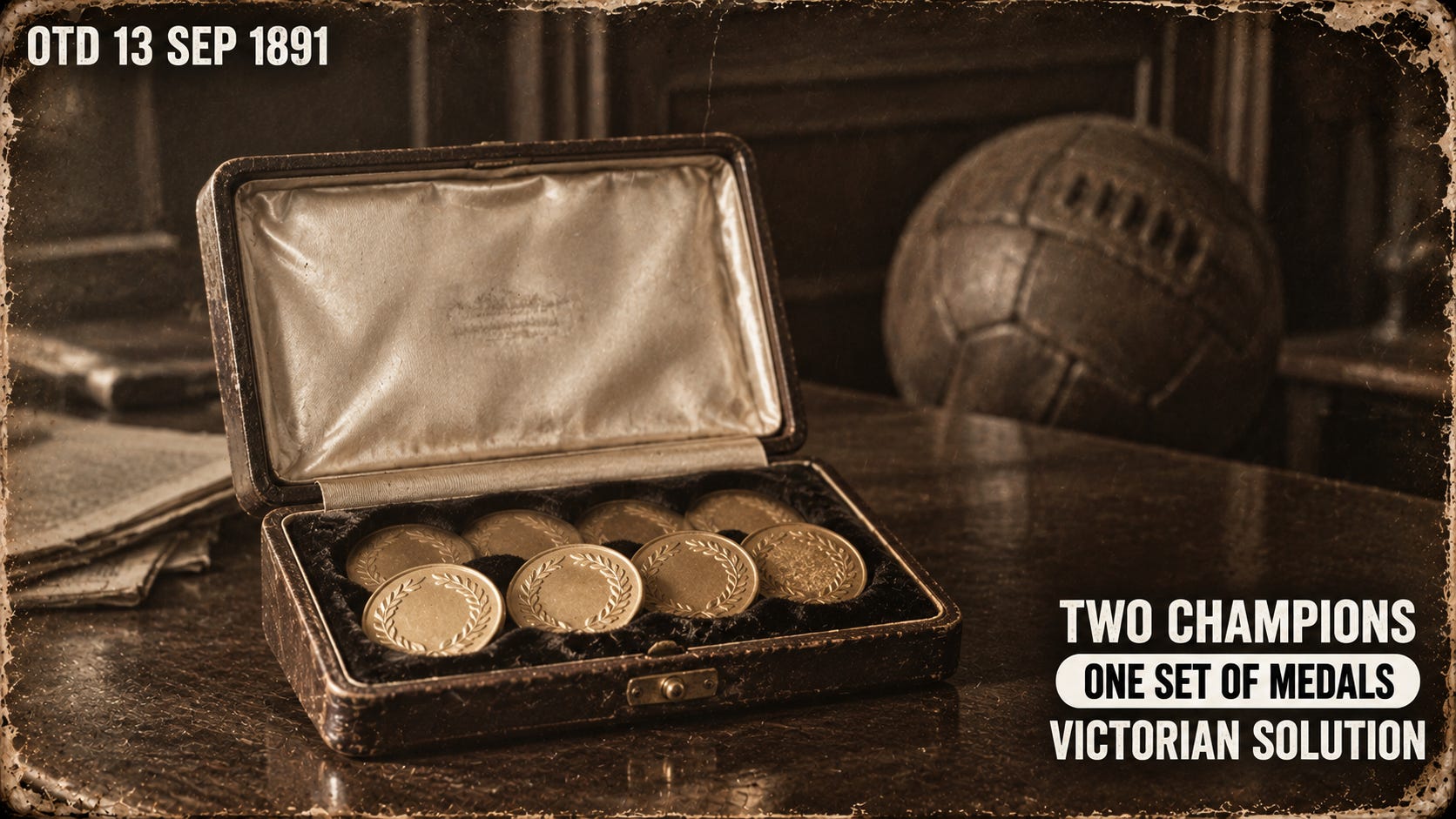
It is September 13, 1891, at the Flores Polo Ground in Buenos Aires, and the two best teams in Argentina’s first football championship are about to play each other. Saint Andrew’s and Old Caledonians have finished the season level, on thirteen points apiece, so a playoff will decide the title. Simple enough, except for one wonderful complication: both clubs have already been declared champions. The match is being played only because the organizers bought a single set of championship medals and now have two winners to give them to. Argentina’s first football playoff is not really deciding the championship. It is deciding who gets the jewelry. And more than a century later, people are still arguing about what that means.
The story starts, as so much early South American football does, with the British community around Buenos Aires: merchants, engineers, teachers, bank clerks and, above all, railway workers, who arrived with cricket bats, rugby balls and footballs. As early as 1867, a match was played on the cricket ground at Palermo, eight against eight, caps to tell the teams apart. Association football was young even in Britain, and in Argentina a curiosity. But the infrastructure that would carry it was already arriving: schools, clubs, newspapers, and the railways, which did more than move footballers. They created British communities all along the lines, and those communities formed teams, and fixtures created a football culture.
Then comes the Scottish schoolteacher Alexander Watson Hutton, who arrived in 1882, believed sport belonged at the heart of education, and in 1884 founded the Buenos Aires English High School, whose old boys would eventually become Alumni, the great dynasty of early Argentine football. Watson Hutton is remembered today as the father of Argentine football. But here is a lovely complication: he did not organize this first championship. That was mainly the work of another Scot, Alec Lamont, associated with Saint Andrew’s and employed by one of the great British railway companies. In early 1891, Lamont and other club men decided Argentina needed something the English had built only three years earlier, when William McGregor’s Football League began with fixed fixtures, points, a table and a champion at the end of a season. On March 7, 1891, they formed the Argentine Association Football League, with strikingly modern objectives: a regular championship, a governing body, rules. Football was no longer to be a loose collection of matches. It was to become a season.
Six clubs registered and one withdrew, so five competed: Saint Andrew’s, Old Caledonians, the Buenos Aires Football Club, Belgrano, and a side literally called Buenos Aires and Rosario Railway. That last name tells you almost everything about this world, and Old Caledonians tells you the rest: they were largely Scots working for the company building the city’s water and sewer system. This was football embedded in the machinery of a fast-growing city. They played each other home and away, two points for a win, and by the end two teams had separated themselves. Old Caledonians finished with six wins, a draw and a defeat for thirteen points, with more goals than anyone. Saint Andrew’s finished with exactly the same record: six wins, a draw, a defeat, thirteen points. Level. Today a tiebreaker would settle it: goal difference, goals scored, head-to-head. In 1891 they simply declared both clubs champions, and only then realized they had a single set of medals and no way to split it. So, a playoff. Not, strictly, for the championship. For the medals.
At Flores, with Lamont himself among the Saint Andrew’s forwards and Charles Douglas Moffatt at centre-forward, the match finished one-all after ninety minutes, because of course the first Argentine championship, having ended level, produced a medal playoff that also ended level. So they played another half hour, and Moffatt took over, scoring twice more for a hat-trick. Saint Andrew’s won 3-1 after extra time and took the medals. And that is where the historical mess begins. Ask the modern Argentine federation and it will tell you the first champions were Saint Andrew’s. Look at detailed historical reconstruction and the answer is Saint Andrew’s and Old Caledonians, joint champions, with the playoff settling only the medals. Both positions have logic. Saint Andrew’s won the decisive match, but the organizers had already crowned both clubs before it was played. This is exactly why origin stories are such fun: football does not arrive with a rulebook, people build the system as they go, and then two teams finish level and somebody asks, now what?
The first league then almost immediately vanished. There was no championship in 1892, and the association faded away, which is why modern Argentine football traces its continuous institutional line not to 1891 but to a second body, also called the Argentine Association Football League, that Watson Hutton founded in 1893. From there the game accelerated and, gradually, stopped being British. Argentine-born players, new clubs, new neighborhoods and new identities took over, and the schools-and-railways pastime became one of Argentina’s defining cultural languages, the world of Racing, River, Boca and the rest. Even professionalism, when it arrived in 1931, kept the same operating system underneath, the one where a match between Estudiantes and Lanús could run away to 8-0 before a referee called it off. But Argentine football’s very first title race produced something beautifully appropriate to everything that followed: two champions, one set of medals, and an argument.
---
📩 Got an idea to an OTD story? otd@17lawsguy.com
Yesterday: 12 September 1885, two Scottish clubs score 36 and 35 on the same afternoon.
Tomorrow: 14 September 1939, the new Football League season is barely underway when war stops it.