

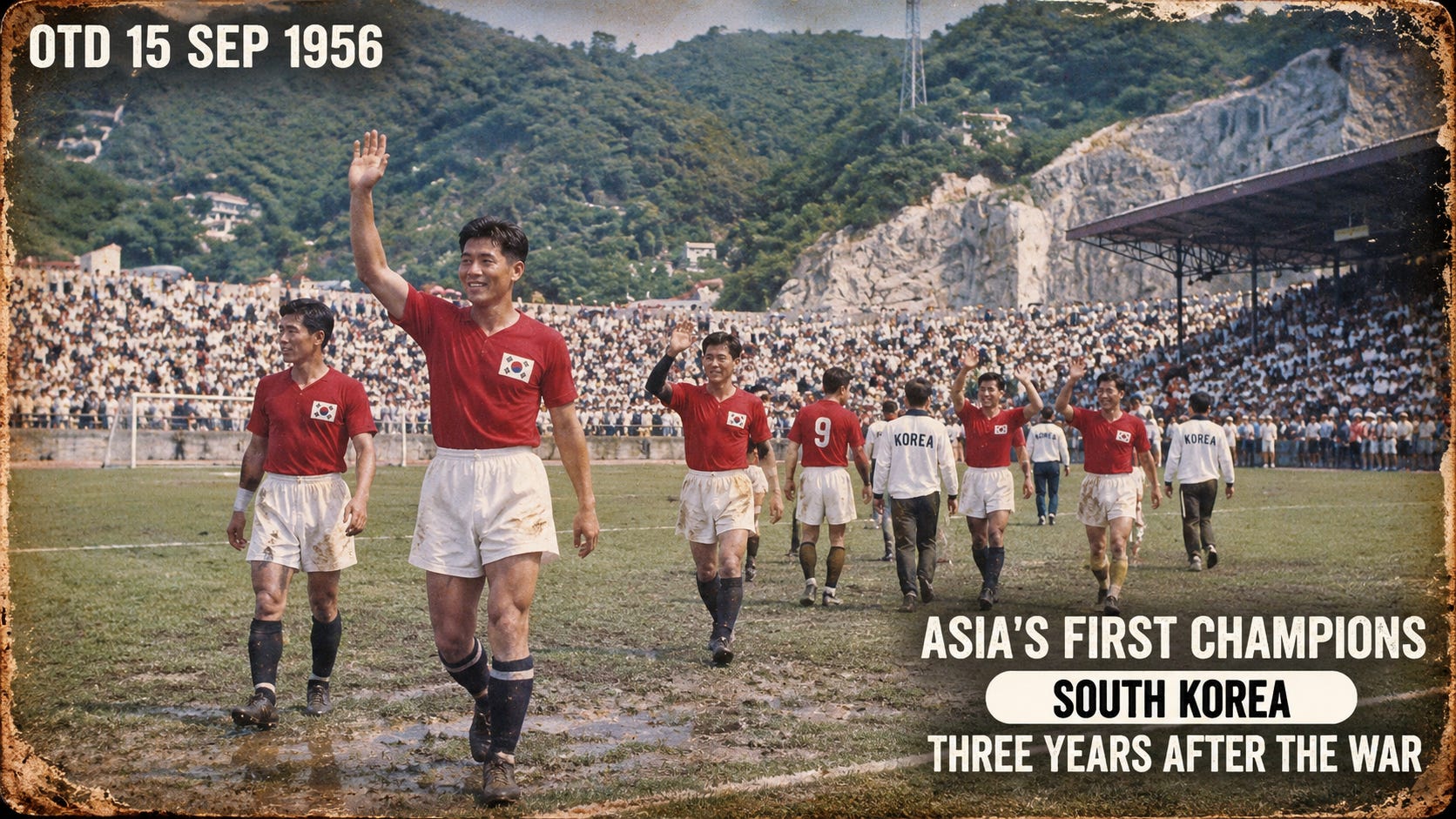
It is September 15, 1956, at the Government Stadium in British Hong Kong, and South Korea need to beat South Vietnam to become the first champions of Asia. There is no final. Just four teams in a round-robin competition, and Korea sit one point behind Israel with one match left to play. But look at the four teams who have reached this tournament: British Hong Kong, South Korea, South Vietnam and Israel. A colony. Two countries created by partition. And a fourth whose very existence has already produced war.
Asia’s first continental championship is not merely being played alongside the politics of the postwar world. Its entire lineup has been created by it.
How Did We Get Here?
Asia was hardly new to international football. India, the Dutch East Indies, Japan and China had all appeared at the Olympic Games, and the Dutch East Indies had become the first Asian team at a World Cup in 1938. Asian Games football began in 1951. What Asia lacked was any body to govern the continental game. Europe did not yet have UEFA. Africa did not yet have its own confederation. South America had run one since 1916. Asia remained a scatter of national associations separated by enormous distances, limited money and rapidly moving borders.
Then, in May 1954, representatives met in Manila during the Asian Games, and thirteen associations founded the Asian Football Confederation: Afghanistan, Burma, Chinese Taipei, Hong Kong, India, Israel, Indonesia, Japan, South Korea, Pakistan, the Philippines, Singapore and South Vietnam. Read that list now and it feels politically impossible. In 1954 it was an attempt to build a football continent while the political continent was still being rebuilt. Empires were retreating, new countries were appearing, China was split between rival governments, Korea was divided, Vietnam was being divided, and Israel was six years old.
The AFC planned its first continental championship for 1956. Twenty teams were placed in a qualifying draw, and twelve withdrew or declined without playing. Not every reason was political: travel was expensive, communications were hard, and several teams in the draw had not even joined the AFC. But politics was never far away. In the western zone, Israel qualified without playing a single match, because Pakistan and Afghanistan refused to host the Israeli team and others withdrew, until the AFC simply informed Israel that it had received walkovers all the way to Hong Kong. The central zone produced South Vietnam, a state barely a year old: the Geneva settlement of 1954 had provisionally divided Vietnam near the seventeenth parallel, and the Republic of Vietnam had been proclaimed in Saigon only in October 1955. Less than eleven months later, its football team was playing to become champion of Asia.
Only in the eastern zone did a team have to fight its way through. South Korea beat the Philippines twice, then met Chinese Taipei, winning 2-0 in Seoul and 2-1 in Taipei, where Woo Sang-Kwon equalized from a penalty and Kim Dong-Keun scored late. That second leg was on September 2, by which point the finals in Hong Kong had already begun. Asia’s first championship started before all of its participants had even qualified.
For Korea, simply arriving was a story in itself. Japanese colonial rule had ended in 1945, the peninsula had been divided, and in 1950 the Korean War began. By the 1953 armistice, cities and families had been shattered, and there was still no peace treaty, only a ceasefire. Football had returned inside a country rebuilding from war. Korea had even reached the 1954 World Cup, though both qualifiers against Japan were played in Tokyo because President Syngman Rhee would not allow the former colonial power’s team into Korea, and the reward was an exhausting journey to Switzerland and defeats of 9-0 to Hungary and 7-0 to Turkey. Humbling scorelines, but reaching a World Cup at all, months after the war, was the achievement. Two years on, the same generation had another chance, and this time not merely to take part, but to win.
The four-team tournament began on September 1, with Hong Kong losing 3-2 to Israel in front of around thirty thousand people. Korea did not start until September 6, against the hosts, and trailed 2-0 at the interval before fighting back to 2-2. Two days later they met Israel, who had enjoyed a full week’s rest to Korea’s two days. Korea fell behind again, and again recovered, Woo Sang-Kwon and Sung Nak-Woon scoring in a 2-1 win, though Cha Tae-Sung was sent off late and South Vietnam’s officials protested that he should be suspended for the decider. He played anyway. Israel had finished their matches on four points. Korea had three. Under two points for a win, Korea had to beat South Vietnam to be champions.
Thirteen thousand gathered at the Government Stadium on September 15 for a match of eighty minutes with no substitutes allowed. Sung Nak-Woon put Korea ahead after five minutes, and South Vietnam equalized from a penalty. Then the match detonated. Woo Sang-Kwon scored a Korean penalty just after the break, South Vietnam levelled again, Choi Jung-Min made it 3-2, Woo scored once more, South Vietnam answered for 4-3, and Choi struck his second to settle it. South Korea 5, South Vietnam 3. The contemporary newspapers cannot even agree on all the scorers, or on parts of the South Vietnamese lineup. When reporters tried to establish who had actually taken the field, one Vietnamese official reportedly explained that the correct lineup was “a military secret.” It is a wonderful line, and for this tournament almost too perfect. South Korea had become Asia’s first champions by beating South Vietnam in British Hong Kong, after drawing with the colony and beating Israel, having qualified against Chinese Taipei. It was football. It was also a map of the postwar world.
So what?
The first thing is that the win made Korea the first power of AFC football. Three matches, two wins, a draw, nine goals, five points, Asian champions. Four years later they hosted the second Asian Cup and won that too, becoming the competition’s first dynasty. And then something strange happened: South Korea never won it again. They would reach finals, produce world-class players, qualify for World Cup after World Cup and even reach a semifinal in 2002, yet the country that won the first two Asian Cups has spent every decade since chasing a third.
The second thing is that the tournament showed why the AFC was both necessary and fragile. Twenty teams appeared in the qualifying design, and only a minority actually played. Israel reached Hong Kong entirely on walkovers. Matches lasted eighty minutes with no substitutes. Two drawn games were meant to go to extra time but were both stopped because it had grown too dark. The competition even began before the eastern qualifier had been decided. By modern standards it feels improvised, and that is exactly the achievement: the AFC built a continental championship across some of the world’s greatest distances and deepest divisions only two years after founding the confederation itself. The machine barely worked. But it worked.
The third thing is that the political map would not hold still. South Vietnam vanished in 1975 when the country was reunified under Hanoi. Hong Kong stayed under British rule until 1997. Chinese Taipei’s name and status would remain contested for decades. Israel would win the Asian Cup in 1964, but political isolation made its place in Asian football increasingly untenable, and it was expelled from AFC competitions in the 1970s before eventually joining UEFA. That crisis was already visible in 1956, since Israel reached the tournament only because opponents would not play it, and just six weeks after the Asian Cup ended, Israeli forces entered Egypt’s Sinai as part of the Suez Crisis. The football did not predict the war. It simply showed how little distance lay between the football map and the political one.
The first Asian Cup tried to unite a continent whose governments could not agree on where the continent began, which countries should exist, or who was willing to meet whom. Football could not resolve any of that. What it could do was build a table in which all four teams could, for two weeks, exist together. Played three, won two, drawn one, lost none. South Korea, champions.
Three things to take away
First, South Korea won the first Asian Cup by beating South Vietnam 5-3. There was no final. The title was decided by a four-team round robin, and Korea finished a single point ahead of Israel.
Second, almost every part of the competition was improvised. Most prospective entrants withdrew, Israel qualified without playing, Korea’s place was confirmed only after the finals had begun, the matches lasted eighty minutes, and even the identity of some of the scorers remains disputed to this day.
Third, the tournament was a portrait of Asia in 1956. British Hong Kong hosted, recently divided Korea beat recently divided Vietnam, and Israel finished second after qualifying through politically motivated walkovers. The AFC had created a continental championship. It had not escaped the continent’s geopolitics.
On this day in 1956, South Korea beat South Vietnam 5-3 to become Asia’s first football champion. A country rebuilding from occupation, partition and war won a tournament made up almost entirely of countries wrestling with occupation, partition and war. Football does not stand outside history. Sometimes, it arranges history into a league table.
---
📩 Got an idea to an OTD story? otd@17lawsguy.com
Yesterday: 14 September 1939, war erases an entire Football League season.
Tomorrow: 16 September 1992, the forgotten death of Larbi Benbarek, the Black Pearl.