

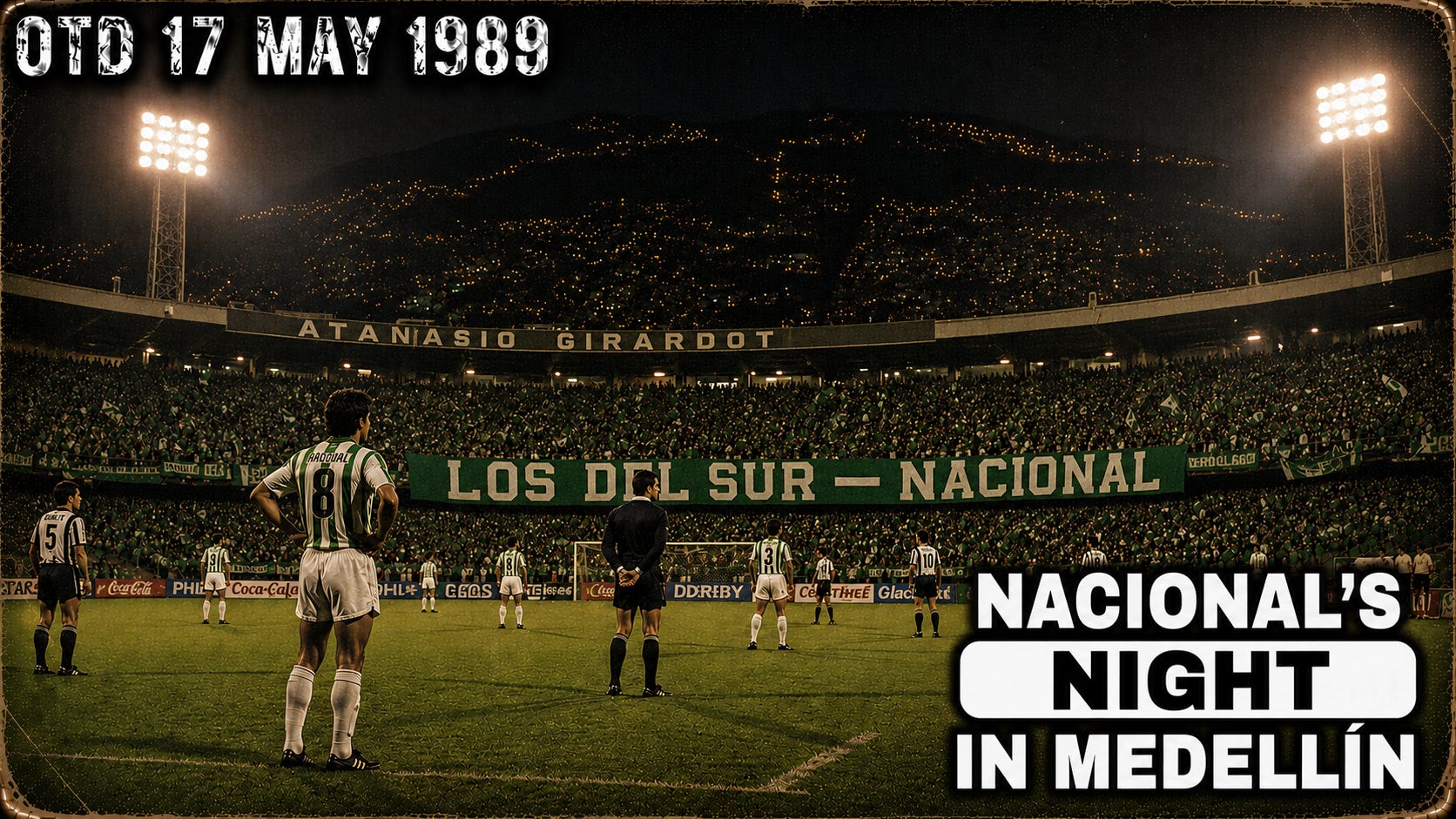
It is 17 May 1989. Medellín. Atlético Nacional against Danubio. Copa Libertadores semi-final, second leg.
The first match in Montevideo finished 0-0. Now Nacional win 6-0. Albeiro “El Palomo” Usuriaga scores four. Alexis García and Níver Arboleda add the others.
On the pitch, it is a demolition.
Off the pitch, it is one of the darkest stories in Libertadores history.
Because years later, Argentine referee Carlos Espósito would say that the night before the match, he and his assistants Juan Bava and Abel Gnecco were threatened by armed men linked to Pablo Escobar — including Jhon Jairo Velásquez, “Popeye.”
So this is not just the night Atlético Nacional reached the Libertadores final. It is a story about beauty under pressure, football under threat, and a tournament being stress-tested by narco power at its most terrifying.
Colombian football had lived previous golden moments. El Dorado in 1949-54 — the gold rush when Millonarios, Di Stéfano, Pedernera and others made Colombia briefly the wildest market in world football.
But by the 1980s, the money was different. Cocaine demand, especially in the United States, produced extraordinary cartel wealth. Medellín and Cali became names far beyond Colombia. The drug trade entered politics, police, business, nightlife — and football.
It is important to say this carefully. Atlético Nacional were not just “a narco team.” That would flatten the story and insult the football. Nacional had a serious sporting tradition. Founded in 1947, they had won Colombian titles before. In the 1970s, they rose under Osvaldo Zubeldía — yes, the same Zubeldía from yesterday’s Estudiantes episode. He brought discipline, preparation and tactical edge to Medellín, winning Colombian league titles in 1976 and 1981.
After Zubeldía’s death in 1982, Nacional remained important, but América de Cali dominated the decade. América, widely linked to the Cali cartel, reached three straight Copa Libertadores finals from 1985 to 1987 and lost all three.
Then came Francisco “Pacho” Maturana. Maturana was not a gangster’s invention. He was one of the great thinkers in Colombian football. He had played under Zubeldía, absorbed the idea that preparation mattered, and added a Colombian language of possession, rhythm and confidence. His Nacional were known as “puros criollos”: built around Colombian players.
René Higuita. Andrés Escobar. Leonel Álvarez. Luis Carlos Perea. Alexis García. John Jairo Tréllez. Albeiro Usuriaga.
This was not ugly football. It was expressive, technical, brave. Higuita was a sweeper-keeper before the term became fashionable. Andrés Escobar was elegance and calm. Valderrama, with Colombia, became the creative centre of Maturana’s wider project.
But the football existed inside a violent ecosystem. Pablo Escobar was a football obsessive, a bettor, a patron, and a symbol of Medellín’s cartel power. Whether influence was direct, indirect, proven, alleged, or simply ambient, Colombian football in those years could not escape the reality: clubs, referees, players and administrators were operating in a world where cartel money and cartel fear were close to the game.
Nacional’s road through the 1989 Libertadores was tough — Racing Club in the round of 16, Millonarios in the quarter-final, Danubio of Uruguay in the semi-final. The first leg in Montevideo finished 0-0.
Then the Argentine officials travelled to Medellín for the return leg.
This is where the story enters the dark.
Carlos Espósito would later say that from the moment they arrived, they were made to understand what could happen to referees who did not cooperate. He and assistants Juan Bava and Abel Gnecco were taken to their hotel. He said armed men later entered his room, with Popeye among them. There was a briefcase of money. There were weapons. There were threats. Nacional had to win. Their lives, they were told, had little value.
The next day, the referees went to the Atanasio Girardot. And Atlético Nacional produced one of the most overwhelming performances in Colombian club history.
Alexis García scored early. Then Usuriaga took over. Four goals. Four from El Palomo. Níver Arboleda made it six.
Atlético Nacional 6, Danubio 0.
On the football field, it was magnificent. Around the football field, it was horrifying. That is the tension of this episode.
The players did not need guns to be brilliant. The team had talent, structure and courage. But the environment was poisoned by people who believed football could be bent by fear.
In the final, Atlético Nacional faced Olimpia of Paraguay. Olimpia won the first leg 2-0 in Asunción. Because the Atanasio Girardot was considered too small for the final, Nacional’s home leg was moved to El Campín in Bogotá. Nacional won 2-0. Usuriaga scored. The tie went to penalties.
Eighteen penalties. Higuita saved. Higuita scored. Players missed. Players froze. The shootout stretched into something almost unbearable. Finally, Leonel Álvarez scored, and Nacional had it.
The first Colombian Libertadores.
But the darkness did not end with the trophy. It intensified.
Later in 1989, the Colombian league was cancelled after referee Álvaro Ortega was murdered in Medellín. His killing became the moment when football’s crisis could no longer be dressed up as rumor, bravado or betting gossip. If referees could be threatened in continental competition and killed in domestic football, the game itself was under attack.
CONMEBOL responded with restrictions. Atlético Nacional, as defending champion, were allowed back in for 1990 — but their home matches moved away from Colombia. They played in Chile.
And what matters so deeply is that the football itself endured. Because the easy version of this story is Narcos with a ball. But Colombian football was also producing something beautiful.
Maturana’s Nacional fed Colombia’s national team. In 1990, Colombia went back to the World Cup after twenty-eight years and drew with West Germany. In 1993, they beat Argentina 5-0 in Buenos Aires, one of the great qualifying results in football history. Then came 1994, the unbearable expectation, the early exit, and the murder of Andrés Escobar — a story we will soon have to tell.
Colombian football survived that too. Not quickly. Not cleanly. And not without scars. But it survived.
Atlético Nacional eventually became part of a different Colombian story. They won the Libertadores again in 2016. That same year, after the Chapecoense air disaster, Nacional asked CONMEBOL to award the Copa Sudamericana title to the Brazilian club they had been due to face. CONMEBOL did so and gave Nacional a fair-play award.
That does not erase 1989. Nothing erases 1989. But it shows the arc.
From a football world terrorized by cartel power to a club capable of symbolizing solidarity.
From fear to memory.
From narco football to football that outlived the narcos.
🎙️ The full episode (linked above) has more — including the murder of referee Álvaro Ortega, the cancellation of the 1989 Colombian league, the 1990 Vasco da Gama scandal, the Intercontinental Cup loss to Sacchi’s Milan, and Atlético Nacional’s eventual moral renewal with the 2016 Chapecoense fair-play gesture. The whole arc is in the audio.
---
🎧 Also available on Apple Podcasts, Amazon Music, Overcast, iHeart, and YouTube.
📩 Got an episode idea? otd@17lawsguy.com
Yesterday: 16 May 1968 — Estudiantes Begin a Dynasty.
Tomorrow: 18 May 1931 — the day Argentina’s professional league was formed.