

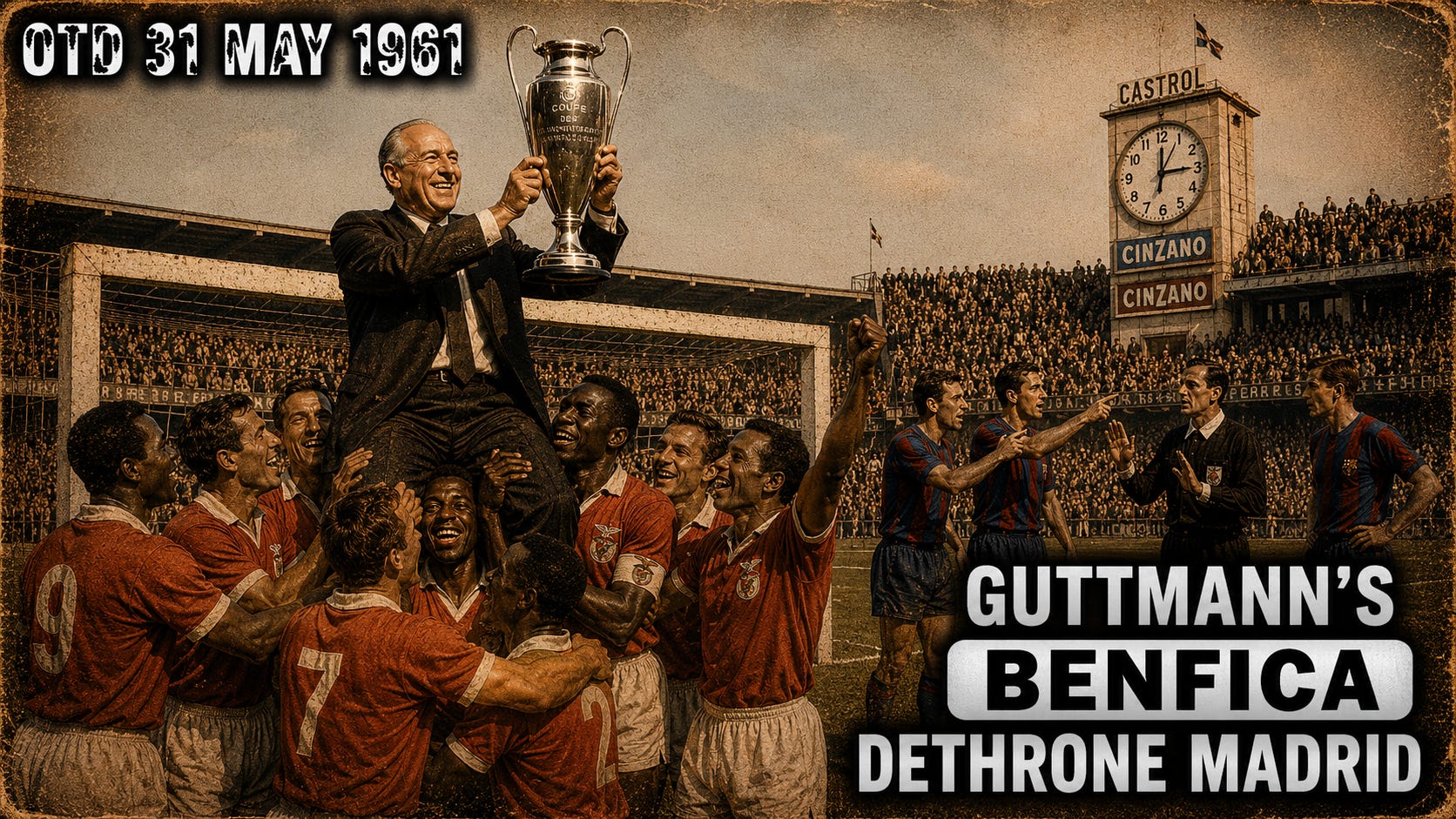
It is 31 May 1961, in Bern. The Wankdorf Stadium — the same ground where, seven years earlier, West Germany shocked Hungary in the Miracle of Bern. And today, another team built on Hungarians loses a final here. Barcelona have Kubala, Kocsis and Czibor. They are expected to become Europe’s next great team. Real Madrid’s five-year reign is over. The European Cup is ready for a new dynasty.
And then Benfica win 3-2.
Not Real Madrid. Not Barcelona. Benfica — a Portuguese club led by a wandering Hungarian genius named Béla Guttmann, changing the direction of European football.
How did we get here? The European Cup was still young, and for its first five seasons it belonged entirely to Real Madrid — Di Stéfano, Gento, Puskás, five finals, five wins, the first dynasty of European club football. But all dynasties age, and the obvious heir was Barcelona: back-to-back La Liga titles, Luis Suárez winning the Ballon d’Or, Kubala an icon, Kocsis and Czibor adding Hungarian genius. So when Barça drew Madrid in the first round of the 1960-61 European Cup and knocked them out, it felt like succession. They beat Hamburg in a semi-final replay and reached their first European Cup final. The stage was set for the takeover.
Benfica, meanwhile, were a giant in Portugal but not yet in Europe — until Guttmann arrived. His route to Lisbon was already absurdly rich: Budapest, Hakoah Vienna, New York, São Paulo, Porto. A Jewish Hungarian who survived the catastrophes of the twentieth century, became a football nomad, and lived by a rule: never stay too long. His famous line was brutal — the first season the coach works quietly, the second is harder, the third is fatal. He cleared out senior players, promoted youth, and built a side of speed, width and risk around captain José Águas and the great Mozambique-born midfielder Mário Coluna. (No Eusébio in the European Cup side yet — that story begins the very next day.)
Barcelona were favorites, and early on they looked it. In the 20th minute, Sándor Kocsis headed them in front — the great Hungarian header scoring at the stadium where Hungary’s golden generation had once been broken. Then, in two minutes, the final flipped. Benfica attacked down the left, Ramallets misjudged the danger, and José Águas finished. 1-1. Moments later a looping ball off a defensive contact dropped over the line and was given as an own goal by Ramallets. Barcelona protested it never crossed. The referee — Swiss official Gottfried Dienst, who five years later would stand at the centre of the most famous goal-line controversy in World Cup history at Wembley — was certain. 2-1 Benfica.
Then the goal that became Benfica mythology. Coluna had broken his nose early and was hanging deeper, outside the box. In the 55th minute the ball dropped to him, and he hit it first time — a thunderous volley. 3-1.
Now Barcelona chased, and the woodwork became a character in the story. Kubala’s shot hit one post, ran across the goalmouth, hit the other, and came back out. Barça swore it crossed. No goal. The square posts of Bern struck again and again — it felt as if geometry itself had turned against them. Czibor pulled one back with fifteen minutes left, 3-2, and the final came alive. But Costa Pereira held firm. Benfica survived.
Real Madrid’s reign was over. Barcelona’s coronation was cancelled. And Benfica were champions of Europe.
What came next made the night legendary. Benfica returned the following year — this time with Eusébio — and beat Real Madrid 5-3 in the 1962 final: Puskás scored a hat-trick and lost, Eusébio scored twice and won. That was the true changing of the guard. Then Guttmann asked the board for more, was refused, and walked away — reportedly vowing that without him, Benfica would not win another European Cup for 100 years. They reached the 1963 final against Milan’s catenaccio and lost. More finals followed. More pain. They have not won a European trophy since.
And Barcelona? One of the great what-ifs. Money problems bit, Luis Suárez was sold to Inter — where Herrera turned him into the brain of the catenaccio machine — and Barça waited until 1992 to finally win this trophy. Thirty-one years after Bern.
The final even left a physical trace on the game: the violent rebounds off Wankdorf’s square posts became a key reference point in football’s move toward rounder, fairer goalposts. Benfica’s win didn’t just redirect European football. It helped mark the end of the square-post era.
🎙️ THE PODCAST GOES DEEPER. The full episode has what this post compresses: both clubs’ full routes to Bern; Guttmann’s extraordinary life and survival in detail; Eusébio’s strange competitive debut the day after the final; the 1962 Madrid rematch; the full curse mythology and Benfica’s seven lost finals since; and the square-posts legacy. That’s the 10-minute version.
---
🎧 Listen on Spotify, Apple Podcasts, Amazon Music, Overcast, iHeart, and YouTube.
📩 Got an episode idea? otd@17lawsguy.com
Yesterday: 30 May 1919 — Roberto Chery, the Save, and the Tribute in Sky Blue.
Tomorrow: 1 June 1978 — the goalless curse of World Cup opening matches.