

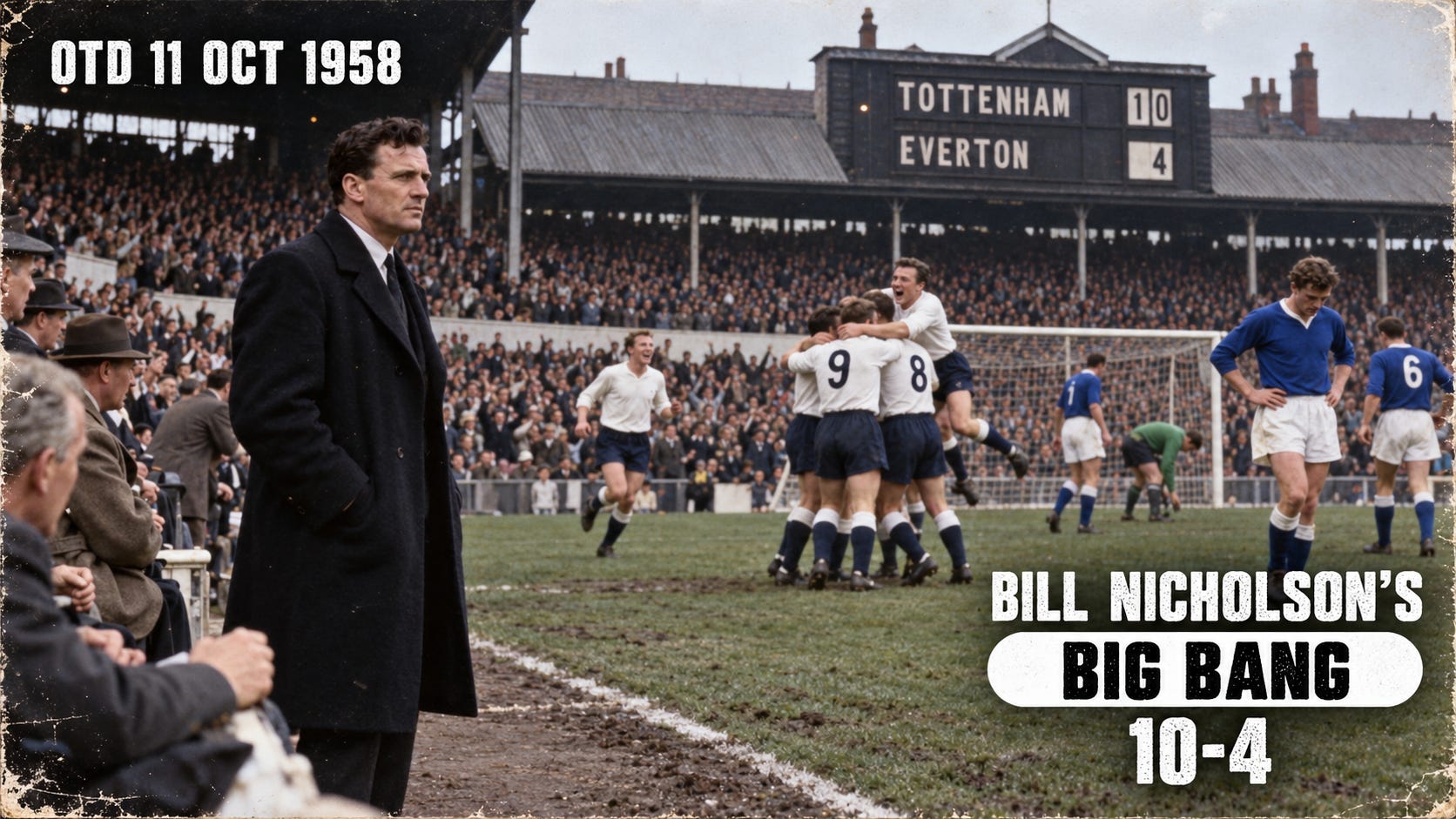
It is 11 October 1958, and Tottenham Hotspur have just appointed a manager who has never managed a senior team. Bill Nicholson is 39, has spent most of his adult life at the club, and has not negotiated a contract or even discussed a raise. The announcement is made on the morning of a First Division match against Everton.
By halftime, Tottenham lead 6-1.
By full time, the new manager’s record reads played one, won one, goals for ten. Bobby Smith has scored four. Jimmy Harris has scored a hat trick for Everton and finished six goals behind. White Hart Lane has witnessed fourteen goals, equaling the largest aggregate ever recorded in an English top-flight match.
Tommy Harmer listens as Nicholson congratulates his players, then offers a warning disguised as a joke: they will not win 10-4 every week.
He is right. Tottenham will spend much of the season fighting relegation. Yet the result feels less like a false dawn than an explosion at the start of an era. Nicholson has inherited the club’s traditions, absorbed its disappointments and learned its football from inside. His first afternoon tells everyone what he intends to do with them.
How did we get here?
Tottenham began in 1882 with schoolboys playing on the marshes of north London. Within two decades, the club had become Southern League champion and, under player-manager John Cameron, won the 1901 FA Cup. Spurs remain the only non-League club to have lifted the trophy since the Football League was formed in 1888.
That victory helped establish an identity before Tottenham had entered the League: southern, ambitious and associated with football that entertained. Peter McWilliam deepened it after becoming manager in 1912. A former Newcastle United and Scotland half-back, McWilliam wanted the ball played along the ground. Spurs won the Second Division in 1920 and the FA Cup in 1921. More important to this story, his football educated two young Tottenham players named Arthur Rowe and Bill Nicholson.
Nicholson had arrived by an improbable route. Born in Scarborough in 1919, the second youngest of nine children, he grew up in a household sustained by his father’s work with a horse-drawn taxi and his mother’s work as a cleaner. A local connection brought him to Tottenham for a trial as a teenager. He joined the ground staff in 1936, made his first-team debut under McWilliam in October 1938 and heard the principle that stayed with him: football was to be played with the feet, not launched toward the head.
War interrupted almost immediately. Nicholson served with the Durham Light Infantry and became a physical-training instructor. The experience gave a quiet young footballer responsibility, taught him how to address groups and made conditioning part of his understanding of leadership. Regional wartime football kept him playing, but his formal Spurs career resumed only after six lost seasons.
Tottenham were in the Second Division when Arthur Rowe returned as manager in 1949. Rowe restored McWilliam’s inheritance and called his version “push and run”: pass quickly to a teammate, move immediately into space, receive the return. It sounded simple because the best ideas often do. It required technique, timing and a shared understanding of where the next space would open.
Spurs won the Second Division in 1949/50, then became English champions in their first season back in the top flight. Nicholson, a disciplined right-half, balanced Alf Ramsey’s advances from full-back. If Ramsey moved, Nicholson covered. The system was attacking but not anarchic; freedom depended on position.
Nicholson made 341 appearances for Tottenham in all competitions. England gave him only one cap, against Portugal at Goodison Park in May 1951. He scored with his first touch, nineteen seconds after kickoff. Instant impact was becoming a habit.
When his playing career ended in 1954, coaching was the natural continuation. Nicholson had studied on the Football Association’s emerging courses while still a player. He joined Tottenham’s staff and worked with England’s under-23s, then became assistant manager in 1955.
The man above him was Jimmy Anderson. Rowe had stepped down after his health collapsed under the pressure of the job, and Anderson inherited expectations transformed by the 1951 championship. His record was better than hindsight often allows: Tottenham finished second in 1956/57, third the following season and reached an FA Cup semifinal. Yet he struggled to reconcile Danny Blanchflower’s tactical intelligence, an aging side and a club that believed it should be challenging for more.
The 1958/59 season began badly. Tottenham lost their first three league games 3-2, 4-2 and 5-0. Results improved, but the team remained in the lower half and had already conceded heavily. Anderson’s health was cited when the club decided he would leave. Nicholson later recalled being summoned by vice-chairman Fred Wale to Brown’s of Tottenham, Wale’s business. Anderson would not continue. Did Nicholson want the job?
No salary was discussed. No contract was offered. Nicholson accepted anyway. He had been coaching at Tottenham for four years and had been part of the club for twenty-two. The agreement was reached several days before the public announcement, which came on the morning of the Everton match. Some players learned only when Nicholson came down to see them that day.
Everton arrived with their own troubles. Johnny Carey’s side had won only three of its first eleven league games. Yet the teams contained serious talent: Blanchflower, Bobby Smith, Terry Medwin and George Robb for Tottenham; Dave Hickson, Bobby Collins and Wally Fielding for Everton. The visitors were not ceremonial victims assembled for Nicholson’s entrance.
At 3 p.m., referee G.W. Pullen started the match in front of 37,794 spectators. Three minutes later, Alfie Stokes put Tottenham ahead. Jimmy Harris equalized in the eleventh minute. For a few moments, the day resembled an ordinary match between two vulnerable teams.
Then Tottenham detonated.
Smith restored the lead in the fourteenth minute. Robb made it 3-1 on the half-hour, and Smith scored again almost immediately. Stokes added his second in the 34th minute. Medwin struck before halftime. Six Tottenham goals had arrived in forty minutes after Everton’s equalizer.
Harris scored again early in the second half, but Smith completed his hat trick in the 62nd minute. Harmer made it 8-2. Harris then completed the rarest kind of hat trick, three away goals in a heavy defeat. Smith scored his fourth, Collins replied for Everton, and center-half John Ryden supplied Tottenham’s tenth in the 89th minute.
The sequence was Stokes, Harris, Smith, Robb, Smith, Stokes, Medwin, Harris, Smith, Harmer, Harris, Smith, Collins, Ryden. Fourteen goals, ten scorers’ entries, one exhausted scoreboard.
Contemporary reports did not treat Everton as entirely hapless. The visitors created enough chances for one correspondent to suggest that a more accurate final score might have been 10-7. That only makes the match stranger. This was not ten goals against a team refusing to cross halfway. It was an afternoon on which almost every attack seemed to expose another open route to goal.
So what?
English football does not maintain an official record category for a manager’s first match. Across more than a century of league competition, caretaker appointments and uncertain handover dates make a definitive comparison difficult. Still, no new manager in the English top flight is known to have started with a larger victory or with his team scoring more than Nicholson’s ten. The 10-4 is the most spectacular managerial debut the division has produced.
It was also deeply misleading if read as an instant cure. Tottenham won 4-3 at Leicester three days later, but Nicholson’s first season remained a struggle. Spurs finished eighteenth in a twenty-two-team First Division, only two places above relegation. The debut did not prove that one pre-match talk had transformed eleven players. It revealed the attacking possibilities Nicholson believed were already inside the club.
He then built the team capable of sustaining them. Cliff Jones had arrived shortly before Nicholson became manager. Dave Mackay came from Hearts, Bill Brown from Dundee, John White from Falkirk and Les Allen from Fulham. Around them were Blanchflower, Smith, Medwin, Maurice Norman, Peter Baker and Ron Henry. Nicholson did not merely preserve Rowe’s push-and-run. He added power, defensive security and relentless fitness.
The curiosity mattered. On a preseason visit to Moscow, Nicholson watched the Bolshoi Ballet and became fascinated by the dancers’ strength and balance. He investigated their training and later brought weightlifter Bill Watson into Tottenham’s conditioning work. In an English culture still suspicious of specialized preparation, Nicholson looked outside football for an advantage.
Tottenham finished third in 1959/60. Blanchflower began speaking about the Double, an achievement that sounded almost absurd. No club had won the English League and FA Cup in the same season since Aston Villa in 1896/97.
Spurs opened 1960/61 with eleven consecutive league victories, still the best start by wins in English top-flight history. They won twenty-two of their first twenty-five league matches, scored 115 goals and secured the championship with three games remaining. Leicester City were beaten 2-0 at Wembley in the FA Cup final. The impossible Double had been completed.
Nicholson did not stop at the summit. Tottenham retained the FA Cup in 1962 and reached the European Cup semifinal, where a brilliant Benfica side survived a furious second leg at White Hart Lane. In 1963, Spurs beat Atlético Madrid 5-1 in Rotterdam to win the European Cup Winners’ Cup. They became the first British club to win a major European trophy.
The first great side broke apart. Blanchflower retired, Mackay suffered two broken legs, Medwin’s career ended through injury and John White was killed by lightning on a golf course at twenty-six. Nicholson rebuilt. He had added Jimmy Greaves, the supreme English goalscorer, and later recruited Pat Jennings, Alan Gilzean, Alan Mullery, Martin Chivers, Martin Peters and Steve Perryman.
The second Nicholson team won the 1967 FA Cup, the 1971 and 1973 League Cups and the 1972 UEFA Cup. Tottenham became the first British club to win two different major European competitions and the first club to win the League Cup twice. Across sixteen years, Nicholson delivered eight major trophies and three Charity Shields. He used only seventy-nine players, evidence of both continuity and the demands he placed on those he trusted.
His reign ended painfully. Crowd trouble surrounding the 1974 UEFA Cup final defeat by Feyenoord distressed him, and a poor opening to the following league season deepened his exhaustion. Nicholson retired as manager on 29 August 1974. The club did not immediately use his knowledge well. For a time, the greatest figure in Tottenham’s history was out of work and even accepted a role at West Ham through Ron Greenwood’s kindness.
Tottenham brought him back in 1976 as a consultant and chief scout. His eye helped identify players including Gary Mabbutt, Graham Roberts and Tony Galvin, connecting Nicholson to the cup-winning sides of the 1980s. He became club president in 1991. Bill Nicholson Way was named beside the stadium in 1999. When he died in 2004, aged eighty-five, he had been associated with Tottenham for sixty-eight years.
Where does that place him among English club managers? Herbert Chapman modernized Arsenal and the office itself. Matt Busby rebuilt Manchester United twice. Bill Shankly remade Liverpool’s identity; Bob Paisley converted that inheritance into European domination. Brian Clough produced miracles at Derby County and Nottingham Forest. Alex Ferguson created the longest modern dynasty, while Arsène Wenger and Pep Guardiola changed how English teams played and prepared.
Nicholson belongs in that company. His case rests on more than eight trophies. He completed the first Double of the twentieth century, made Tottenham Britain’s first European winner, rebuilt a great team instead of merely maintaining one, and turned a club philosophy into measurable achievement. He was not the game’s loudest mythmaker. His work spoke in firsts.
The contrast with Tottenham in 2026/27 is severe. Through five Premier League matches, Roberto De Zerbi’s team had no wins, two points and a goal difference of minus six, the club’s worst five-game start of the Premier League era. Spurs failed to score in their first four league matches for the first time in their history and needed their 67th shot of the season to register a goal.
It would be unfair to compare five games with sixteen years, or a modern coach’s unsettled squad with Nicholson’s lifetime inside one institution. The useful contrast is philosophical. Nicholson inherited a club in trouble, but he could define what Tottenham football meant and recruit, coach and condition players toward it. Modern Tottenham possess resources he could scarcely have imagined. What they continue to seek is the same coherence.
The 10-4 did not create Bill Nicholson’s greatness. It announced the alignment that made greatness possible: a manager formed by the club, a style inherited but not worshiped, and the authority to build beyond one afternoon.
Three things to take away
The 10-4 was a record-scale beginning, not a miracle cure. Nicholson’s Tottenham scored ten in his first match, yet finished eighteenth and fought relegation. His achievement was turning one day’s possibility into a durable team.
Nicholson joined tradition to innovation. He inherited McWilliam and Rowe’s passing football, then strengthened it through recruitment, structure and conditioning ideas gathered even from the Bolshoi Ballet.
His place in the managerial pantheon rests on firsts. The twentieth century’s first English Double, Britain’s first major European trophy, two different European competitions and eight major trophies make Nicholson far more than Tottenham’s greatest manager.
On This Day...
On 11 October 1958, Tottenham Hotspur announced Bill Nicholson as manager and gave him no gentle introduction. Everton scored four times. Jimmy Harris completed a hat trick. Spurs scored ten anyway. By evening, the unknown first-time manager had produced English football’s most explosive opening statement. Harmer was correct that it could not happen every week. Nicholson spent the next sixteen years proving that it had not needed to.
---
Questions, corrections or story ideas: otd@17lawsguy.com
Yesterday: 10 October 2017, The Night Couva Turned the Tables.