

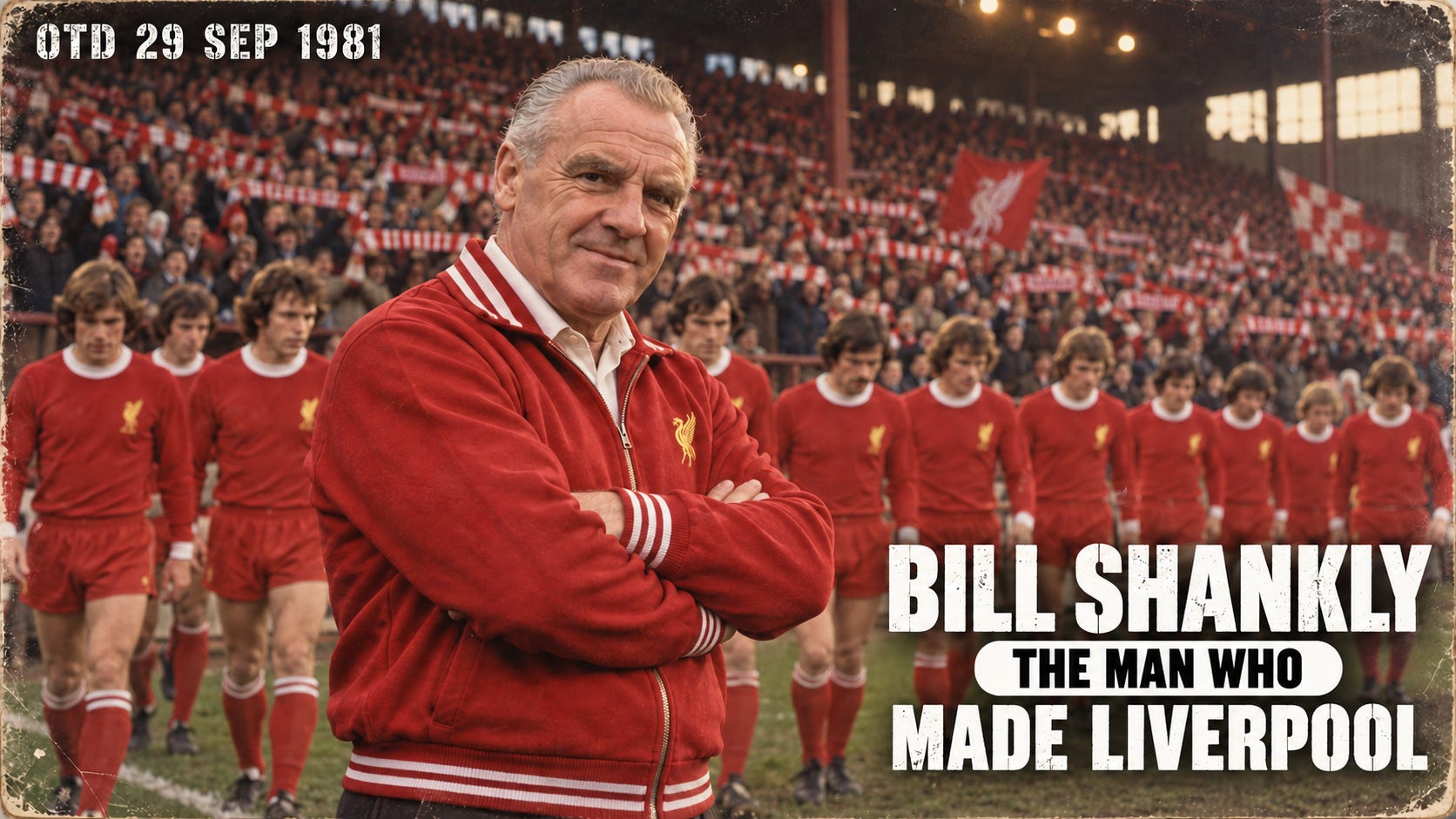
It is September 29, 1981, and Bill Shankly passes at Broadgreen Hospital in Liverpool, aged 68. Seven years earlier he had walked away from Liverpool Football Club after winning the FA Cup, saying he wanted rest and more time with his wife, Ness, and their family. But Shankly’s only real hobby was football, and retirement cut him off from the daily life that had defined him. Liverpool carried on without him and became even more successful, and somehow every trophy won by Bob Paisley, Joe Fagan and Kenny Dalglish seemed to make Shankly larger rather than smaller. He did not win Liverpool’s first European Cup. He built the club that could.
How did we get here?
Shankly came from Glenbuck, a small mining village in Ayrshire, Scotland, born on September 2, 1913, one of ten children. His father, John, was a tailor with strong socialist convictions. Glenbuck was extraordinarily productive for such a small place, and four of Shankly’s brothers became professionals, including Bob, who later managed Dundee to the Scottish championship. Bill left school at fourteen and went down the mine, and when the pit closed, football became his escape. Glenbuck supplied the foundations of his worldview: work, solidarity, loyalty, and the belief that nobody succeeds alone, which became his idea of a football team.
Carlisle United signed him in 1932, and a year later Preston North End paid 500 pounds for the energetic young half-back. Shankly was not an elegant star. He was combative, intelligent and extraordinarily fit, a player who tackled, covered ground and gave the ball to teammates better placed to use it, and the manager was already visible inside the player: simplify the game, understand your job, never cheat the collective. Preston reached the 1937 FA Cup final and lost 3-1 to Sunderland, then returned to Wembley in 1938 against Huddersfield Town, in a match that produced one of English football’s great broadcasting stories. It was the first FA Cup final televised in full. With the match still goalless deep into extra time, the commentator Thomas Woodrooffe had declared that if a goal was scored now, he would eat his hat. Moments later, Shankly helped send George Mutch through, Huddersfield’s captain Alf Young challenged him, and Preston won a penalty. Mutch scored it for a 1-0 win, and Woodrooffe kept his promise after a fashion, eating a hat made from cake and marzipan.
The Second World War then took the years that should have been Shankly’s playing prime. Official league football stopped, and he served in the Royal Air Force, playing wartime football for Preston when he could, in a career effectively lost between the ages of 26 and 32. When league football resumed he returned to Preston, eventually playing nearly 300 league games for the club and winning twelve caps for Scotland, before retiring in 1949 and going straight into management. First came Carlisle, then Grimsby, then Workington, at each improving the team while growing frustrated with directors who did not share his ambition. Then, in 1956, came Huddersfield Town, the same club where Herbert Chapman had built a great side three decades earlier before moving on to reconstruct Arsenal. There he gave a sixteen-year-old named Denis Law his league debut, recognizing his extraordinary ability immediately. Years later, as Liverpool manager, Shankly wanted to sign Law, but Liverpool could not afford him.
Liverpool finally gave that ambition a home. When Shankly arrived in December 1959, Liverpool were stuck in the Second Division, where they had been since 1954, and had recently suffered the humiliation of an FA Cup defeat to non-league Worcester City. Anfield was tired, the training ground at Melwood was neglected, and the squad held too many players who could not carry the club where Shankly intended to go. But the raw materials existed: an enormous support base, a city that understood work, community and defiance, and good football people already inside the club in Bob Paisley, Joe Fagan and Reuben Bennett, soon joined by Ronnie Moran. Shankly demanded authority and boardroom backing, moved on roughly two dozen players, and began rebuilding. In 1961 he signed Ian St John from Motherwell and Ron Yeats from Dundee United, and when he introduced the enormous Yeats to Liverpool’s directors, he reportedly told the defender to walk around the room so they could see how big he was, then announced that Liverpool had acquired a colossus. It was theater, but purposeful theater. Shankly did not merely believe in his players. He enlarged them until everyone else believed too. At Melwood he introduced intense small-sided games built around control, movement, angles and quick passing, and Liverpool’s football settled into something often recognizable as a 4-4-2, though the shape mattered far less than the principles behind it: pass to a red shirt, move to receive it back, cover for one another, press the opponent, repeat until it becomes instinct. The Boot Room, literally a room where boots were once stored, became an informal coaching chamber where Paisley brought knowledge of treatment and tactical detail, Fagan kept extensive records, and Bennett and Moran added their own understanding. Arguments happened privately in there. When Liverpool emerged, the club spoke with one voice.
Liverpool won promotion in 1962 and were champions of England two years later, and Shankly then changed how the club looked. Before a European Cup match against Anderlecht in November 1964, he asked Yeats to model red shorts alongside Liverpool’s red shirt, Ian St John suggested adding red socks, and Shankly looked at his giant captain and saw the psychological effect at once. The all-red Liverpool was born. Around the same time, “You’ll Never Walk Alone,” a song from the musical Carousel that had reached number one for the Liverpool group Gerry and the Pacemakers in 1963, became the Kop’s own, sung on even after it left the charts. Shankly did not order the supporters to adopt an anthem. He simply understood what they had created, a promise linking team, crowd and city, and had the words “THIS IS ANFIELD” placed above the tunnel. As he said, “to remind our lads who they’re playing for and to remind the opposition who they’re playing against!” In 1965, Liverpool won the FA Cup for the first time, beating Leeds United 2-1 after extra time, and three days later the European champions Inter Milan came to Anfield for a European Cup semifinal. Before kickoff, Liverpool paraded the FA Cup around the ground, the noise was overwhelming, and Shankly had turned a trophy presentation into psychological warfare. Liverpool won 3-1. They lost the return leg in Milan 3-0, but Liverpool now belonged among Europe’s great clubs, and another league title followed in 1966.
His weakness was loyalty. The devotion that built his first great team made it difficult to dismantle, and only after a humiliating FA Cup defeat at Watford in 1970 did he begin building a second one, bringing through Ray Clemence, Emlyn Hughes, Steve Heighway, John Toshack, Brian Hall and Kevin Keegan. That side won the league and the UEFA Cup in 1973, and at the celebration outside St George’s Hall, Shankly looked out over a vast red crowd and declared that Chairman Mao had never seen a greater show of red strength. In 1974 Liverpool demolished Newcastle United 3-0 in the FA Cup final, one of their most complete performances at Wembley and the last match of his managerial career. Chairman John Smith had reportedly offered him a new contract on his own terms, and the club hoped he would stay for life. Instead, on July 12, his retirement was announced. He was only 60. To Liverpool’s supporters he had seemed indestructible.
Retirement did not fit him. Shankly kept turning up at Melwood, talking to players, watching training, offering advice, and while his presence felt entirely natural to him, it became increasingly difficult for the club. Paisley had reluctantly accepted the manager’s job after years as Shankly’s lieutenant, and players could look from the new boss to the old one and wonder whose authority actually mattered. When someone once praised Paisley’s start, Shankly reportedly replied that he could have left a monkey in charge, a line that was funny and also revealed exactly the problem. Eventually Liverpool asked him to stay away from the training ground. There was real logic in it: Manchester United had struggled for years under Matt Busby’s shadow after he stepped aside, and Liverpool wanted Paisley to stand on his own feet. But what was institutionally sound was personally brutal. Shankly had expected a continuing role, and was never offered the board place supporters believed he deserved; invited to the 1976 UEFA Cup final in Bruges, he was reportedly kept apart from the official party. He sometimes felt more welcome across Stanley Park at Everton’s training ground, and wrote bitterly that Everton and Manchester United had received him more warmly than the club he had helped build. Yet his bond with Liverpool’s supporters never broke. On September 26, 1981, he suffered a heart attack and was admitted to Broadgreen Hospital; early reports suggested he had stabilized, but he then suffered a cardiac arrest and died in the early hours of September 29, with Ness beside him. Matt Busby, Jock Stein and Bob Paisley stood among the mourners at his funeral. Liverpool’s first home league match afterward finished 2-2 against Swansea City, managed by John Toshack, one of Shankly’s own great signings. Even that result carried one of his fingerprints.
So what?
Shankly won three league championships, two FA Cups and a UEFA Cup, honors that do not by themselves explain his standing. Paisley won more, six league titles and three European Cups among them, and Fagan then won the league, the League Cup and the European Cup in his first season, with Dalglish continuing the dynasty after that. But every later trophy enlarged Shankly’s legacy rather than shrinking it, because Paisley did not inherit an ordinary football club. He inherited a functioning system: its expectations, its recruitment, its coaching collective, its pass-and-move football, and the Boot Room’s own line of succession. Paisley refined that system brilliantly. Shankly had changed what Liverpool believed it was possible to be, and that places him among English football’s great club-builders, alongside men like Herbert Chapman at Huddersfield and Arsenal or Matt Busby at Manchester United. Shankly’s own contribution was closer to cultural architecture than to any single tactical innovation: the red kit, the tunnel sign, the Boot Room, the communion with the Kop, the conviction that winning required everyone to work for everyone else. The room itself no longer exists; it was knocked through in 1993 to make way for press facilities, a small, almost too neat illustration of how completely the culture had outgrown the physical space that once contained it.
His sayings became part of football’s language, some of them embellished, others jokes elevated into philosophy, and his line about football being a matter of life and death has read painfully ever since Heysel and Hillsborough showed that the game can never be more important than human life. But beneath the exaggeration sat Shankly’s real point, that football mattered because ordinary people invested their families, their communities and their identities in it. Liverpool’s history now holds triumph and trauma together, and whenever the Kop sings The Fields of Anfield Road, with its line about a Kopite calling outside the Shankly Gates, he returns to the ground that once asked him to keep his distance. The gates bearing his name were unveiled in 1982, and his statue followed outside the Kop in 1997, its inscription offering the simplest verdict football has ever produced for one man: he made the people happy.
Three things to take away
First, Shankly was formed by Glenbuck. Mining, family, socialism and the belief that collective work gave ordinary people dignity all became, later, his idea of how a football team should function.
Second, his Liverpool revolution went well beyond trophies. He transformed training, recruitment, presentation and belief, and built a culture strong enough to keep winning long after he had gone.
Third, Paisley’s greater trophy haul does not diminish Shankly, it proves him right. His greatest achievement was building a Liverpool capable of becoming even stronger once he had left it.
On this day in 1981, Bill Shankly died in Liverpool at 68. He did not live to see most of the trophies his culture made possible, and he may never have fully realized how far his revolution would travel. But every time Liverpool wear red, touch the sign above the tunnel, or sing that nobody walks alone, he is still there.
---
📩 Got an idea to an OTD story? otd@17lawsguy.com
Yesterday: 28 September 1878, the Lancashire Football Association was founded above a pub in Bolton.