

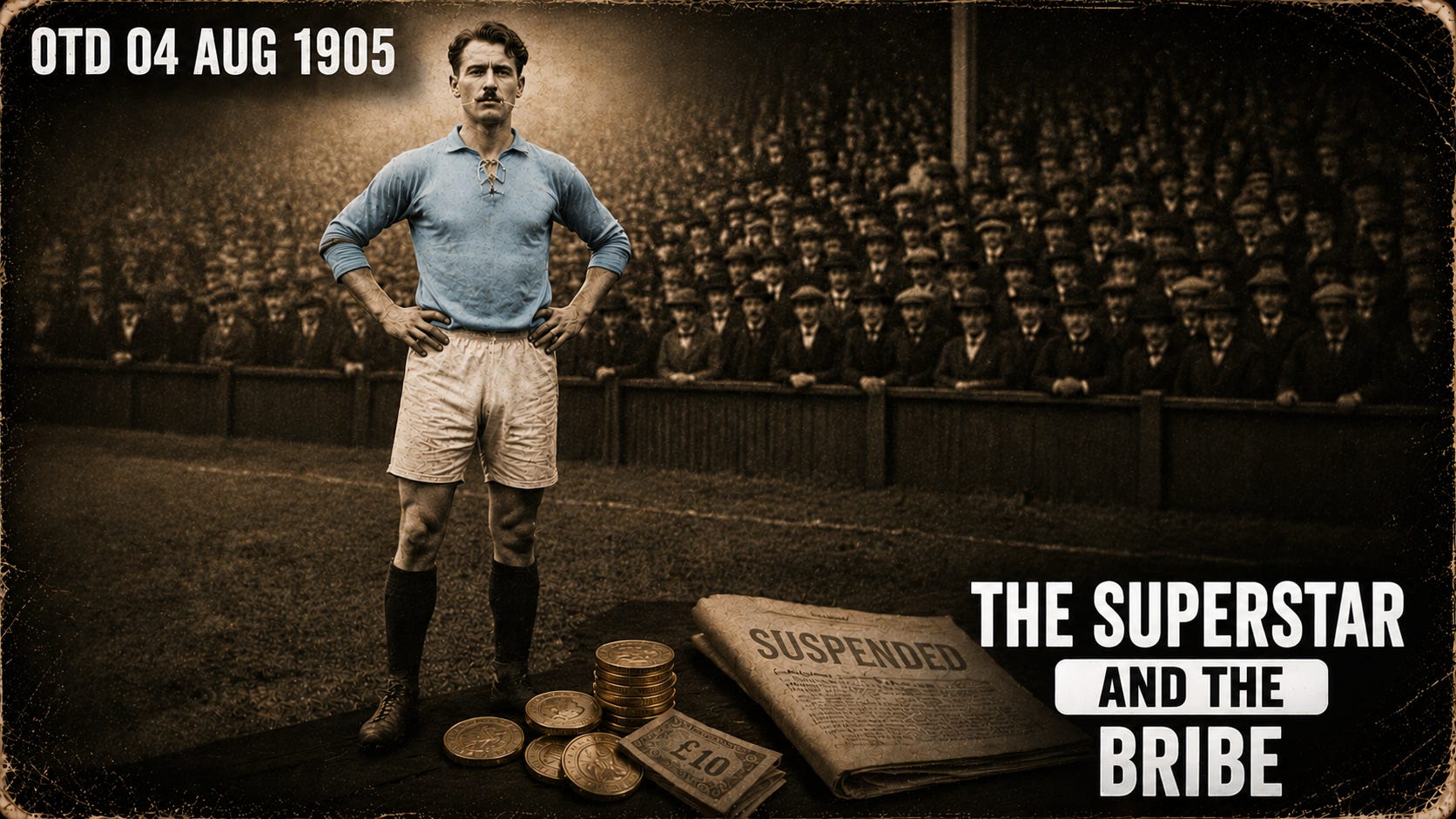
It is August 4, 1905. London. The Football Association. And Billy Meredith, Manchester City’s great winger, Wales international, FA Cup hero, and one of football’s first superstars, is suspended. His offense: trying to bribe Aston Villa captain Alec Leake with ten pounds to throw a match. Meredith denies it. The FA does not believe him. And one player’s scandal becomes something much bigger: illegal payments, the maximum wage, a Manchester City investigation, players sold off, United transformed, and Meredith reborn as one of football’s first great labor voices.
Meredith was Welsh, born in Chirk, a mining village, working down the pit before football took him away. He joined Manchester City in 1894, and in only his second game scored twice against Newton Heath, soon to become Manchester United, so one of the first great Manchester football stories already had both clubs in it. He played outside right, fast and elusive, famous for the toothpick under his moustache. This was football before television, so charisma traveled by newspaper report and people saying: you have to see him. And people did. In 1904 he scored the only goal in the FA Cup final against Bolton, City’s first major trophy, and he was the footballer people paid to watch.
But this was a game under financial pressure. Professionalism had been legal since 1885, but by 1901 the maximum wage was four pounds a week, for footballers drawing crowds and becoming the reason clubs made money. So football was professional enough to sell, but not professional enough to let players share in what they created. That is where hypocrisy breeds. Corruption was not rare; Preston, West Ham, and Burnley had all been caught up in payment or bribery cases before Meredith.
In 1904-05, Manchester City were chasing the title. On the final day they went to Aston Villa needing to win, and lost 3-2. Afterward, Villa captain Alec Leake alleged that Meredith had offered him ten pounds to throw the game, more than two weeks of the legal maximum. Meredith said he was innocent; the FA found him guilty and, on August 4, 1905, suspended him. English football was staring at one of its biggest names and accusing him of trying to corrupt the result.
And then City did not stand behind him. That was the turning point. Meredith expected support; instead the club distanced itself, so he did something dangerous. He talked. Why am I alone? According to Meredith, City had been paying players over the legal maximum. Everyone knew. Everyone benefited. Only he was punished. Now the FA had a bigger case: not a bribe but a club, a wage system, a financial culture. City were investigated, manager Tom Maley punished, the club fined, seventeen players suspended until January 1907, and City forced to sell.
This was the earthquake, because the punishment redistributed Manchester football. Meredith was sold to Manchester United, along with Sandy Turnbull, Herbert Burgess, and Jimmy Bannister, and those players became central to United’s rise: the league in 1908, the FA Cup in 1909. The players City lost helped United become champions.
Meredith’s story shows how early the modern football economy arrived. This is 1905, and already there are star players, wage controls, side payments, a bribery allegation, and an argument over who really benefits. The answer was clear: not the player. So his second life matters. On New Year’s Day 1907, still banned, he helped form the Players’ Union and became its first chairman. The maximum wage would not be abolished until 1961, so the road from Meredith to Jimmy Hill was long, but he was on it early.
He returned in 1907, won two league titles and an FA Cup with United, then went back to City and, in 1924, aged 49, scored his final City goal in an FA Cup tie. Still chewing the toothpick, still the old wizard on the wing. He remains complicated: guilty in the record, but also a culprit who exposed a system, a star punished for a bribe who pointed toward a wider corruption of illegal wages and a structure built to keep players down while clubs grew rich. That does not make him innocent. It makes him important.
🎙️ THE PODCAST GOES DEEPER. The full episode has the four-pound maximum wage, City’s forced sale to United, and Meredith founding the Players’ Union. That’s the 10-minute version.
---
🎧 Listen on Spotify, Apple Podcasts, Amazon Music, Overcast, iHeart, and YouTube.
📩 Got an episode idea? otd@17lawsguy.com
Yesterday: 3 August 1928, the day football outgrew the Olympics.