

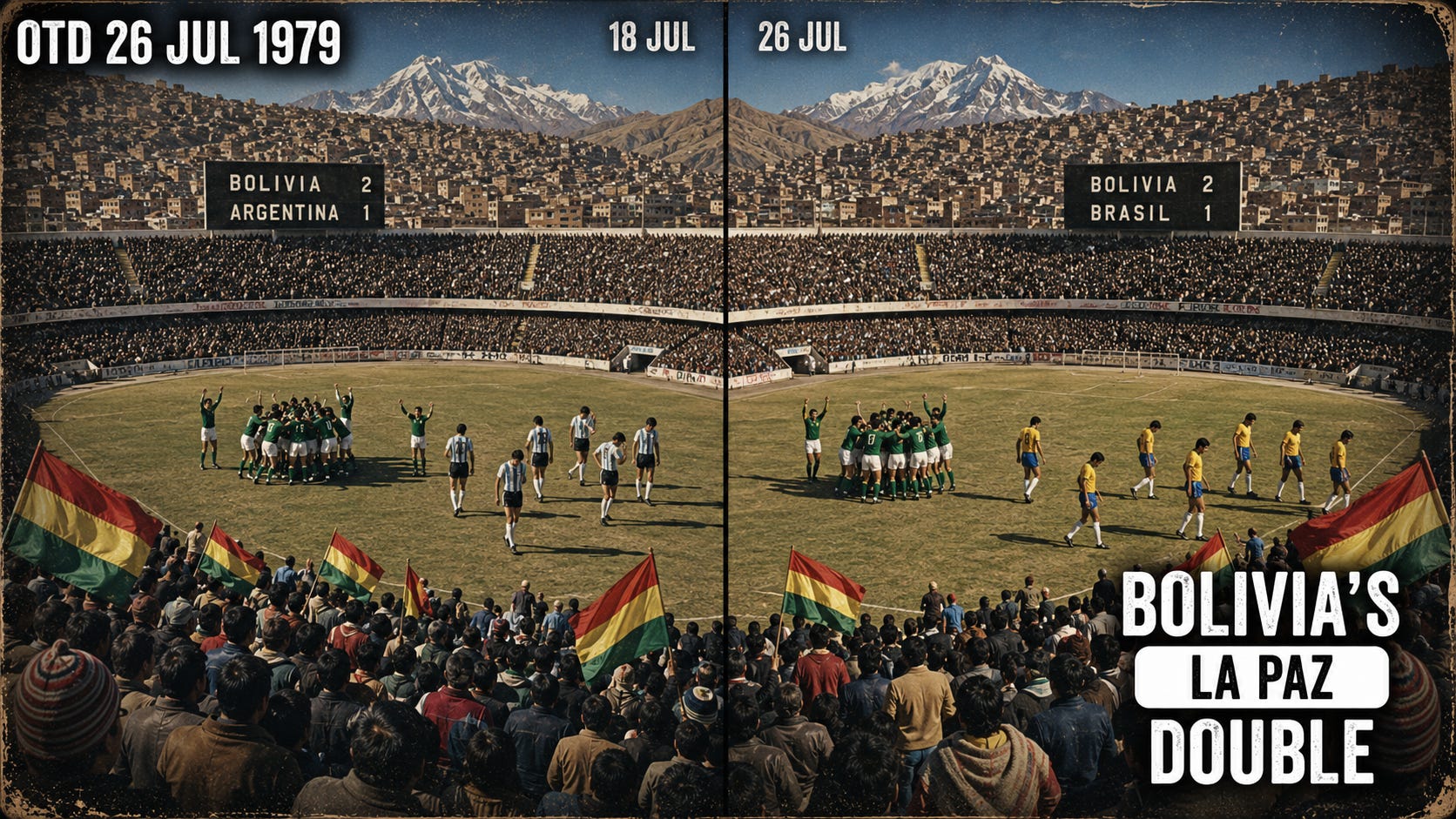
It is July 26, 1979. La Paz. Estadio Hernando Siles. Bolivia against Brazil. Eight days earlier, in the same stadium, Bolivia beat the reigning world champions, Argentina, 2-1.
Today they beat Brazil 2-1.
Same city, same stadium, same score, eight days apart.
What on Earth happened here?
The short answer is that Bolivia played at home. The better answer is that Bolivia played at home, at roughly 3,600 meters, inside a Copa América format that briefly turned geography into destiny.
Bolivia have never been one of CONMEBOL’s powers. Their football history is richer than outsiders allow, but the international record has usually lived nearer the bottom of the table than the top. The great exception was 1963, when Bolivia hosted the South American Championship and beat Brazil 5-4 on the final day to become champions of South America. Their only major title. A peak, not a plateau.
By 1979 they are looking for another tilt toward the mountains, and the tournament hands them the perfect structure. There is no host country that year. The nine teams outside defending champions Peru are split into three groups of three, played home and away. Which means Argentina have to come to La Paz. And Brazil have to come to La Paz.
The Hernando Siles sits almost twelve thousand feet above sea level. At that height, football changes. Lungs work differently, recovery slows, a sprint costs more, a bad first touch is harder to repair. Visitors know all of this. They can arrive early, consult doctors, tell themselves they are professionals. Then the match starts, and the air begins collecting its debt.
Bolivia also have a coach who understands both the football and the national psyche: Ramiro Blacut, who played in the 1963 champion side. Sixteen years on, he is the manager trying to manufacture another shock. This is not yet the Tahuichi generation; the academy in Santa Cruz opened only in 1978. This is older Bolivia, the memory of 1963, and players who understand that if the giants come to their house, the house has to feel like a mountain.
On July 18, Argentina arrive as world champions with César Luis Menotti on the bench and Daniel Passarella on the field. Jesús Reynaldo scores twice, Carlos López pulls one back, 2-1. Huge, but explicable. Travel. Altitude. A bad day.
Then Brazil, on July 26, with Cláudio Coutinho as coach and a squad carrying Leão, Roberto Dinamite, Sócrates, Zico, and Éder. Not 1970 Brazil, not yet 1982 Brazil, but still Brazil. They start like it: Dinamite scores from the penalty spot after half an hour, and the hierarchy begins reasserting itself.
Bolivia answer within six minutes. Carlos Aragonés levels from the spot. In the sixty-third minute he scores again, this time with his head, and the stadium stops being a venue and becomes pressure. Brazil chase. Bolivia hold. Bolivia 2, Brazil 1.
Then the format collects its own debt, because home and away means Bolivia have to leave the mountain. On August 8 in Buenos Aires, Argentina win 3-0. On August 16 in São Paulo, Brazil win 2-0. In La Paz, Bolivia beat those two teams 4-2 on aggregate. Away, they lose 5-0. Brazil top the group.
The double is still real. A country that almost never finishes above Argentina and Brazil beat both in eight days, and one of them was the world champion. South America is not a spreadsheet. It is geography, altitude, travel, noise, old fear, and old pride.
The altitude argument never ends, and the numbers say the same thing. In the 2026 World Cup qualifiers, Bolivia took seventeen of their twenty points at home. But altitude is a weapon, not a development plan, and it can protect a weak system from seeing itself clearly. Bolivia’s real progress came later: the professional league founded in 1977, Tahuichi, and the generation of Etcheverry, Erwin Sánchez, Cristaldo, and Moreno that beat Brazil 2-0 in La Paz in 1993, inflicting their first ever World Cup qualifying defeat, and reached USA 94. In the 2026 World Cup cycle, Bolivia made the intercontinental playoff, beat Suriname, and lost 2-1 to Iraq on neutral ground in Mexico. Away from the mountain, the margin gets thin again.
🎙️ THE PODCAST GOES DEEPER. The full episode has the 1979 home-and-away format, Ramiro Blacut’s link to 1963, and the road from Tahuichi to USA 94. That’s the 10-minute version.
---
🎧 Listen on Spotify, Apple Podcasts, Amazon Music, Overcast, iHeart, and YouTube.
📩 Got an episode idea? otd@17lawsguy.com
Yesterday: 25 July 1976, Defensor breaking a 44-year duopoly in Uruguay.
Tomorrow: 27 July 1928, Latvia win the first Baltic Cup, inside Europe’s argument over the World Cup.