

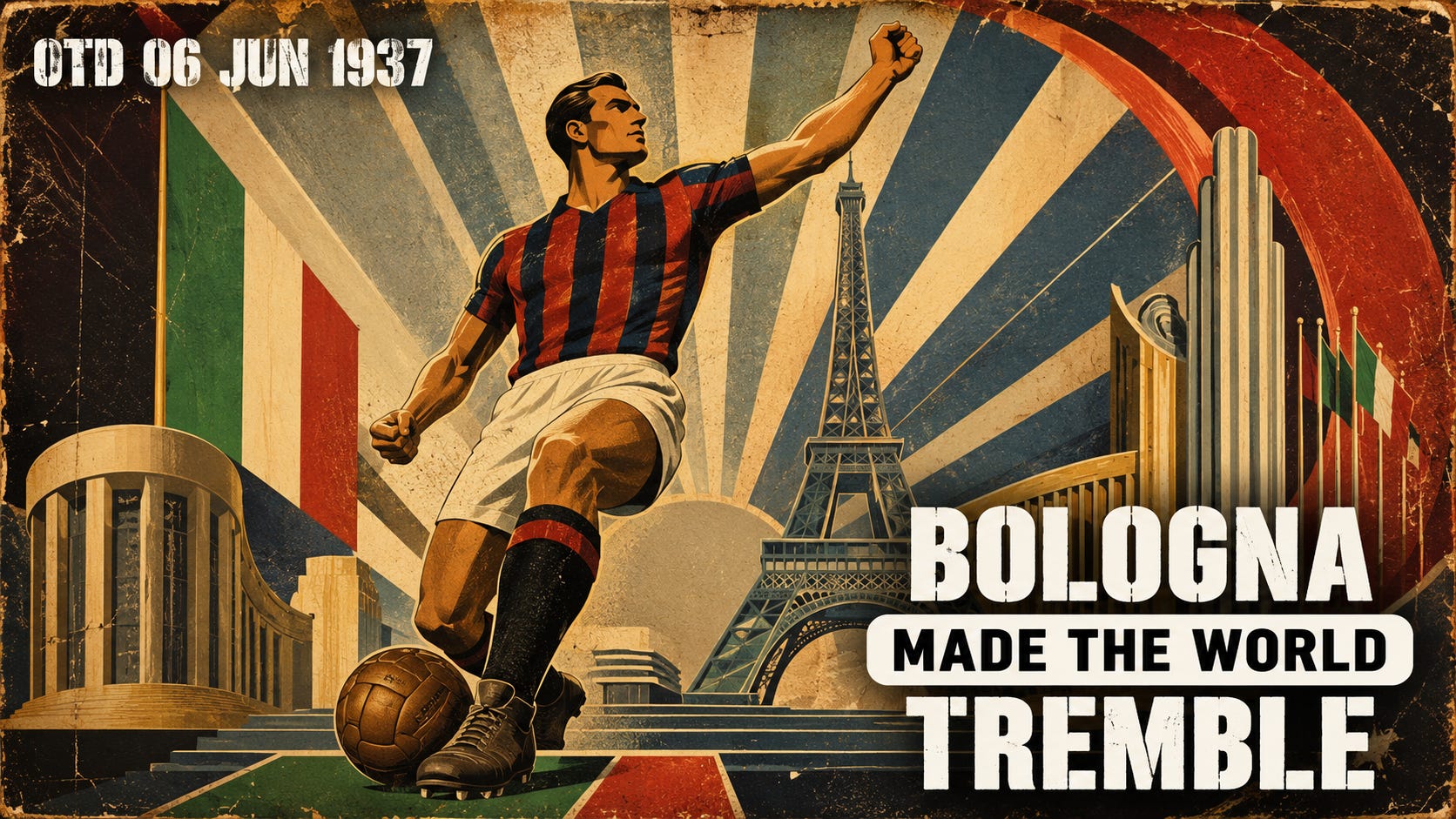
It is 6 June 1937, at Colombes in Paris — the Stade Olympique Yves-du-Manoir. Bologna against Chelsea, in a tournament staged alongside the Paris International Exposition, the world’s fair of art and technology. And the result isn’t close: Bologna 4, Chelsea 1.
An Italian club has beaten an English club to win an international tournament. And in 1937, that means something — because England still sees itself as the home of football, Italy now sees itself as football’s modern power, and on this day Bologna tells Europe that the Italian club game has arrived.
How did we get here? Through two decades of divergence. England legalized professionalism in 1885 and by the 1930s had half a century of paid players, league structure, huge crowds — and the comfortable belief that the game still belonged to the island that codified it. The continent developed differently and faster in some ways: Austria professionalized in 1924, Hungary in 1926, Italy reorganized with the Carta di Viareggio and made Serie A a national league by 1929. Central Europe — Vienna, Budapest, Prague — became a football laboratory, where the game was argued over like politics or music. Jimmy Hogan carried the passing game there; Hugo Meisl built Austria’s Wunderteam and helped create the Mitropa Cup.
Then Italy rose. Vittorio Pozzo took the Danubian lessons and added Italian steel — structure, conditioning, the Metodo, and the controversial oriundi. Italy won the 1934 World Cup at home, drew moral honors in the brutal Battle of Highbury against England in 1934, and took Olympic gold in Berlin 1936. So by 1937 the pattern was clear: England had tradition, Italy had momentum, and Europe was politically on edge — the Paris fair itself had the Nazi German and Soviet pavilions glaring at each other across the Trocadéro.
Into that atmosphere came a tournament of eight invited elite clubs: Austria Wien (Mitropa holders), Slavia Prague (Czechoslovak champions), Marseille (French champions), Sochaux, VfB Leipzig, Phöbus Budapest, Chelsea — and Bologna, the Italian champions. Bologna were the key. Coached by Árpád Weisz — a Hungarian Jew and one of the great modern coaches of the era, who had already shaped a young Meazza at Inter — they were the side Italy remembers as lo squadrone che tremare il mondo fa: the team that makes the world tremble. Their goalkeeper Carlo Ceresoli had saved a penalty against England at Highbury; their forward Schiavio, scorer of Italy’s 1934 World Cup-winning goal, was coaxed out of effective retirement for Paris. That’s how seriously they took it.
The tournament had its quirks — Chelsea reached the semi-final by drawing 1-1 with Marseille and advancing on drawn lots; football still sometimes settled things with a hat or a slip of paper. But Bologna announced themselves by thrashing France’s strong Sochaux 4-1, then beating Slavia Prague 2-0.
The final was effectively over by half-time. Chelsea started brightly for ten minutes — lively, technical. Then Bologna organized. In the 14th minute a Chelsea error let in Reguzzoni; six minutes later Busoni made it 2-0; around the half-hour Reguzzoni struck again. 3-0 at the break. In the second half Reguzzoni completed his hat-trick for 4-0; Sam Weaver pulled one back. Bologna 4, Chelsea 1.
Why did it matter so much? Because English clubs didn’t yet play regular European competition — there was no European Cup, no UEFA calendar, no continental measuring stick. So a neutral tournament, with an English club in the final, won 4-1 by the Italian champions, made real noise. It confirmed the decade’s story: Italy wasn’t a political mirage. National team, Olympic team, club football — all of it was now competitive at the highest European level. And the link to 1938 was direct: a year later the World Cup final was played at this same Colombes stadium, Italy beating Hungary 4-2, with Bologna’s Andreolo and Biavati in the side.
But here the story darkens, and it must be told plainly. Árpád Weisz stood at the top of European football in 1937. Within a year, Mussolini’s racial laws made his life in Italy impossible. He was Jewish. He was forced out of Bologna, out of Italy, into exile — and eventually he and his family were deported by the Nazis. His wife and children were murdered. Árpád Weisz died at Auschwitz in 1944. The coach of the team that made the world tremble was very nearly erased from the history he had helped write.
And the great what-if hangs over all of it. Before the war, elite clubs from Italy, Austria, Czechoslovakia, France and England were already meeting — in the Mitropa Cup, in tournaments like this. What if it had grown into a permanent European club championship before 1955? Instead, war came. Bologna’s Paris moment became a flare rather than a foundation. Chelsea went home, England kept looking inward (the FA stayed outside FIFA until after the war), and English clubs didn’t fully join the European conversation until the 1950s.
That’s why 6 June 1937 matters. Not a UEFA final; not the Champions League before the Champions League. But a signal — a club from Italy, coached by a Hungarian, shaped by the Danubian and Italian schools, beating a London club by three goals in Paris. Football’s centre was moving. And England wasn’t fully listening yet.
🎙️ THE PODCAST GOES DEEPER. The full episode has what this post compresses: the post-WW1 professionalization across Europe; the Mitropa and Meisl-Pozzo lineage; the full tournament round-by-round; Bologna’s squad and Weisz’s methods; and the direct 1938 World Cup connection. That’s the 10-minute version.
---
🎧 Listen on Spotify, Apple Podcasts, Amazon Music, Overcast, iHeart, and YouTube.
📩 Got an episode idea? otd@17lawsguy.com
Yesterday: 5 June 1957 — The Day a Penalty Became a Pass.
Tomorrow: 7 June 1970 — Gordon Banks and the save that stopped Pelé.