

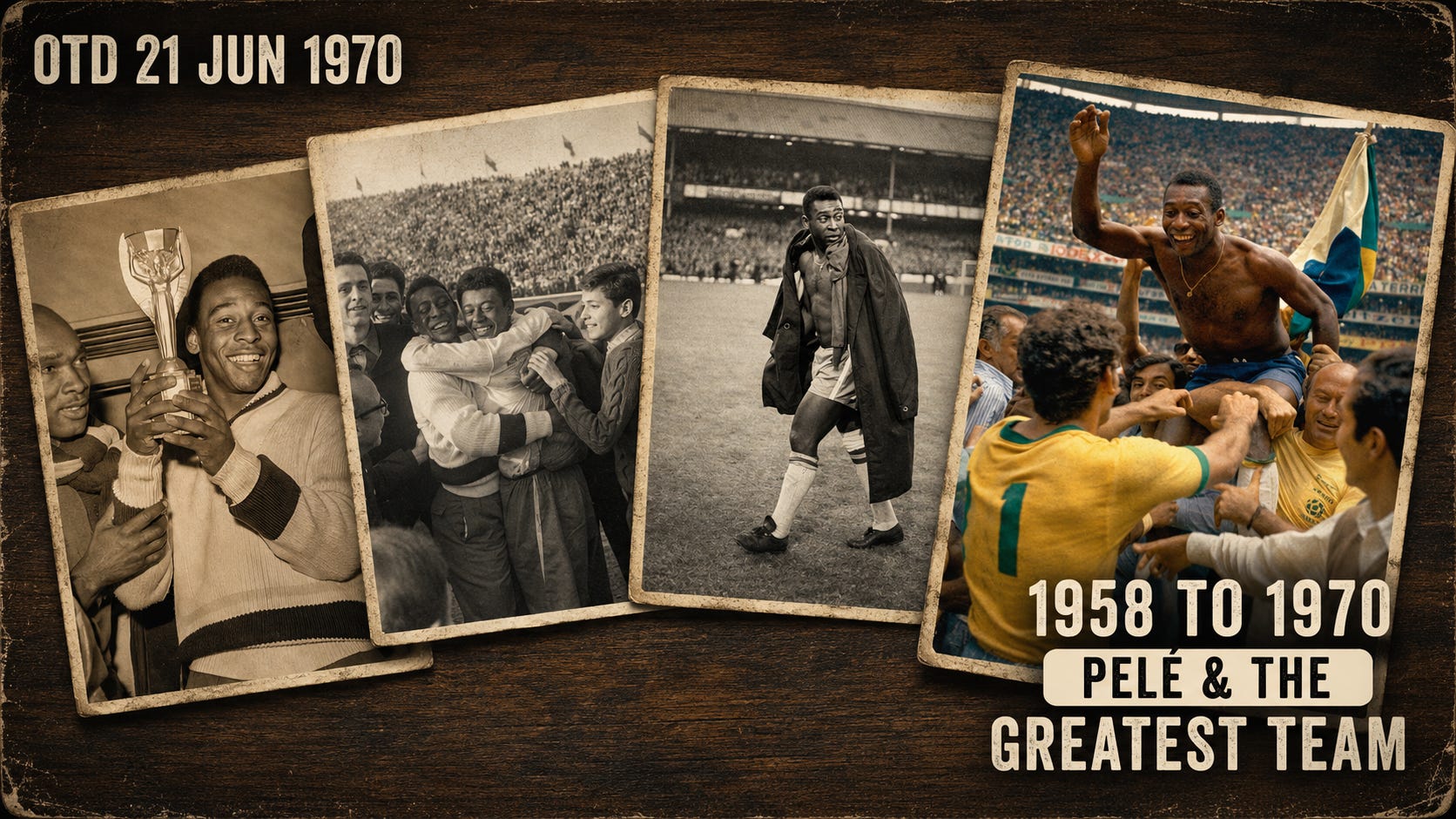
It is 21 June 1970, at the Estadio Azteca in Mexico City. Brazil against Italy, the World Cup final. And today football gets one of its perfect endings. Brazil 4, Italy 1. Brazil become the first nation to win three World Cups and get to keep the Jules Rimet Trophy. Pelé scores and becomes the first, and still only, player to win three World Cups. And the 1970 Brazil team walks into football mythology as maybe the greatest team of all time.
How did we get here? Brazil had been world champions twice, in 1958 with a seventeen-year-old Pelé and the magic of Garrincha, and in 1962. But their World Cup story also had wounds: the Maracanazo of 1950, and the humiliation of 1966, when Pelé was practically kicked out of the tournament and Brazil fell in the group stage. So 1970 was not only a team chasing a title. It was a restoration. And even that began with instability. João Saldanha took Brazil brilliantly through qualifying, winning all six, but was removed before the tournament. The politics were heavy: Brazil was under military dictatorship, and the national team was a government obsession. In came Mário Zagallo, a World Cup winner as a player, and his great problem was also his great gift: too much talent. Pelé, Tostão, Rivellino, Gérson, Jairzinho. In another country, two of them sit. Zagallo chose structure over exclusion: let intelligence organize intelligence, let the ball move, let the players think. Behind them were Clodoaldo, Carlos Alberto, Félix in goal. Not a perfect defense, but good enough, in front of a team that could make football feel improvised even when it was engineered. Not chaos. Organized joy. O jogo bonito.
Italy arrived as European champions, with World Cup titles from 1934 and 1938 and the tactical gravity of Serie A behind them: Facchetti, Burgnich, Mazzola, Rivera, Riva, Boninsegna. Their coach Ferruccio Valcareggi wrestled with the staffetta, Mazzola or Rivera. Italy’s route was strange, one goal scored in the whole group stage, then a 4-1 win over Mexico, and then, four days before this final, the Game of the Century: Italy 4, West Germany 3 after extra time, with Beckenbauer playing with his arm in a sling. Greatness, but also exhaustion. Brazil’s route was cleaner and more radiant: past Czechoslovakia, then England in the match of Pelé’s header and Gordon Banks’s impossible save, then Romania, Peru, and Uruguay in the semi-final, turning the old Maracanazo ghost into a stepping stone.
And now the final, in front of more than 107,000. In the 18th minute, Rivellino crossed and Pelé rose above Burgnich, hung, and headed down. 1-0. Burgnich later said he had told himself Pelé was flesh and bone like everyone else, and that he was wrong. But Italy answered: in the 37th minute a Brazilian mistake let Boninsegna in. 1-1 at half-time, Brazil’s beauty against Italy’s survival. Then the second half became Brazil’s argument with history. In the 66th minute Gérson struck low and precise with his left foot. 2-1. Five minutes later, his free kick was headed down by Pelé and bundled in by Jairzinho, who had now scored in every match of the tournament. 3-1.
And then, in the 86th minute, the goal that became the team’s forever signature. Brazil moved the ball from deep, Clodoaldo dancing past Italian challenges in midfield, the ball going left, then across the field, Tostão, Jairzinho, Pelé, and Pelé, instead of shooting, rolling the ball perfectly into space, and Carlos Alberto arriving like a train to finish with his right foot. 4-1. It is not only a goal. It is a thesis. Everybody involved, the ball faster than fear, the right-back finishing like a centre-forward, Pelé seeing the future one pass before everyone else.
Brazil won the trophy literally. Under the rules, the first nation to win three times would keep the Jules Rimet Trophy, and Brazil got to three first. The trophy went to Brazil permanently (it would be stolen in 1983 and never recovered, a story for another day). And Pelé was crowned: the teenage miracle of 1958, the injured champion of 1962, the abused genius of 1966, now the completed footballer, the first truly worldwide television football king, in color, under the Mexican sun.
This Brazil team became the permanent measuring stick, and that is slightly unfair to everyone since. The Netherlands of 1974 were more revolutionary but won nothing. West Germany were magnificent but not loved the same way. Maradona’s 1986 was maybe the greatest individual tournament but not the same collective ideal. Spain from 2008 to 2012 won three straight major titles but were admired more than adored. Brazil 1982 were maybe the closest in spirit, but they did not win. Brazil won again in 1994 and 2002, and neither side escaped 1970’s shadow. That is the strange gift and burden of Brazil 1970: they define what Brazil, and a great team, is supposed to be. Joyful. Collective. Beautiful. And winners.
That is why 21 June 1970 matters. Not only because Brazil won a third World Cup, but because they set a standard the sport has been measuring itself against ever since.
🎙️ THE PODCAST GOES DEEPER. The full episode has more on Brazil’s 1966 wound, the Saldanha-to-Zagallo upheaval under the dictatorship, the too-many-tens problem, the route through England and Uruguay, the goal-by-goal of the final, the permanent Jules Rimet Trophy, and the long debate over the greatest team ever. That is the 10-minute version.
---
🎧 Listen on Spotify, Apple Podcasts, Amazon Music, Overcast, iHeart, and YouTube.
📩 Got an episode idea? otd@17lawsguy.com
Yesterday: 20 June 1976, Antonín Panenka and the Penalty That Became a Name.
Tomorrow: 22 June 1986, the Hand of God and the Goal of the Century.