

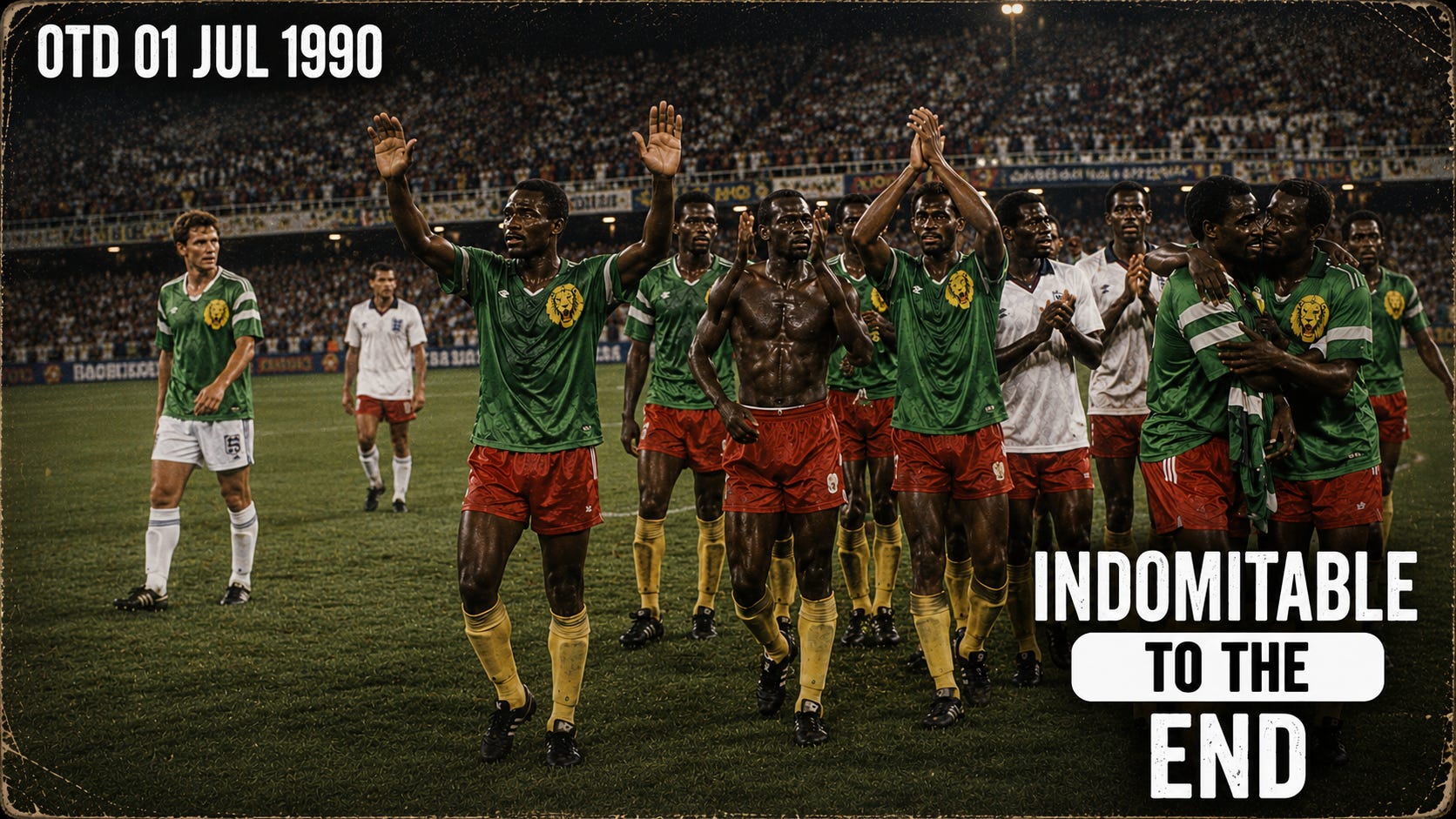
It is 1 July 1990, in Naples. England against Cameroon, a World Cup quarter final. And with seven minutes left, Cameroon lead 2-1. They are minutes away from becoming the first African team ever to reach a World Cup semi-final. Roger Milla, a 38-year-old substitute, has changed the match again. England are wobbling. The whole football world is watching. And then Gary Lineker wins a penalty. Then another. England 3, Cameroon 2, after extra time. The Indomitable Lions are out. But they have already changed the World Cup forever.
To understand how close this was, you have to know Cameroon were no accident. They had real football institutions, two Africa Cup of Nations titles in the 1980s, and a generation good enough to stop being thought of as merely regional. And they had opened Italia 90 by beating the holders Argentina, with nine men on the pitch by the end, one of the great World Cup shocks. They topped their group. They knocked out Colombia. By the time they reached Naples, the novelty framing should already have been dead.
The beating heart of it all was Milla. At 38, he had been pulled almost out of semi-retirement on an island in the Indian Ocean after the country, and its president, wanted him there. Off the bench, he kept transforming matches, and dancing at the corner flag when he scored. He was the proof that this was joy, not luck.
Against England, the pattern repeated. England led through David Platt, and at half-time it looked manageable. Then Milla came on, dropped into the space between England’s defense and midfield, and the match tilted. He won a penalty that Emmanuel Kundé converted. He spun and slid a pass through for Eugène Ekéké. Suddenly it was 2-1 Cameroon, and the impossible was visible: twenty-five minutes away, then seven.
Then came Gary Lineker, and the moments that decided it, twice from the penalty spot, the second in extra time after Cameroon had tired and pushed higher than they should.
Cameroon lost, but they ended the lazy idea that African football was a novelty act, a charming visitor that would always fall short. They did not fall short because they were African. They fell short because they were seven minutes and two penalties away on one night, the same way great teams from everywhere fall short. The distinction is everything. Within a few years the World Cup expanded Africa’s allocation of places, a direct acknowledgement of what Cameroon had proven.
And the line of African progress that followed, deeper runs, a quarterfinal becoming less of a shock, eventually a semi-final reached at last, traces back to a team that came up seven minutes short and decades ahead.
🎙️ THE PODCAST GOES DEEPER. The full episode has more about Cameroon’s football history and the chaotic build-up, the N’Kono and Bell goalkeeper drama, the win over Argentina and the Colombia match with the Higuita moment, the goal-by-goal in Naples and the two Lineker penalties, and how Cameroon reshaped African football’s place in the World Cup. That is the 10-minute version.
---
🎧 Listen on Spotify, Apple Podcasts, Amazon Music, Overcast, iHeart, and YouTube.
📩 Got an episode idea? otd@17lawsguy.com
Yesterday: 30 June 2006, Lehmann’s List.
Tomorrow: 2 July 2010, Luis Suárez’s Handball That Paid Off.