

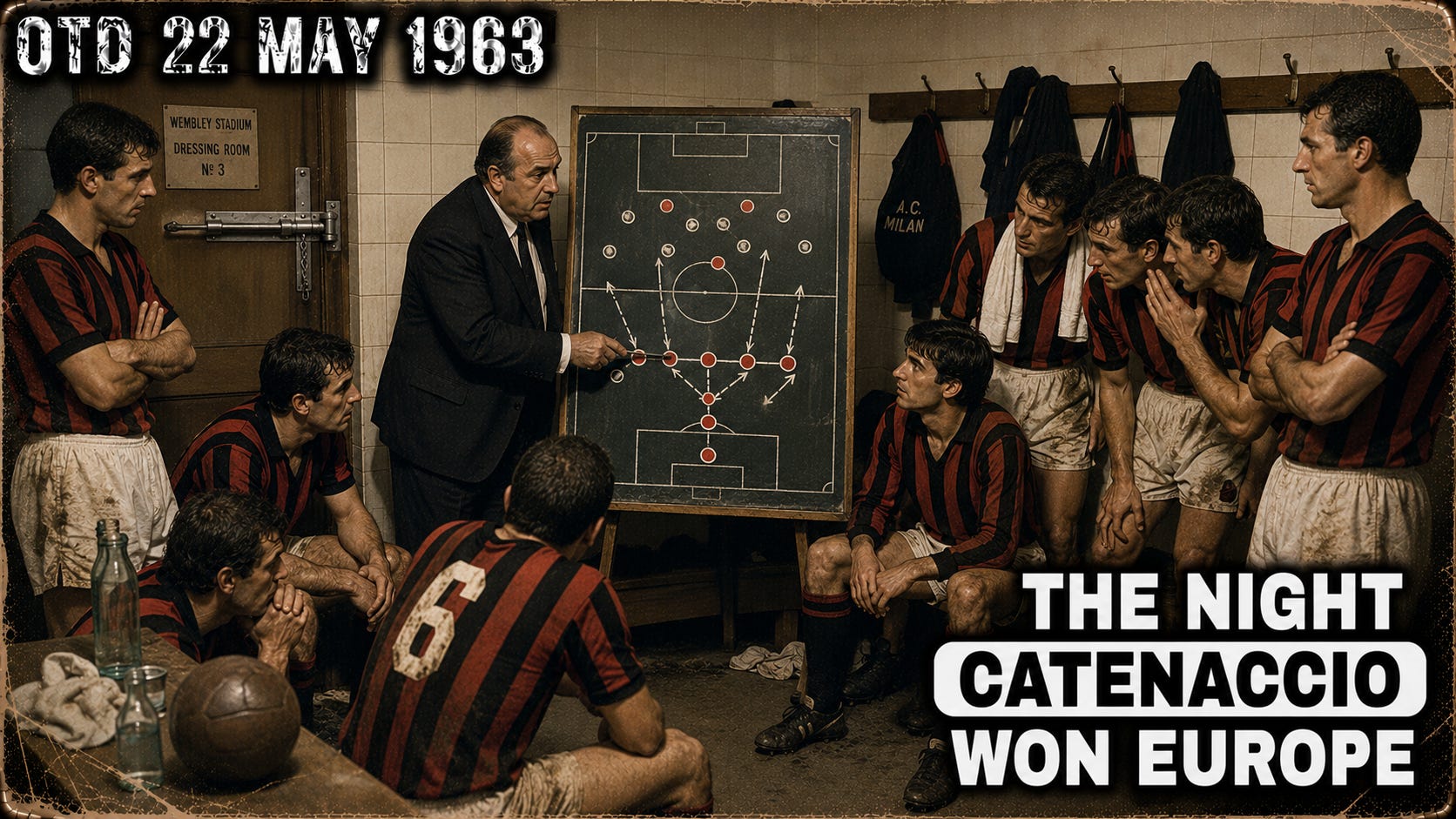
It is 22 May 1963. Wembley Stadium. AC Milan against Benfica.
The European Cup has existed for seven seasons. Real Madrid won the first five. Benfica won the next two. Now Benfica are chasing three in a row, with Eusébio, Coluna, José Augusto, Simões, Torres, and the aura of a side that had just beaten Real Madrid 5-3 in the previous year’s final.
Milan are chasing something else. A first European Cup. A first European Cup for any Italian club. And proof that the continent is changing.
Benfica score first. Milan come back. José Altafini scores twice. Milan win 2-1.
And catenaccio, the door-bolt, arrives at the summit of Europe.
In the beginning, the European Cup belonged to Real Madrid. Di Stéfano, Gento, Puskás, Kopa, Rial, Santamaría. From 1956 through 1960, Madrid won five straight, beating Eintracht Frankfurt 7-3 at Hampden in one of football’s great attacking performances. The first age of the European Cup was white shirts, royal authority, and forwards who treated space as private property.
Then Benfica broke it. In 1961 they beat Barcelona. In 1962 they beat Real Madrid 5-3 in Amsterdam — Puskás scored a hat-trick and still lost, because Eusébio and Béla Guttmann’s side came roaring back. Benfica were not just defending champions. They were trying to prove the post-Madrid era belonged to Lisbon.
Milan arrived from a different football language. They had won Serie A in 1961-62 under Nereo Rocco. And in the 1962-63 European Cup they were devastating: 14-0 over Union Luxembourg, 8-1 over Galatasaray, 5-2 over Dundee. Altafini finished the tournament with 14 goals. Gianni Rivera was a genius of timing and passing.
So let us be careful. This was not a team that could not attack.
But Rocco’s genius was not romance. It was calculation.
Catenaccio literally means door-bolt — the little chain or bolt inside a hotel-room door. It does not mean simply defending with everyone. The original idea was precise: man-mark tightly, add a spare defender — the libero or sweeper — behind the markers, close the central route to goal, then counter-attack quickly into the space the opponent has left.
Its roots go back to Karl Rappan’s Swiss verrou, another door-bolt system. In Italy, Gipo Viani at Salernitana is often credited with an early form. Rocco refined it at Triestina and Padova, where smaller clubs needed a clever way to survive against stronger opponents.
Gianni Brera called it “the right of the weak.”
But at Milan, Rocco showed that the right of the weak could become the weapon of the strong.
He made one key decision for the final: he dropped Paolo Barison and started Gino Pivatelli — not to dazzle, but to follow Mário Coluna, Benfica’s deep brain. That was the tactical hinge.
In the 19th minute, Eusébio — twenty-one years old, explosive, already one of the great players on earth — shot Benfica ahead. The old European Cup was still alive.
Then Milan survived. Maldini organized. Trapattoni worked. Rivera kept looking for the pass. In the 58th minute, Rivera released Altafini, and Milan were level.
Almost immediately came the controversial moment. Coluna broke forward, Pivatelli chased, the challenge came from behind. Coluna went down badly hurt. In a final with no substitutions, Benfica effectively lost the player who gave them control. Coluna would later insist the foul decided the game. Milan insisted it was not ordered. But it became the symbolic image of the night: Benfica’s conductor removed, and Milan’s system closing the space that used to belong to players like him.
In the 66th minute, Rivera threaded the ball through. Altafini’s first effort was saved; the rebound came back; Altafini finished. Milan 2, Benfica 1.
After that, the last act was the one Italian football would make familiar. Benfica had the ball. Milan had the shape. Eusébio kept trying, but the grand late wave never came.
Cesare Maldini lifted the cup. Italy had its first European Cup. And the tactical age had turned.
From 1956 to 1962, every winner was Real Madrid or Benfica. From 1963 to 1969, the trophy spent four of seven seasons at San Siro. The first age of the European Cup was built around attacking royalty. The second age was built around systems. Rocco. Herrera. Then Michels, Happel, Lobanovskyi, Sacchi. From here onward, the coach became part of the headline.
Inter took the next step — Herrera’s side beat Real Madrid in 1964 and Benfica in 1965, harder and leaner and more obsessive, chased by the eternal argument: genius or anti-football? Then Celtic answered in 1967 with attack, width and joy. Then Ajax and Total Football seemed to smash the door-bolt open.
But catenaccio did not disappear. It mutated. The Italian obsession with space, protection, timing and risk never left. And it taught opponents to think differently: how do you break a spare defender? How do you make space when the opponent no longer gives it to you? Total Football is partly an answer to that question. So is pressing. So is the modern false nine.
That is the deeper lesson of 1963. A system creates dominance. Then another system emerges to solve it. Rocco did not kill football’s romance. He forced romance to become more intelligent.
🎙️ The full episode (linked above) has more — including the deeper tactical lineage from Rappan to Herrera’s Grande Inter, the genius-or-anti-football debate, Celtic’s 1967 counter-myth, and how Milan themselves beat Cruyff’s emerging Ajax 4-1 in 1969. The whole arc is in the audio.
---
🎧 Also available on Apple Podcasts, Amazon Music, Overcast, iHeart, and YouTube.
📩 Got an episode idea? otd@17lawsguy.com
Yesterday: 21 May 1904 — The Founding of FIFA.
Tomorrow: 23 May 1992 — Hannover’s Impossible Cup.