

It is approaching five o’clock on September 30, 1984, and Montevideo is holding two matches at once.
At the Estadio Centenario, Peñarol are being held by Montevideo Wanderers. Across the city at the Parque Central, Central Español are level with Huracán Buceo. Central had spent the previous season in Uruguay’s second division. Their ambition for 1984 had been to stay in the top flight. Now, deep into the closing minutes, one more goal will make them champions of the country.
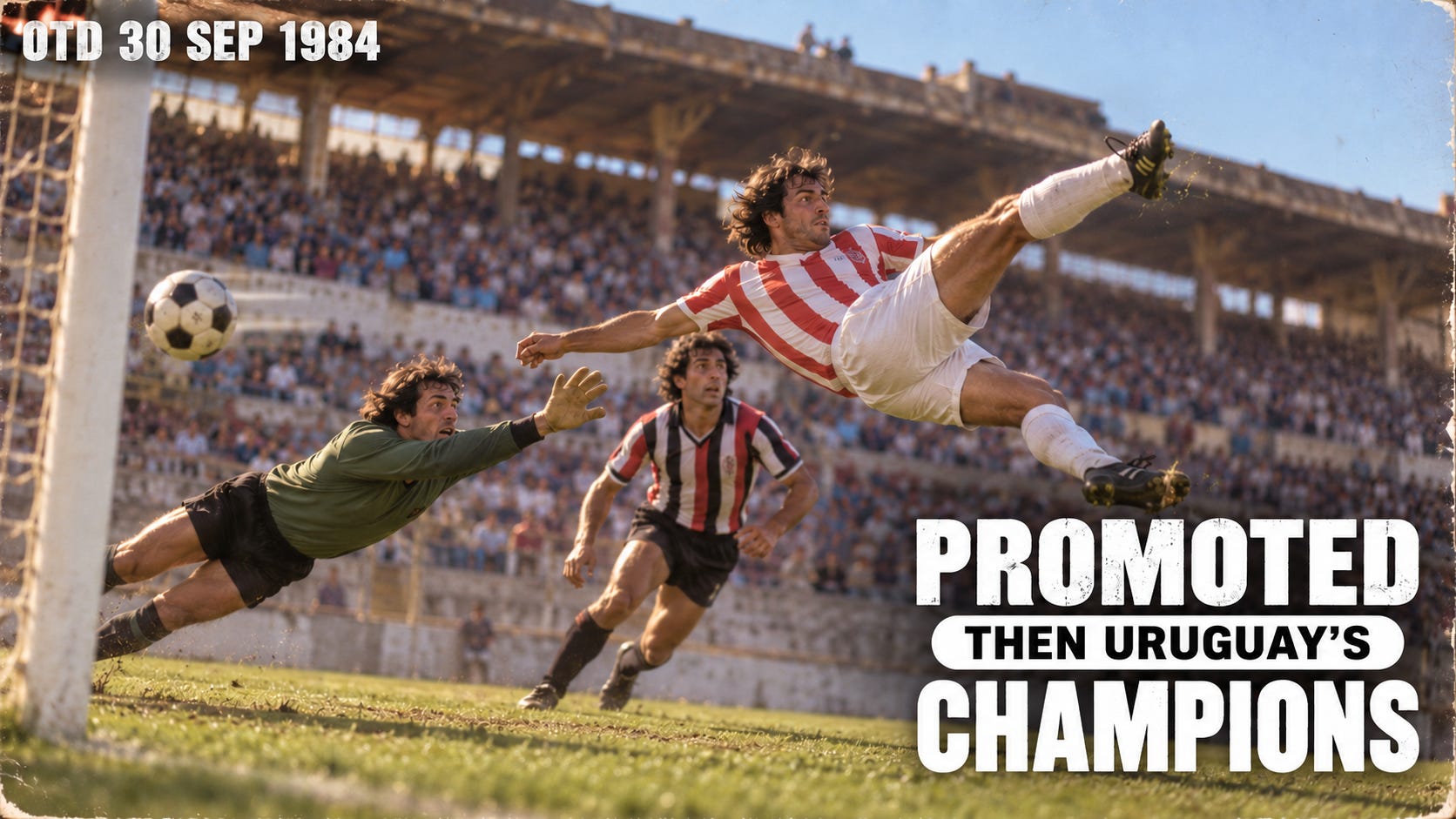
Wilfredo Antúnez, on as a substitute, sends over a measured cross. José Ignacio Villarreal launches himself into the air and meets it with a finish later remembered as both beautiful and brutal.
Central lead 2-1. At the Centenario, Peñarol cannot find a winner. Their match ends goalless.
Central Español, a club that had begun the year bracing for relegation, have finished above Peñarol and Nacional to win the Uruguayan championship in their first season back in the top division. It is a result Uruguayan football has not produced again since.
How did we get here?
Central Español’s story starts in Palermo, a Montevideo neighborhood built by dockworkers, tradespeople and the city’s Afro-Uruguayan community, and shaped by candombe, the drumming and carnival tradition carried through generations from that community. The club was founded there on January 5, 1905, through the merger of two local sides. Tradition holds that the two clubs played one match to settle the new organization’s name, and Central won it 2-0. The name itself came from the nearby Cementerio Central, the Central Cemetery. Even the colors, red, blue and white, were borrowed from the neighborhood: they belonged to Los Esclavos del Nyanza, a celebrated Black candombe comparsa whose costumes and drumming defined Palermo’s carnival.
This was a club built from the street, not from institutional weight, and Uruguayan professional football, once it arrived in 1932, was built almost entirely on institutional weight. Nacional and Peñarol shared every professional championship for forty-four straight years. In 1976, Defensor, a club with neither history’s resources, finally broke the run, guided by a coach named Ricardo De León who convinced his players that the giants were not supernatural. It stood, for years, as one remarkable exception in an otherwise closed competition.
Central, meanwhile, had spent much of its existence shuttling between divisions, including a long spell in the second tier through the 1950s. It adopted its current name in 1971 after an arrangement with Spain’s migration institute, which wanted a club representing Uruguay’s Spanish community. By 1983 Central were back in Primera B, coached by Roberto Fleitas, a meticulous young manager who would later lead Uruguay to the Copa América and Nacional to the Copa Libertadores. Fleitas built a defense that conceded only three goals in eighteen matches, one of them a penalty, and by his goalkeeper Héctor Tuja’s recollection went the entire first half of the season without conceding at all. Central won promotion by a single point.
Then Fleitas left, and Central handed the team to Líber Arispe, a member of Defensor’s history-making 1976 squad who had absorbed De León’s conviction that a smaller club could out-think a bigger one. Arispe kept Fleitas’s promoted core and added players who were cheap, hungry and mostly ignored elsewhere. Central had no money to do otherwise. A few weeks into preseason, watching training from the stands with club president Rodríguez Cavalierri, Arispe revised his own early forecast of a mid-table finish. Perhaps, he suggested, they should start thinking about a batacazo, a shock.
Nobody outside the club was thinking that way. Uruguay’s thirteen top-flight sides would play each other home and away, two points for a win, and Central were widely picked to struggle. Arispe and his fitness coach Germando Adinolfi set small, sequential targets instead: first secure survival, then reach the Liguilla, the end-of-season tournament that decided Uruguay’s Copa Libertadores places. Only once each target was within reach did the players allow themselves to look higher.
The squad had no single star beyond a defense that simply refused to concede and a forward nobody else particularly wanted. José Ignacio Villarreal had reached professional football late, in his mid-twenties, coming from Treinta y Tres by way of Huracán Buceo before joining Peñarol. At Peñarol he sat behind Fernando Morena, one of Uruguay’s great goalscorers, and when Peñarol signed another forward, Villarreal asked to leave on loan. Central took the player the champions did not need.
The nine matches that decided it
Central opened the season unremarkably, trading results as a newly promoted side finding its level. They drew with both Peñarol and Nacional, and lost a third-place playoff to Danubio at the midpoint. But the defense held, and Villarreal kept scoring. On July 28 at the Centenario, Central beat an unbeaten Peñarol 1-0. It would remain Peñarol’s only defeat in twenty-four league matches all season, and Central had delivered it themselves.
Even so, Tuja later said the team was never outright top of the table until the very end. Central simply kept collecting points while the pressure built on the two clubs above them. Their final four matches turned into a private cup run. First they beat Defensor, the club whose breakthrough eight years earlier had shown that the duopoly could be cracked. Then, at the Parque Palermo, they won a chaotic 5-4 shootout against Sud América, a strange way for the country’s tightest defense to stay alive. Next came a 1-0 win over Montevideo Wanderers, settled by a free kick from César Pereira, which drew Central level with Peñarol going into the final round.
That set up the afternoon of September 30, with Peñarol hosting Wanderers at the Centenario and Central playing Huracán Buceo not at their own small Parque Palermo but at the Parque Central, the ground belonging to Nacional. It is a ground with its own outsized place in football history: on July 13, 1930, it staged the very first match of the very first World Cup, the United States beating Belgium 3-0 in front of a modest crowd that had no idea it was watching the opening act of the sport’s grandest tournament. Fifty-four years later, on the same pitch, Central’s own unlikely coronation was about to unfold.
Villarreal put Central ahead, Huracán equalized, and for a stretch the destiny of the title hung on news arriving from across the city. Peñarol could still take it. Then Antúnez, warming up on the touchline without even knowing the score had leveled, came on and delivered the cross that Villarreal turned into the winner. Peñarol’s match finished scoreless. Central had done it.
Their final record read thirteen wins, nine draws and two defeats, 39 goals scored and only 17 conceded, the best defense in the competition. Villarreal finished as the league’s top scorer with eighteen goals. Tuja conceded the fewest of any goalkeeper. Central collected 35 points to Peñarol’s 34 and Nacional’s 32. A club that had opened the year worrying about relegation had finished above both giants of Uruguayan football.
So what?
Defensor’s title in 1976 could still, at a stretch, be filed away as one gifted club’s exceptional season. Central Español removed that excuse. This was not an institution slowly climbing toward the summit. It was a newly promoted, financially threadbare side built mostly from its own second-division squad, strengthened with players other clubs had passed over, and it had just finished above both Nacional and Peñarol combined. Arispe had carried Defensor’s belief into Central’s dressing room and proved it was transferable rather than a one-off.
What followed bore that out. Defensor won again in 1987. Danubio became champions in 1988, Progreso in 1989, Bella Vista in 1990, four straight titles that went to clubs outside the old pairing. Central had not caused all of it alone, but it turned one breakthrough into evidence that the door, once opened, would not simply swing shut again.
The players scattered outward from there. Obdulio Trasante moved to Peñarol, won further championships and the 1987 Copa Libertadores, and later played in Brazil and Colombia. Tuja followed several teammates to Defensor and became champion again in 1987. Villarreal went to Nacional in 1985, later played across Colombia and Central America, and that same year won four caps for an unbeaten Uruguay side under coach Omar Borrás, a brief taste of the national team to go with his championship medal. He eventually returned to Central not as a player but as club president, trying to keep the institution he had crowned alive for another generation. He died suddenly in January 2025, at 67, and Central Español suspended the anniversary celebrations it had planned that month in his honor.
The fairytale had one cruel twist. Winning Uruguay’s championship did not, by itself, carry Central into the following year’s Copa Libertadores; qualification ran through the separate Liguilla tournament, and Central lost the deciding playoff for the continental place to Bella Vista. The champions of Uruguay never played in South America’s premier club competition, and to this day they still have not. Central finished third domestically in 1986, but 1984 did not turn them into a permanent power. They were relegated again in 1992, drifted between divisions in the years that followed, and did not return to continental competition until a brief Copa Sudamericana appearance in 2006.
Central Español’s rise has company elsewhere, though rarely in this exact shape. Ipswich Town won England’s championship in 1962, their first season in the top flight. Nottingham Forest were promoted in third place and won the English title outright the very next year, then went on to lift two European Cups. Kaiserslautern came back up to the Bundesliga and won it in their first season back, finishing above Bayern Munich. Rosario Central managed something similar in Argentina, promoted for 1986 and champions the following season. Each of those clubs had to beat a genuine rival for the title. Central Español had to beat two clubs that, between them, had claimed all but one of the previous fifty-two professional championships on offer. That is what makes their single season stand apart even among promoted champions.
Central did not simply climb into the room where Nacional and Peñarol had always sat. They arrived straight from the floor below, walked past both of them, and made it look as though the door had never been locked at all.
Three things to take away
Central’s miracle was built in the second division, not discovered in the first. Roberto Fleitas constructed the promoted squad on a defense that barely conceded, and Líber Arispe kept that core intact, added players nobody else wanted, and carried forward the same conviction that had already carried Defensor to a title eight years before.
This was not a gift from two collapsing giants. Peñarol lost exactly once across twenty-four league matches all season, and Central were the club that beat them. Central finished the campaign with the competition’s leading scorer and its stingiest defense, won on merit rather than on anyone else’s mistake.
A single breakthrough became a pattern because Central proved it could travel. Defensor had shown the Nacional-Peñarol duopoly could be broken once. Central Español showed the lesson was repeatable, and within a decade four different clubs had done what once looked impossible.
On September 30, 1984, Central Español beat Huracán Buceo 2-1 to become champions of Uruguay in their first season back in the top flight, with José Ignacio Villarreal, the striker Peñarol had once loaned out because they did not need him, scoring both goals. Peñarol lost only the one match all year, and it was to Central. A club named for a cemetery, colored by a carnival comparsa, and built from a neighborhood rather than an institution had produced one of South American football’s most gloriously improbable seasons.
---
📩 Got an idea to an OTD story? otd@17lawsguy.com
Yesterday: 29 September 1981, Bill Shankly died at 68, the man who built the Liverpool that would define English football for a generation.