

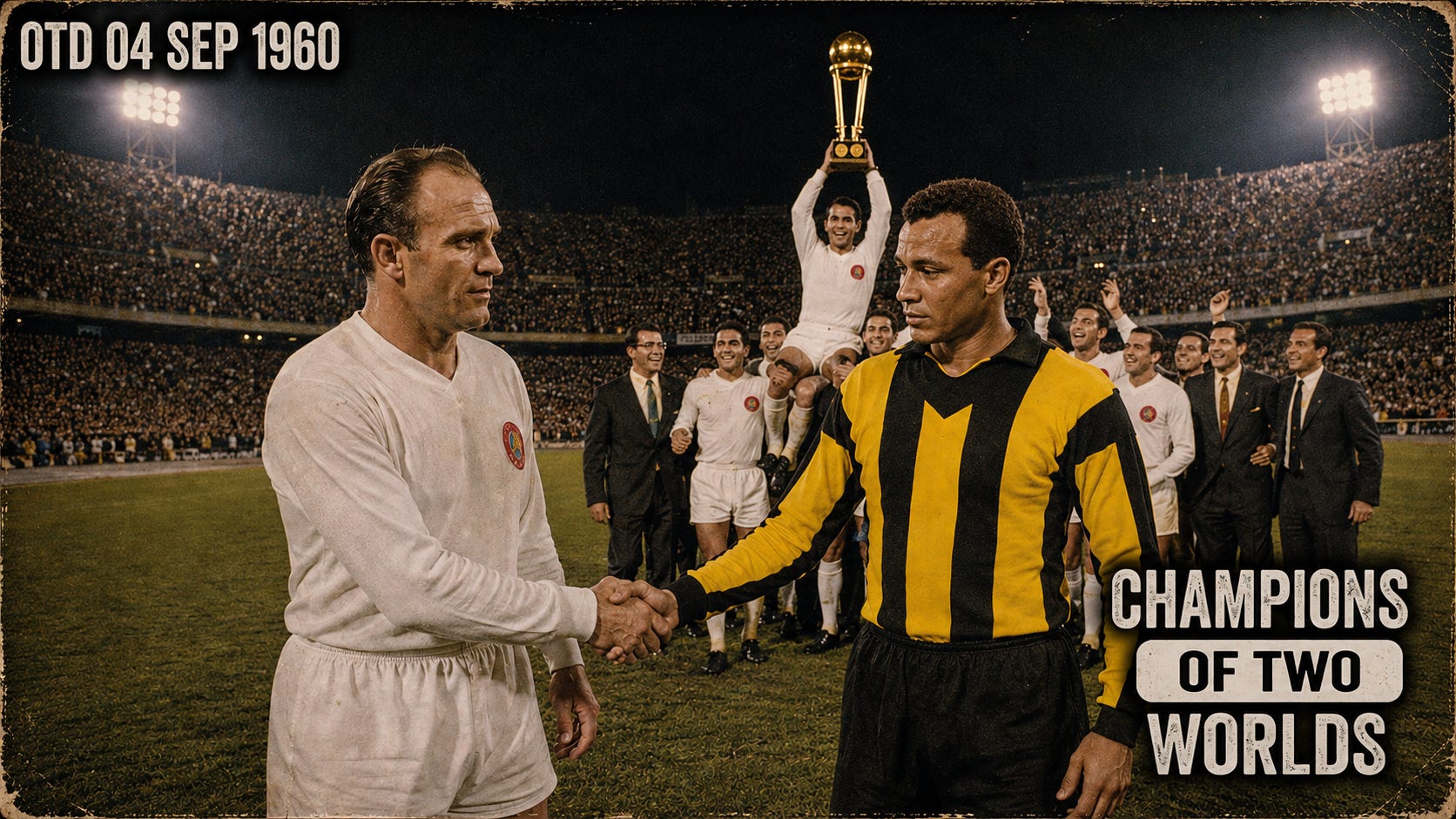
It is September 4, 1960, at the Santiago Bernabéu, and within nine minutes Real Madrid lead Peñarol 3-0. The first Intercontinental Cup is effectively decided before some of the ninety thousand spectators have found their seats. The competition existed to answer a wonderfully simple question, one football had never formally settled: who is the best club in the world? The champions of Europe against the champions of South America, over two legs, one on each continent. The first, in Montevideo, had finished goalless. Tonight, in Madrid, the question gets its first official answer.
The idea was older than the trophy. Back in 1951, the Copa Rio had gathered eight major clubs from Europe and South America in Brazil in an ambitious attempt to crown a club world champion, and Palmeiras won it. The machinery did not last, because travel and calendars and institutions were not yet ready. But the idea survived, and by the mid-1950s Europe had built its half. The European Champion Clubs’ Cup began in 1955, and Real Madrid simply took ownership of it, winning the first five editions ever played. The fifth had produced one of the greatest finals in the game’s history, a 7-3 defeat of Eintracht Frankfurt at Hampden Park, with Ferenc Puskás scoring four and Alfredo Di Stéfano three. By 1960 Real Madrid were perhaps the most glamorous institution in football, and their team was already a global one: the Argentine-born Di Stéfano, the Hungarian Puskás, the Uruguayan José Santamaría, Paco Gento of Spain, the Brazilian Canário.
Peñarol were no exotic challengers arriving to be measured. They were one half of Uruguay’s great institutional divide with Nacional, an enormous club in the middle of another golden period, and their side was international too, captained by Néstor Gonçalves and containing the Ecuadorian Alberto Spencer, who would become the greatest goalscorer in the history of the Copa Libertadores. That competition, South America’s answer to the European Cup, had only just been born in 1960, and Peñarol had become its first champion. Two continents now each had an official champion, and the temptation to put them together was irresistible. Administrators on both sides, among them the Brazilian José Ramos de Freitas and, in Europe, Pierre Delaunay, the son of one of UEFA’s founding visionaries, helped shape the idea.
The first leg in Montevideo, before more than seventy thousand at the Centenario, ended goalless, Real unable to break Peñarol down. So everything moved to Madrid two months later, refereed by the Englishman Ken Aston, the same official whose later frustration with match communication would help inspire red and yellow cards. Then Real Madrid exploded. Puskás scored in the third minute, Di Stéfano in the fourth, Puskás again in the ninth. Chus Herrera made it four before the break, Gento a fifth early in the second half, and Spencer, of course, pulled one back. Real Madrid 5, Peñarol 1, and the champions of Europe were the first Intercontinental champions.
The competition mattered because it gave the two strongest club ecosystems of the era a direct argument, not between national teams but between clubs, and for decades the answer genuinely mattered. Peñarol won it the next year, and again in 1966, beating Real Madrid; Santos won it twice with Pelé; Internazionale, Estudiantes, Nacional, Boca Juniors and others followed. But the story also turned ugly. The 1967 meeting of Racing and Celtic became the Battle of Montevideo, with six dismissals, fighting and police on the pitch, and Jock Stein left doubting the whole enterprise was worth playing. The 1969 series between Estudiantes and Milan was worse still. Through the 1970s several European champions simply refused to take part, and some editions were not played at all.
The rescue came in 1980, when the competition became a single neutral match in Japan, soon sponsored by Toyota, with Europe flying east and South America west for one night and a world title. That format stabilized things for a quarter of a century, until FIFA launched its own Club World Championship in 2000. The old Intercontinental Cup ran until 2004, FIFA’s competition became the global successor from 2005, and in 2017 FIFA formally recognized the old winners as world club champions of their era, much as Uruguay are recognized as world champions for their 1924 and 1928 Olympic golds. The little two-club idea has since mutated into something enormous: a revived FIFA Intercontinental Cup from 2024 involving all six confederations, and a 32-team Club World Cup in 2025.
Did any of this create football’s transatlantic traffic? Not really. Di Stéfano had already crossed from Argentina to Colombia to Spain, Santamaría from Nacional to Real Madrid, Spencer from Ecuador to Peñarol. Players and ideas were moving across the ocean long before 1960. What the Intercontinental Cup did was make the comparison regular, letting each football world see itself against the other. It was an accelerant of globalization, not its beginning. And in 1960, before European wealth had tilted the balance, these were genuinely two football worlds meeting as equals. That may be the most important thing about the night.
---
🎧 Listen on Spotify, Apple Podcasts, Amazon Music, Overcast, iHeart, and YouTube.
📩 Got an episode idea? otd@17lawsguy.com
Yesterday: 3 September 1989, a flare, a bleeding goalkeeper, and El Maracanazo.
Tomorrow: 5 September 1931, an Old Firm collision that cost Scotland its Prince of Goalkeepers.