

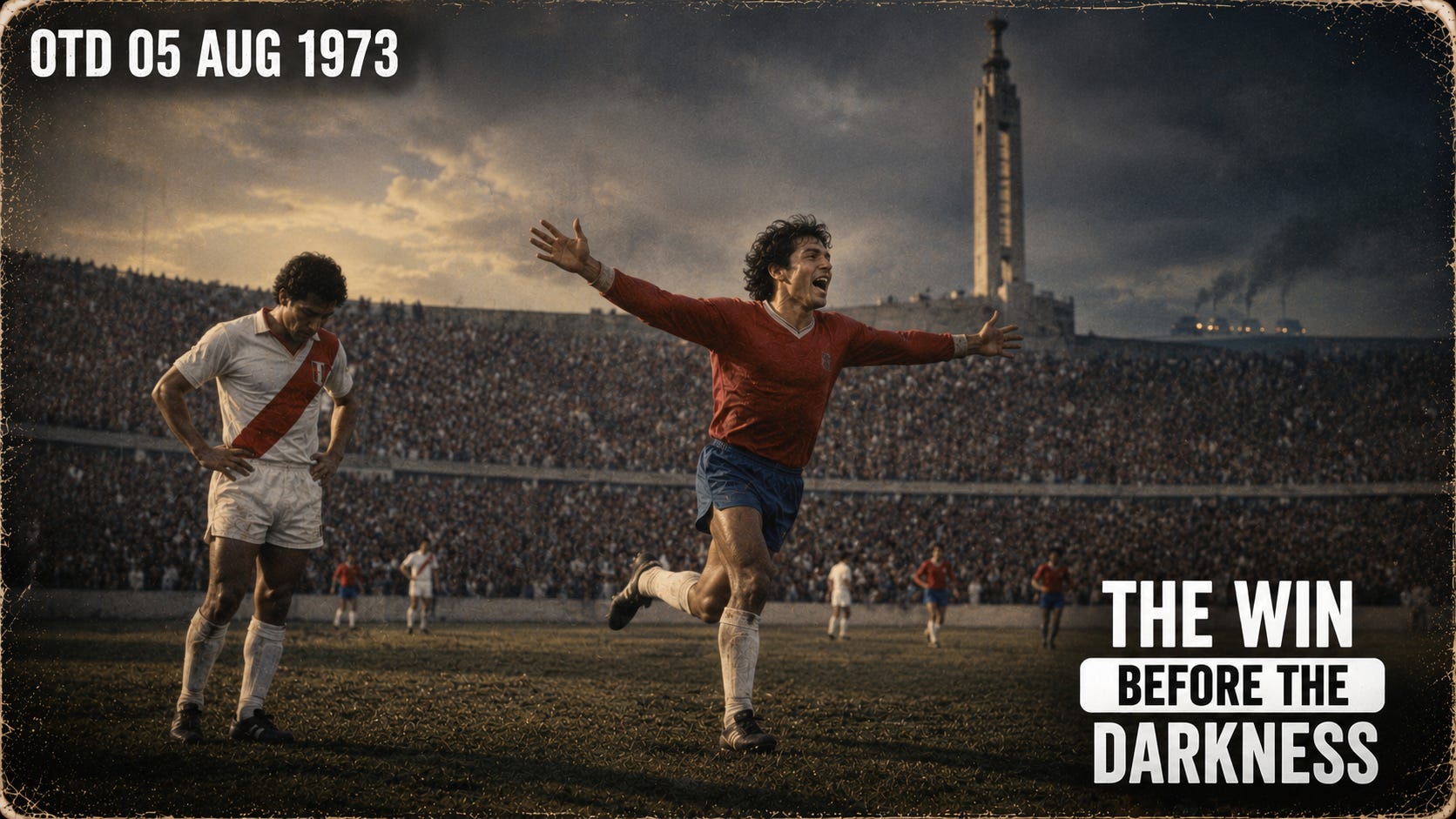
It is August 5, 1973. Montevideo. Estadio Centenario. Chile against Peru, a World Cup qualifying playoff, the winner bound for an intercontinental playoff against the Soviet Union. Peru score first. Chile equalize before half-time. Then Rogelio Farías scores. Chile 2, Peru 1. Chile survive. But this is not just a football playoff. It is a match played while Chile is moving toward a coup, a dictatorship, and one of the strangest World Cup qualifiers ever staged.
Chilean football is old and serious, competitive without being Brazil, Argentina, or Uruguay, until 1962, when a country still shaken by the 1960 Valdivia earthquake hosted the World Cup and finished third. By the early 1970s there was another strong generation. Colo-Colo reached the 1973 Libertadores final and fed the national side: Carlos Caszely, Chamaco Valdés, Leonardo Véliz, and above them the coach Luis Álamos. So Chile’s campaign was tied to one of the country’s great club stories.
It was also tied to its politics. Salvador Allende had been president since 1970, and Chile was polarized: economic crisis, strikes, Cold War pressure. Some players were politically visible. Véliz was openly left-wing. Caszely was associated with the Allende side of public life. Football could not float above the country’s tension.
For the 1974 World Cup, Chile were drawn with Peru and Venezuela, then Venezuela withdrew, so the group became brutally simple. Peru won 2-0 in Lima. Chile won 2-0 in Santiago. Two home wins, identical, so they needed a neutral playoff in Montevideo. And between those matches Chile nearly broke: on June 29, 1973, the Tanquetazo, a failed tank-led coup attempt, warned that the state was cracking. Chile’s footballers prepared for Peru while their country prepared for something darker.
On the day, nearly 58,000 came to the Centenario. Peru were no soft opponent, only three years removed from the 1970 World Cup quarter-finals. In the forty-second minute Héctor Bailetti put Peru ahead, and if it stayed there Chile were out. But right before half-time Valdés equalized, and that goal changed the dressing room. In the fifty-seventh minute Farías scored. Chile 2, Peru 1. Chile held, and at the final whistle they had eliminated Peru and reached the playoff. They already knew the opponent: the Soviet Union.
The win in Montevideo is a hinge between two worlds. Before August 5, the story is football. After, it becomes football under terror. On September 11, 1973, the coup came. Allende died in La Moneda. Pinochet and the military junta took power. The National Stadium in Santiago was turned into a detention, interrogation, and execution site, and the national team was caught inside that new reality. Players were called up for the Soviet playoff while the country was under military control. Some feared for themselves, some for their families. Caszely carried his own political shadow; his mother would later be detained and tortured by the regime, and he would refuse to shake Pinochet’s hand before the 1974 World Cup. These were not abstract politics. They were inside the players’ homes.
The Soviet playoff became impossible to separate from the coup. The first leg, in Moscow on September 26, two weeks after the coup, ended 0-0, a brilliant result. But the second leg was scheduled for the Estadio Nacional, the same stadium the regime was using as a detention center. The Soviet Union refused to play there. FIFA sent inspectors, the authorities showed them what they wanted seen, and when the Soviets demanded a neutral venue, FIFA refused. On November 21, Chile kicked off without opponents, passed the ball into an empty net, and were awarded a 2-0 win. That ghost match deserves its own full telling, and it will get one. Chile reached the 1974 World Cup and went out in the first round, and the National Stadium now carries two memories that can never be cleanly separated: goals and torture, crowds and prisoners, football and state violence.
🎙️ THE PODCAST GOES DEEPER. The full episode has the Tanquetazo, the Moscow 0-0 two weeks after the coup, and the empty-net ghost match at the Estadio Nacional. That’s the 10-minute version.
---
🎧 Listen on Spotify, Apple Podcasts, Amazon Music, Overcast, iHeart, and YouTube.
📩 Got an episode idea? otd@17lawsguy.com
Yesterday: 4 August 1905, Billy Meredith and the bribe.
Tomorrow: 6 August 1936, Josep Sunyol, FC Barcelona’s president, assassinated during the Spanish Civil War.