

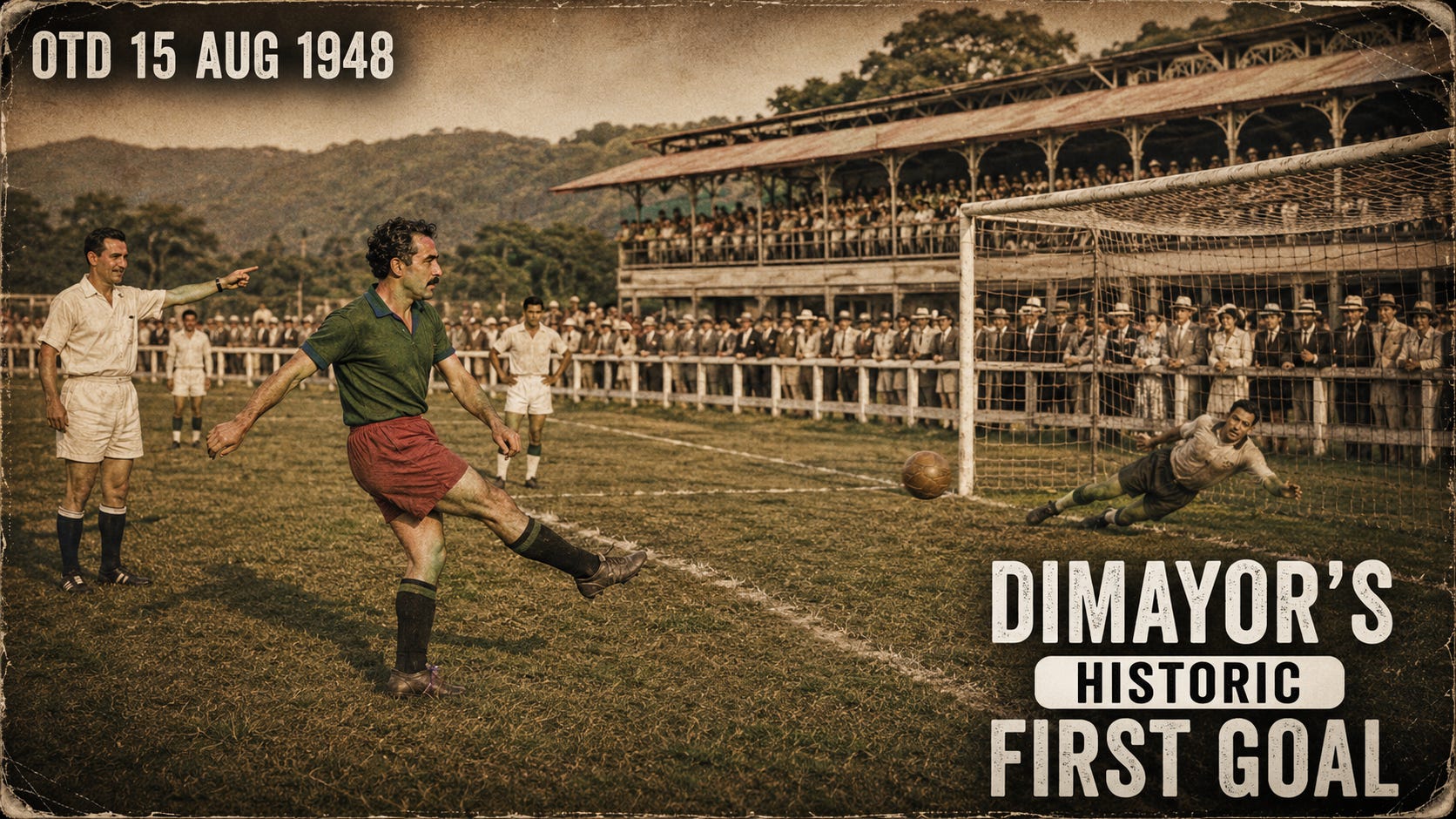
It is August 15, 1948, two days after Sweden won Olympic gold in London. This morning we are outside Medellin, in Colombia, at the San Fernando racetrack. Atletico Municipal against Universidad. Fifteen minutes in, Rafael Serna scores a penalty. Carlos Rodriguez adds another. Atletico Municipal win 2-0. And Serna’s goal is much bigger than the opening goal of a match. It is the first goal ever scored in Colombia’s professional football league. Today is Fecha 1. Ten clubs. A new national championship. And the beginning of an institution that will give Colombia Santa Fe, Millonarios, Atletico Nacional, then El Dorado, Di Stefano, and some of the most extraordinary football history anywhere in the world.
But how did we get here? Colombia had played football for decades, but the game developed regionally. The first major structure grew on the Caribbean coast, the Liga del Atlantico was founded in 1924, and Colombia entered FIFA in 1936. Yet one question kept dividing the game: who actually controlled Colombian football? Barranquilla? Bogota? Medellin? Cali? By 1939 there was already a battle over whether the federation should stay in Barranquilla or move to Medellin. This was not one integrated football country, but a collection of ambitious regional cultures arguing about who ran the game.
Underneath that argument, another revolution was coming: money. Clubs wanted professionalism, players wanted to be paid, and foreign touring teams showed what football could become as entertainment. In January 1948, Bogota staged an international tournament with River Plate and Velez Sarsfield, and one Velez match reportedly drew around twelve thousand paying spectators. The message was obvious: there was a market here.
Then Colombia itself exploded. On April 9, 1948, the Liberal political leader Jorge Eliecer Gaitan was assassinated in Bogota. The Bogotazo followed. Rioting devastated large parts of the capital, and Colombia entered the terrible period remembered as La Violencia, years of partisan bloodshed. The professional league was not created because of the assassination; the idea already existed. But a national mass spectacle suddenly looked useful in a country desperately short of shared experiences. In late June, representatives of ambitious clubs gathered in Barranquilla and created the Division Mayor del Futbol Colombiano. Dimayor. Notice the geography: Alfonso Senior came from Bogota, Humberto Salcedo from Cali, Jorge Osorio Cadavid from Medellin. This was not simply Bogota taking football from everyone else. It was professional clubs from Colombia’s major cities challenging an older regional structure. But Bogota did win something: Dimayor set its headquarters there.
Now they needed an actual national league, which was not trivial in a country divided by mountains and enormous distances. Avianca reportedly gave the clubs a large reduction on air fares, so professional football in Colombia would literally have to fly. Ten teams entered, among them Santa Fe and Millonarios from Bogota, America and Deportivo Cali, Junior from Barranquilla, and Universidad, a Bogota club that played its early home matches in Pereira. And now the match. Atletico Municipal, the club we know today as Atletico Nacional, played Universidad at the San Fernando racetrack. Serna scored that first professional goal from the spot, and Carlos Rodriguez made it 2-0. Across the country, Fecha 1 came alive: Millonarios destroyed Once Deportivo 6-0, and the first champion would be Santa Fe.
And 1948 built the machine that made 1949 possible, because one year later everything went crazy. Dimayor operated outside the normal FIFA transfer structure, and that created an extraordinary opportunity. Adolfo Pedernera came. Then Nestor Rossi. Then Alfredo Di Stefano. Millonarios became the Ballet Azul, and other clubs raided Argentina, Uruguay, Peru, and beyond. El Dorado, the great gold rush, could not happen until Dimayor existed. August 15, 1948 built the marketplace, and 1949 blew the doors off it. Eventually the international system closed the loophole, the imported stars left, and Colombian football had to discover what survived when the circus moved on. And it kept living inside the country around it: through La Violencia, through El Dorado, through the later narco era, through the great national team of the 1990s, and through the Copa America triumph of 2001. Colombian football has never existed outside Colombian history. Some things change. Some relationships endure.
🎙️ THE PODCAST GOES DEEPER. The full episode has the Barranquilla-Bogota-Medellin-Cali power struggle, the Bogotazo backdrop, Santa Fe’s first title, and the road to El Dorado. That’s the 10-minute version.
---
🎧 Listen on Spotify, Apple Podcasts, Amazon Music, Overcast, iHeart, and YouTube.
📩 Got an episode idea? otd@17lawsguy.com
Yesterday: 14 August 1965, two Bundesliga harbingers.
Tomorrow: 16 August 1936, a tackle in Buenos Aires that ends in a police station.