

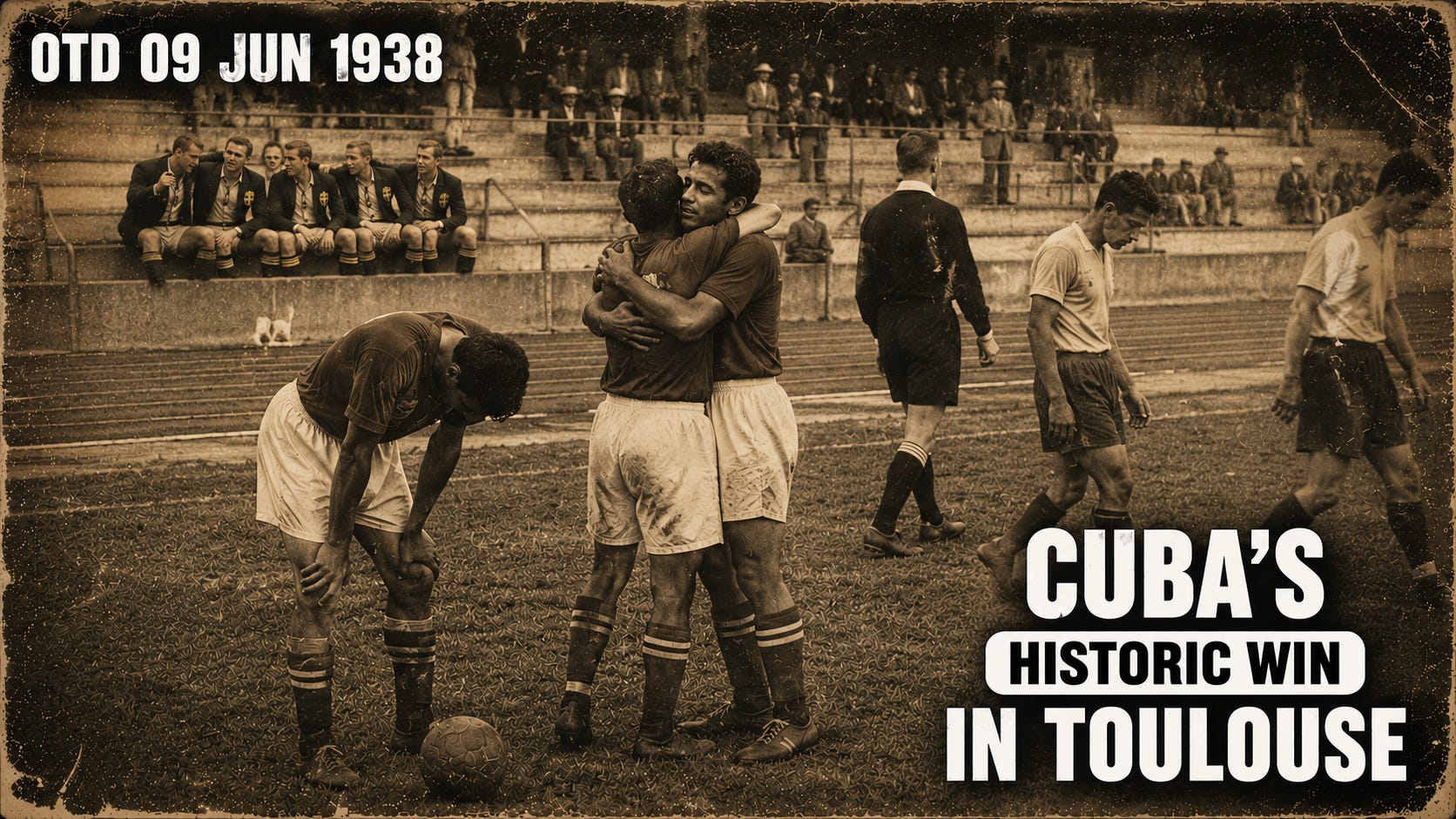
It is 9 June 1938, in Toulouse. Cuba against Romania, a World Cup replay. And yes, you read that correctly: Cuba, at the World Cup, in 1938 — not watching, not dreaming, but playing. And today, winning. Cuba 2, Romania 1.
It is still Cuba’s only ever win at the World Cup finals. It is also one of those early World Cup stories that feels almost impossible from the modern distance: ships, withdrawals, replayed matches, Caribbean football and pre-war Europe, and a Cuban team that reached the quarterfinals before almost anyone had learned to imagine the Caribbean on that stage.
How did we get here? Start with Cuba before Castro — not the Cuba most listeners instinctively picture. The Cuba of 1938 is a republic shaped by sugar, U.S. influence, political turbulence, Spanish inheritance, Afro-Cuban culture, a baseball obsession, and a Havana already among the most vivid cities in the Americas. The country had passed through the Machado dictatorship, the upheaval of 1933, and the rise of Fulgencio Batista as the strongman behind the system — not yet the elected president of 1940, not yet the dictator Castro would overthrow in 1959.
Baseball was king. But football had roots too, especially through Spanish clubs and immigrant communities in Havana — names like Centro Gallego, Juventud Asturiana, Iberia, Hispano América and Fortuna, which tell you this was Cuban football carrying Spanish, Galician and Asturian identities. The Asociación de Fútbol de Cuba was founded in 1924; Cuba joined FIFA in 1932. At the 1930 Central American and Caribbean Games in Havana they beat Jamaica 3-1 and Honduras 7-0 under coach José Tapia, who remained central through 1938. They tried to reach the 1934 World Cup, beating Haiti over three matches before losing to Mexico. So by 1938 Cuba weren’t a superpower — but they weren’t imaginary either.
Then came the chaos of 1938 qualification. FIFA gave the tournament to France, and much of the Americas — expecting it to return across the Atlantic — withdrew or stayed out. Cuba’s path became, in effect, a walkover. That sounds like a joke; it isn’t, quite. It’s an artifact of how fragile world football still was: travel was expensive, Europe was tense, the Spanish Civil War was raging, Austria qualified and then vanished into Nazi Germany after the Anschluss, and the Dutch East Indies (today Indonesia) reached the finals largely through withdrawals too. The 1938 World Cup wasn’t the polished global machine we know — it was a brilliant, unstable, pre-war tournament held together by steamship routes, telegrams, improvisation, and Jules Rimet’s stubborn belief that it had to survive.
Cuba arrived in France to face Romania — no novelty, veterans of 1930 and 1934, expected to advance. The first match, 5 June in Toulouse, was a classic: Romania led through Bindea; Socorro equalized; Magriñá put Cuba ahead; Romania levelled late through Barátky; in extra time Socorro scored again, and Cuba were minutes from a famous win — until Dobay made it 3-3. No shootouts in 1938. So, a replay.
Four days later, same city, same tie. Romania led again through Dobay. And the question was whether Cuba’s moment had passed. It hadn’t. Early in the second half Héctor Socorro equalized, then Tomás Fernández scored — two goals in quick succession. Cuba led 2-1, and held on. The first Caribbean nation ever to play at a World Cup had won a match at a World Cup.
The reward was brutal. Three days later came Sweden in the quarter-final — rested, because Austria had withdrawn after the Anschluss and handed them a walkover, while Cuba had played 210 minutes against Romania in four days. Sweden won 8-0 in Antibes. The adventure ended heavily. But it didn’t erase Toulouse: Cuba finished the 1938 World Cup as quarterfinalists. Partly a trick of format, yes — but you play the tournament in front of you, and Cuba drew Romania, replayed Romania, beat Romania, and entered the last eight. That is forever.
The players deserve their names: José Tapia the coach; Héctor Socorro, scorer in both matches; José Magriñá; Tomás Fernández, scorer of the winner; Juan Tuñas, ‘Romperredes’ — the Net-Breaker — who later played in Mexico and became the last surviving member of the 1938 squad; goalkeepers Carvajales and Ayra; captain Pedro Bergés, and the rest of a team that carried Cuban football somewhere it has never returned.
Because that’s the melancholy. Cuba’s World Cup story since 1938 isn’t an arc of expansion; it’s an arc of absence. They didn’t return in 1950 or build on the run. After 1959, Cuban sport became globally formidable — in baseball, boxing, athletics, volleyball, Olympic disciplines — but football never became the national obsession. Cuba helped found CONCACAF in 1961; there were Gold Cup quarterfinals in 2003, 2013 and 2015 and a 2012 Caribbean Cup title — but the World Cup never came back. And modern Cuban football carries another layer: for decades, players abroad with national teams have sometimes defected, seeking careers or lives beyond Cuba’s limits, so the team manages not just tactics but a divided national experience.
Which makes the geography almost surreal. Ninety miles away, South Florida now has Inter Miami, Messi-era glamour, global investors and packed stadiums. Across the water sits Cuba — the first Caribbean World Cup team, a country with real football history, but still wrestling with resources, player retention, and the pull of baseball and migration. It isn’t that Cuba has no football. It’s that Cuba’s football feels like a history interrupted — which places it among the small, half-forgotten nations of the early World Cups: the Dutch East Indies in 1938, Egypt in 1934, Haiti in 1974, teams that arrived once, left a mark, and became footnotes unless someone chooses to recover them.
That’s why 9 June 1938 matters — to recover Cuba, not as a curiosity, but as a reminder that world football was never as neat as its official posters suggest. Cuba did something no Cuban team has done since. They won at the World Cup.
🎙️ THE PODCAST GOES DEEPER. The full episode has what this post compresses: pre-Castro Cuba in more detail; the Havana club scene; the full 1938 qualification chaos; the first match and replay beat by beat; the squad and José Tapia; and Cuba’s long post-1938 arc through CONCACAF, the 2012 Caribbean Cup and the defection era. That’s the 10-minute version.
---
🎧 Listen on Spotify, Apple Podcasts, Amazon Music, Overcast, iHeart, and YouTube.
📩 Got an episode idea? otd@17lawsguy.com
Yesterday: 8 June 1969 — The Qualifier Before the Football War.
Tomorrow: 10 June 1978 — final-day drama in Group 1, and the host nation forced out of Buenos Aires.