

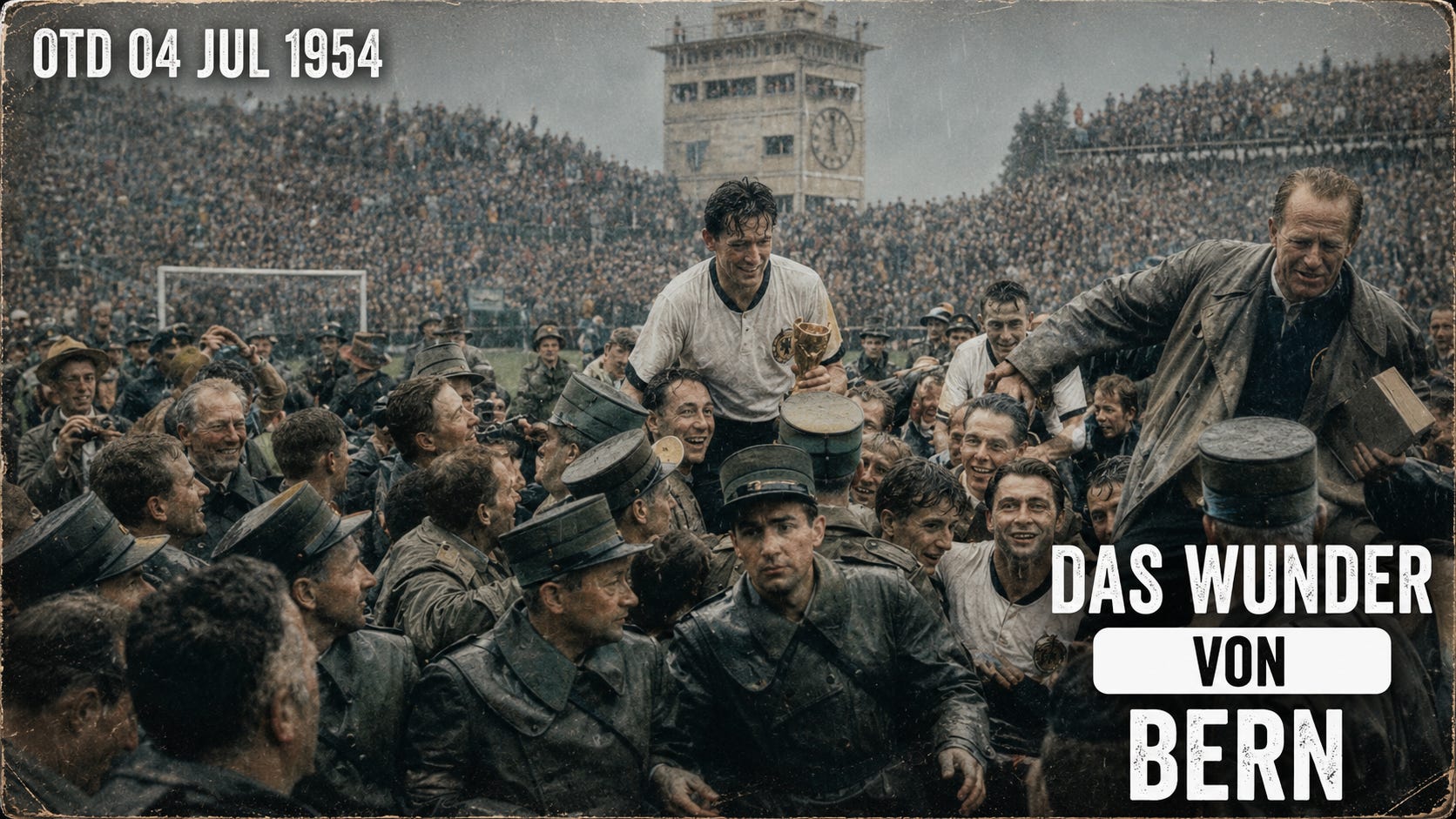
It is 4 July 1954, at the Wankdorf Stadium in Bern, in the rain. The World Cup final, West Germany against Hungary. It is not supposed to be a contest. Hungary are the Magical Magyars, unbeaten in years, Olympic champions, the team that dismantled England 6-3 at Wembley and had already beaten West Germany 8-3 in this same tournament. After eight minutes, they lead 2-0. And then, somehow, they lose. West Germany 3, Hungary 2. Das Wunder von Bern, the Miracle of Bern.
To understand why it stunned the world, start with the two teams’ places in it. West Germany were less than a decade removed from the war, a country still rebuilding, only readmitted to FIFA in 1950, its football played in regional leagues under a methodical coach, Sepp Herberger, whose plain sayings hid deep football sense. Hungary were the future arriving early: Puskás, Kocsis, Hidegkuti, a state-built side of movement and intelligence that felt less like favorites than like an inevitability.
Their group meeting had already produced an 8-3 Hungarian win, but it carried a hidden cost. Puskás was hurt in that match, and would play the final short of full fitness. Herberger, meanwhile, had half-accepted the group defeat, rotating his side and learning, and then taken the easier route to the final while Hungary ground through Brazil and Uruguay, two exhausting four-two battles.
The final began as everyone feared. Puskás scored, then Czibor, and after eight minutes it was 2-0, the confirmation of everything Hungary were supposed to be. Then West Germany refused it. Morlock turned one in on ten minutes, Rahn bundled in an equalizer on eighteen, and suddenly the favorites were no longer demonstrating superiority but trying to rescue it. Hungary hit the post and the bar, Grosics was beaten, Turek in the German goal saved everything he reached, and the balance of the match quietly turned.
The conditions helped. The rain fell hard, the pitch grew heavy, and this was what Germans came to call Fritz Walter weather, cool and wet, the ground slowing in ways that suited West Germany more than Hungary. There was even an edge in equipment: a man named Adi Dassler was with the German camp, and their boots had screw-in studs better suited to the mud. A boot is not a magic wand, but on that day it was part of the story, and the company it belonged to, Adidas, was bound to this match forever after.
Six minutes from time, Rahn collected a half-cleared ball on the left, shaped, and struck low with his left foot. West Germany led 3-2. On German radio the commentary broke into pure disbelief, a call that an entire nation would remember for generations. Hungary had the ball in the net late through Puskás, but the flag went up for offside, a decision they dispute to this day. Then the final whistle, and a football order was overturned.
For West Germany, less than ten years after the war, it became far more than a football result, a moment a rebuilding country would point to as a beginning. For Hungary, it was the one match their great team could not afford to lose, and within two years, after the events of 1956, that team was scattered forever.
🎙️ THE PODCAST GOES DEEPER. The full episode has: West German football’s post-war rebuild and Herberger’s methods, the Magical Magyars story, the 8-3 group match, both sides’ roads to the final, the goal-by-goal and the disputed late offside, the role of the weather and the boots, and how the miracle shaped German football and identity. That is the 10-minute version.
---
🎧 Listen on Spotify, Apple Podcasts, Amazon Music, Overcast, iHeart, and YouTube.
📩 Got an episode idea? otd@17lawsguy.com
Yesterday: 3 July 2018, England Finally Wins a Shootout.
Tomorrow: 5 July 1982, Paolo Rossi 3, Brazil 2.