

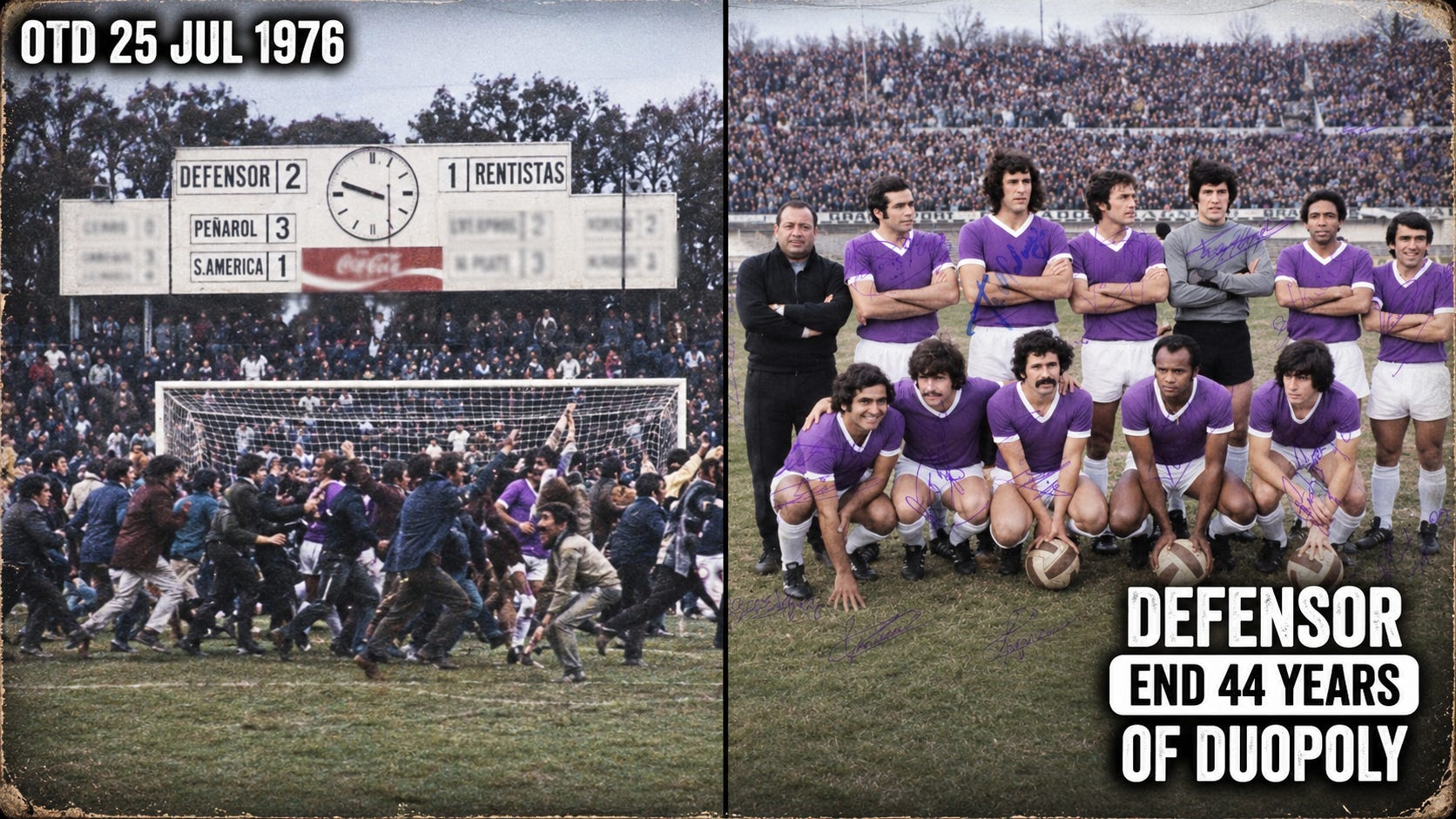
It is July 25, 1976. Montevideo. Estadio Luis Franzini, a freezing afternoon, thirteen thousand people. Defensor against Rentistas. Defensor win 2-1. And for the first time in the history of Uruguayan professional football, the champion is not Peñarol and not Nacional.
To understand the size of that, you have to understand the wall. Uruguay is one of the most successful football cultures on earth: Olympic gold in 1924 and 1928, the first World Cup in 1930, the Maracanazo in 1950. But domestically the game narrowed to two clubs. From the beginning of professionalism in 1932 through 1975, every single champion was Peñarol or Nacional. Forty-four years. The press had a phrase ready for what happened in 1976: por primera vez un chico. For the first time, a small club.
Defensor are from Punta Carretas. Violet shirts. Not small in pride or history, but in the gravitational field of Uruguayan football they are not supposed to win anything.
Then comes José Ricardo De León. El Profe. He is not picking eleven players, he is building a method: hard work, structure, fitness, collective discipline, modern ideas. Players called him a natural leader and a tactical guide. Critics called his football result-first. In 1976 the argument settles itself, because Defensor win.
This is also Uruguay in the mid-1970s, under military dictatorship. Surveillance. Fear. Politics everywhere, including inside football, however much people pretend otherwise. Defensor are sometimes called el equipo rojo, the red team, and in that context red is not only a description of a football color. Some players are viewed with suspicion by the authorities. Even a league table can carry a social argument.
The campaign begins exactly as history expects. Fecha 1, at the Centenario: Defensor 0, Peñarol 3. The big club wins, the small club is reminded of its place, and Defensor accounts of that day describe expulsions, a penalty, and the old feeling that the system leans toward the big shirt.
They do not collapse. They beat Wanderers, Cerro, Huracán Buceo, River Plate, Danubio. They draw with Nacional. They drop points to Sud América, Liverpool, Fénix, and keep collecting anyway. At halfway, Defensor and Peñarol are level on fifteen points.
Then the hinge. Fecha 12, back at the Centenario, more than forty thousand people, and this time it is not a curiosity, it is a title match. Rudy Rodríguez scores early in the second half. Fernando Morena equalizes from a penalty that Defensor accounts still dispute. Juan Alberto Schiaffino, Peñarol’s coach and one of the heroes of 1950, is sent to the stands and refuses to go for more than five minutes. Then Rodolfo Rodríguez, Pichu, comes off the bench, and three minutes later Luis Cubilla rolls him a short free kick. Pichu hits what the old report calls a balazo. A bullet. Defensor 2, Peñarol 1.
Nothing is settled. They still lose to Nacional. They still draw with Danubio. In the penultimate round at Capurro they have to beat a Fénix side fighting relegation, and they win 3-2. So Defensor arrive at the final day one point clear, knowing Peñarol are playing Sud América and that history is perfectly capable of correcting itself.
Fifth minute at the Franzini: Alberto Santelli scores. Rentistas equalize, and the anxiety comes flooding back, because everyone in the stadium knows Peñarol are winning elsewhere. Then Luis Cubilla, the veteran, a man who had already played for Peñarol, Nacional, and Barcelona, scores in violet. Defensor 2, Rentistas 1. Final whistle. Champions by one point.
And Defensor take their lap of honor backwards. La vuelta olímpica al revés. A rebellion even in the direction of the celebration.
The dam did not burst. Peñarol and Nacional reasserted themselves immediately and still dominate. But after 1976 the impossible had evidence: Central Español in 1984, Defensor again in 1987, Danubio in 1988, Progreso in 1989, Bella Vista in 1990, Liverpool of Montevideo as recently as 2023. And De León’s squad scattered into coaching across the continent. One player remembered him holding up the Peñarol stripes, the Nacional crest, and the violet shirt, and asking what the difference was.
None.
🎙️ THE PODCAST GOES DEEPER. The full episode has the 2-1 over Peñarol at the Centenario, the dictatorship-era el equipo rojo context, and Defensor’s 1977 Libertadores debut. That’s the 10-minute version.
---
🎧 Listen on Spotify, Apple Podcasts, Amazon Music, Overcast, iHeart, and YouTube.
📩 Got an episode idea? otd@17lawsguy.com
Yesterday: 24 July 2000, Luís Figo’s impossible move to Real Madrid.
Tomorrow: 26 July 1979, Bolivia beat Brazil in La Paz, eight days after beating the world champions.