

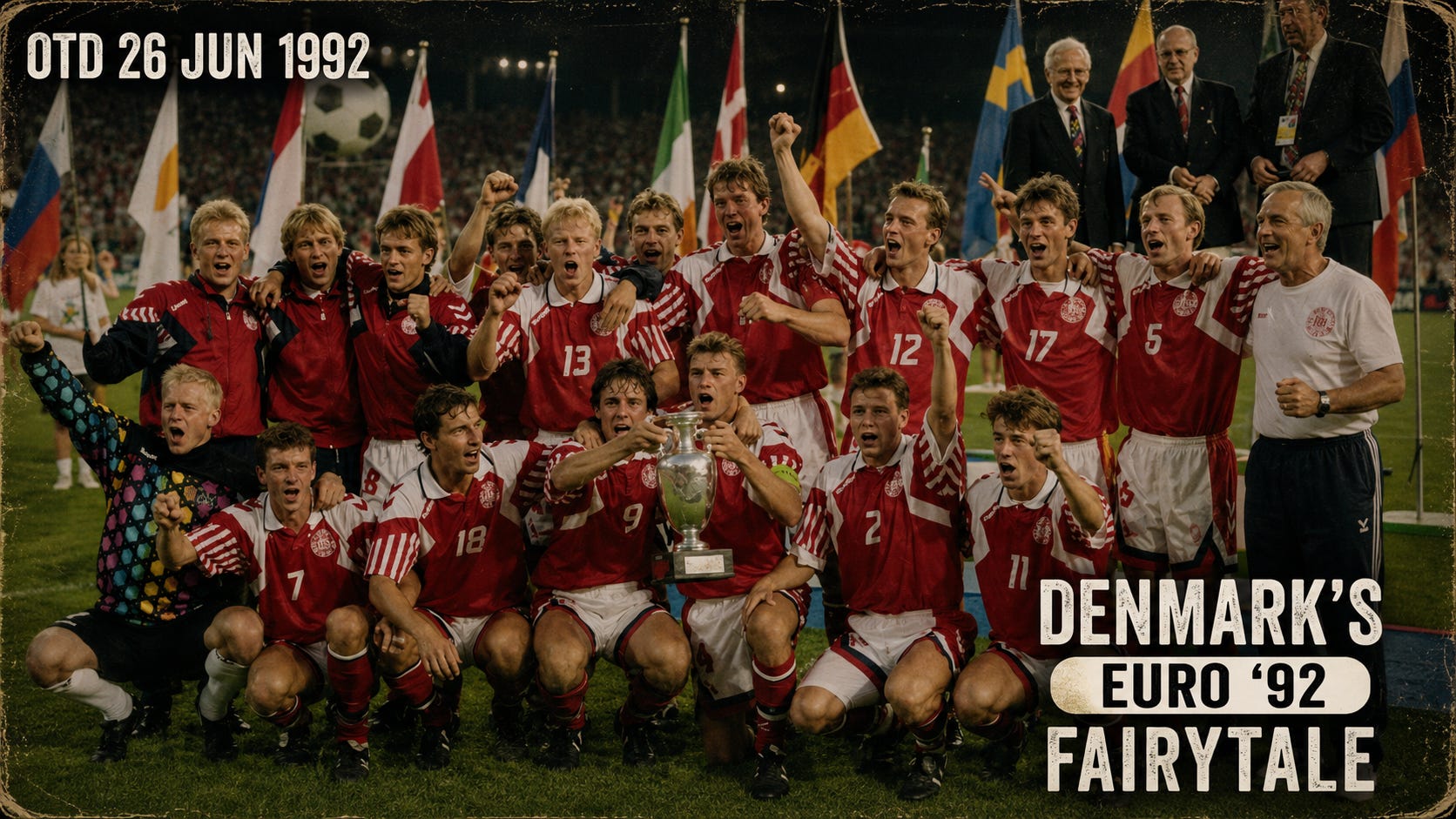
It is 26 June 1992, in Gothenburg. Denmark against Germany, the European Championship final. And it is not supposed to be happening. Denmark did not qualify for this tournament. They were called in only after Yugoslavia were expelled, with ten days’ notice, some players pulled back from holiday. No proper preparation. A coach many fans did not even want. And today, against the reigning world champions, they win. Denmark 2, Germany 0. One of the greatest fairytales football has ever produced.
To feel why it matters, you have to know that Denmark were football pioneers who somehow never cashed it in. One of the oldest football associations in the world, Olympic silver before the First World War, and then decades clinging to amateur ideals while everyone else turned professional. The Danish Dynamite side of the 1980s finally gave the country a great team, all flair and charm, and still no trophy. By 1992, under the orderly, unglamorous Richard Møller Nielsen, even that romance had faded, and their best player, Michael Laudrup, had walked away.
They had finished second to Yugoslavia in qualifying and gone home. Then Europe’s politics intervened: with Yugoslavia tearing apart and barred from the tournament, Denmark got the call. Møller Nielsen, by his own joke, had been planning to fit a new kitchen. Now he had ten days to fit a national team together.
What he built was not pretty, but it was clear: compact, hard to beat, opportunistic, with a goalkeeper named Peter Schmeichel becoming a wall. They opened with a draw, lost to Sweden, looked finished, then refused to die. There is a penalty shootout against the holders, the Netherlands, that turns on Schmeichel denying one of the best strikers alive. There is a final against a Germany side stacked with world champions. And there are two goals, one from a man famous for never scoring, and one from a player carrying a private grief no parent should have to carry. The details of those moments deserve to be heard, not summarized.
What stays with me is the sheer impossibility of it. Greece in 2004 and Leicester in 2016 belong in any conversation about great sporting shocks. But Denmark 1992 has its own category, because they were not even supposed to be in the building. They did not qualify. They lost a group match. They were missing their greatest player. And then they beat France, the Netherlands and Germany to lift the trophy.
It changed the country’s football imagination. After the Dynamite years of charm without silverware, Denmark finally had proof that it could win, not only enchant. And it remains one of the last great stories of an era that was about to vanish, because the rule that had quietly shaped Denmark’s whole defensive approach was about to change forever.
🎙️ THE PODCAST GOES DEEPER. The full episode has what this post holds back: the 1995 proof this shock wasn’t a fluke, the back-to-the-keeper era that ended right after this tournament, the Schmeichel save from Van Basten in the shootout, John Jensen’s unlikely goal and Kim Vilfort’s deeply moving story, the group-stage escape against France, and how 1992 reshaped Danish football. That is the 10-minute version.
---
🎧 Listen on Spotify, Apple Podcasts, Amazon Music, Overcast, iHeart, and YouTube.
📩 Got an episode idea? otd@17lawsguy.com
Yesterday: 25 June 2006, the Battle of Nuremberg.
Tomorrow: 27 June 1954, the Battle of Berne.
Great memories
This was lived experience. It didn't rain for a whole month and during the tournament. The Maastricht referendum on June 2nd, and the Royal Couple's silver wedding anniversary a week later combined with the sudden entry into the Euro - just across Øresund - meant that Copenhagen felt like a month-long party. It was a wild ride.