

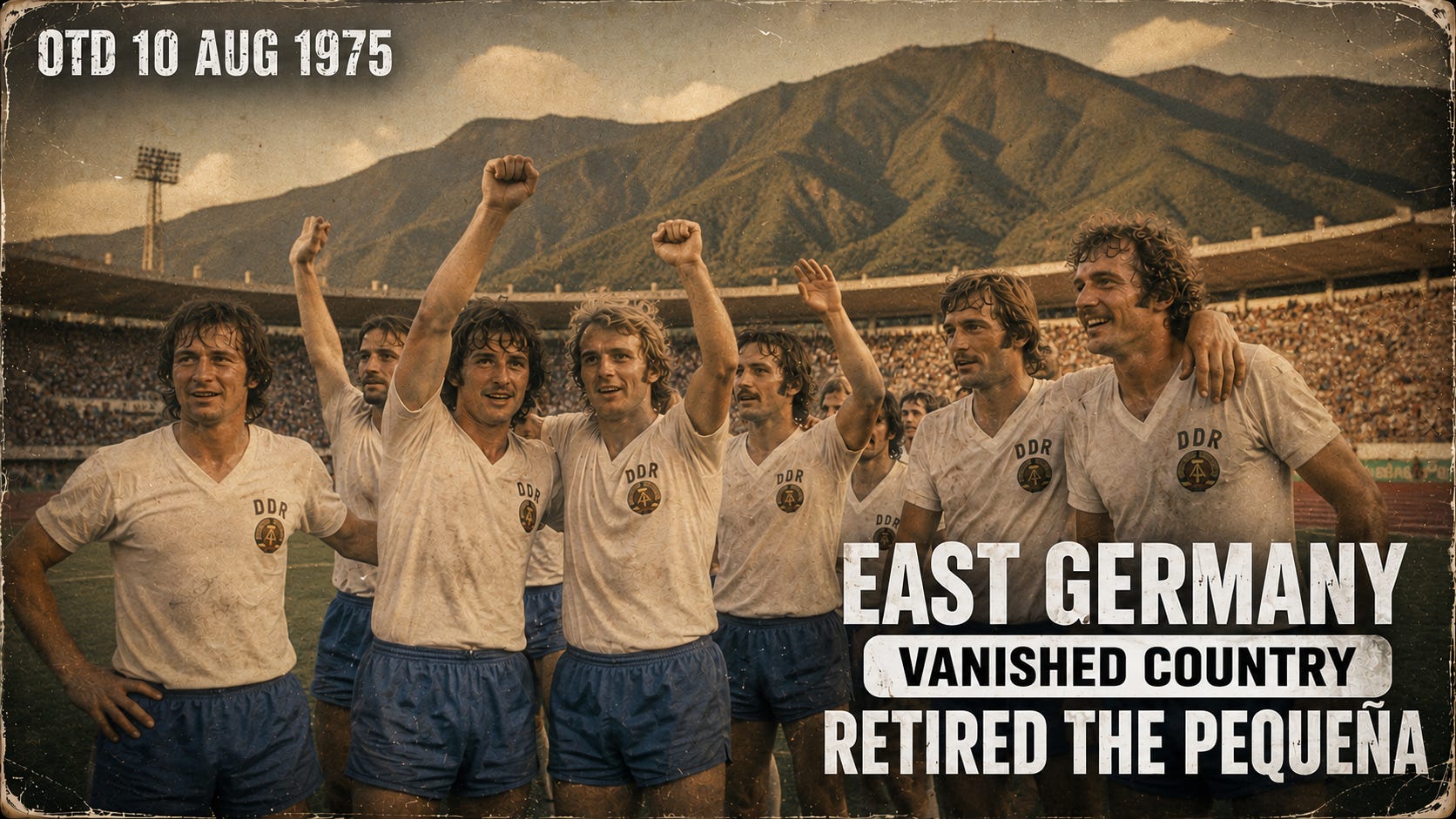
It is August 10, 1975. Caracas. Estadio Olímpico. East Germany against Boavista of Portugal, the final of the Pequeña Copa del Mundo, the Little World Cup. Jürgen Pommerenke scores from the penalty spot, Joachim Streich makes it two, and though Boavista pull one back late, East Germany hold. East Germany 2, Boavista 1. And with that, a strange old tournament reaches its end, won not by a club but by a national selection from the German Democratic Republic.
Start with the idea. Before the European Cup and the Copa Libertadores, football already wanted a world of clubs to exist. Brazil had staged the 1951 Copa Rio. Caracas was part of the same instinct: what if the best clubs from Europe and South America met in one place?
The Pequeña Copa del Mundo began in Venezuela in 1952, an invitational organized by private enterprise. This is football before the institutions caught up: promoters, appearance money, a capital city trying to place itself on the football map. And in the 1950s the world came. Real Madrid won in 1952 and 1956, Millonarios in 1953, Barcelona in 1957.
But the Pequeña was filling a gap, and once official competitions arrived, the gap shrank. The European Cup began in 1955; the Copa Libertadores and Intercontinental Cup in 1960. Suddenly the question of the best club across continents had a formal answer. So the Pequeña lost status, paused after 1957, returned in the 1960s under different names, then went quiet from 1971 to 1974.
And then, one last revival in 1975, the old dream almost ghostly. Four teams: Boavista, Real Zaragoza, Rosario Central, and East Germany. Not an East German club. The national selection. That oddity tells you everything. In the 1950s the Pequeña wanted to crown the club world; in 1975 it was loose enough to invite a state-amateur national team into a club tournament.
But East Germany were not tourists. They were a serious side under Georg Buschner. In the GDR, players were officially amateurs, in practice full-time athletes inside a planned machine, and Olympic football suited that perfectly, because Western professionals were restricted while Eastern Bloc amateurs were effectively the real national teams. The same Cold War logic that had powered Hungary. By 1975 the GDR’s decade was already impressive: Olympic bronze in 1972, Magdeburg’s Cup Winners’ Cup in 1974, and Sparwasser’s famous 1-0 over West Germany in Hamburg at the 1974 World Cup.
So the summer of 1975 was not a holiday. It was a controlled stress test on the road to Montreal 1976, a brutal tour through Canada, the United States, Mexico, and Venezuela: seven matches, twelve days, nearly thirty-nine hours of travel. Then Caracas. On August 9, East Germany beat Rosario Central 1-0, and Boavista beat Zaragoza on penalties. In the final on August 10, Pommerenke and Streich scored, Boavista fought back late, and East Germany won 2-1. The last Pequeña Copa del Mundo belonged to the GDR.
This is a tiny trophy inside a large arc. Nobody should pretend the 1975 Pequeña equaled the European Cup. But that is why it is interesting, because the last winner of this old Little World Cup is not Real Madrid or Palmeiras. It is East Germany, a country that no longer exists, entering a club tournament because the old boundaries had gone soft. The club world had grown up, and the Pequeña no longer knew what it was.
For East Germany, Caracas sat between Hamburg 1974 and Montreal 1976, sharpening a squad that in 1976 won Olympic gold, the GDR’s only major football title. Placed beside 1972 bronze, Hamburg, Magdeburg, and 1980 silver, the 1970s were East German football’s golden decade. Not romantic, not free, a system with surveillance and ideology inside it, but disciplined and genuinely world-class in the spaces the Cold War made available. And the Pequeña’s end tells us how football institutions win: promoters can invent a Little World Cup when official football has not built the product, but once the European Cup, the Libertadores, and the World Cup fill the calendar, an invitational built on local money becomes fragile. It ends here, with a Cold War team lifting the last remnant of a 1950s dream.
🎙️ THE PODCAST GOES DEEPER. The full episode has the tournament’s 1950s glory years, the GDR’s brutal 1975 tour, and the road from Hamburg to Olympic gold. That’s the 10-minute version.
---
🎧 Listen on Spotify, Apple Podcasts, Amazon Music, Overcast, iHeart, and YouTube.
📩 Got an episode idea? otd@17lawsguy.com
Yesterday: 9 August 1942, the Death Match.
Tomorrow: 11 August 1999, when a solar eclipse rescheduled a football match.