

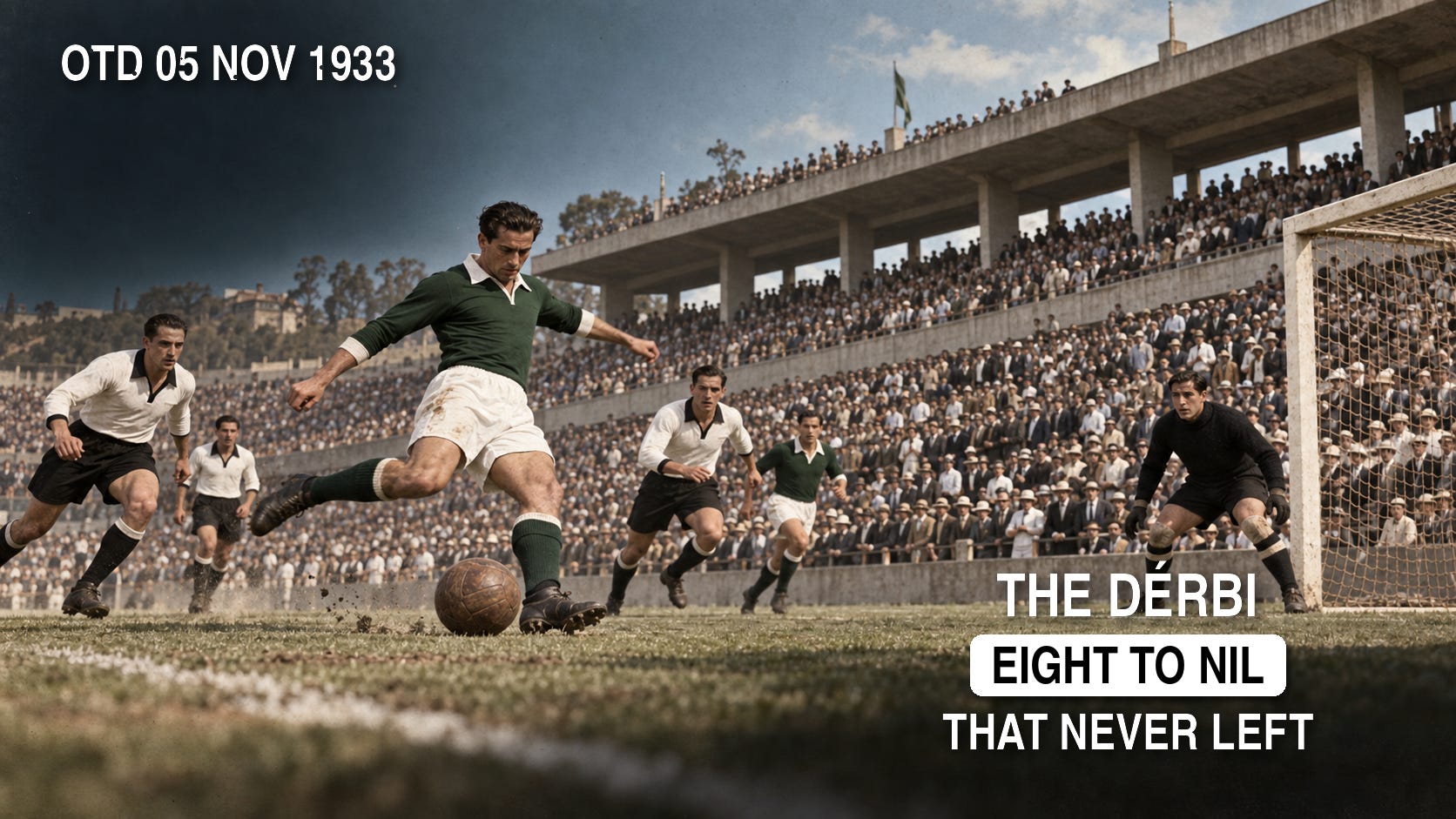
On 05 November 1933, São Paulo discovered that eight could become a chant.
The players of Palestra Itália had returned to their clubhouse beside Parque Antarctica after demolishing Corinthians 8-0. Soup awaited them. Wine was apparently considered an extravagance. Outside, supporters carried the result into the city. On the tram home, according to club historian Jota Christianini, the refrain needed only one word: “Oito, oito, oito.” Eight, eight, eight.
The number has never left the rivalry.
Palestra’s victory remains the largest in the history of the Dérbi Paulista and Corinthians’ heaviest defeat. Romeu Pellicciari scored four. Gino Imparato added three. Elísio Gabardo supplied the other. A contemporary report judged that the eight might easily have been more.
Yet this was not merely a freak score between mismatched teams. Corinthians were already eight-time state champions. Palestra were building the strongest side in São Paulo. The match helped decide two competitions at once, in the first season of legal professionalism in the city. It was played inside a newly rebuilt stadium that announced how quickly Brazilian football was changing.
One club left the afternoon close to two titles. The other returned to an institutional crisis. The scoreboard became a permanent piece of rivalry folklore.
How did we get here?
Corinthians and Palestra Itália were born from the same expanding, immigrant, working city.
Five laborers founded Sport Club Corinthians Paulista in Bom Retiro in 1910. The name came from Corinthian FC, the famous English amateur tourists then visiting Brazil, but the new club belonged to São Paulo’s streets and factories. It entered the city championship in 1913 and won it the following year. By the end of the 1920s, Corinthians had become one of the state’s dominant forces, with three consecutive Paulista titles from 1928 through 1930.
Palestra Itália arrived in 1914 as an institution for São Paulo’s vast Italian community. Its founders wanted a club capable of representing Italians and their descendants against the city’s established sporting elite. The identity was ethnic, but the support and playing talent grew far beyond a single social category. Both future giants drew energy from people whom the older gentlemen’s clubs had not originally imagined as the owners of São Paulo football.
Their first official meeting took place on 06 May 1917. Corinthians entered unbeaten in 25 competitive matches. Palestra won 3-0, with Caetano Izzo scoring all three. The new rivalry therefore began with an interruption: the younger club broke the older club’s streak and announced that São Paulo’s hierarchy would not remain settled.
For much of the 1920s, Paulistano still represented the old establishment and supplied stars such as Arthur Friedenreich. When Paulistano withdrew from football at the end of the decade, the city lost one of its central powers. Corinthians and Palestra, the popular clubs of Bom Retiro and the Italian community, moved closer to the center of the game and closer to each other.
They also entered an argument over what football had already become.
Brazilian clubs officially maintained amateur teams, but leading players routinely received money, jobs or favors away from the accounts. The arrangement preserved amateur respectability while allowing clubs to recruit and retain talent. It also invited disputes over eligibility and left players without the protections that an honest professional system might offer.
In 1933, clubs in São Paulo and Rio de Janeiro accepted professionalism. The change was not simply about paying players. It created a new sporting economy built around gates, stronger competitions, purpose-built grounds and clubs prepared to treat football as their main public business.
The first Torneio Rio-São Paulo joined leading clubs from Brazil’s two strongest football cities. Its structure now looks peculiar. Matches between São Paulo clubs could count simultaneously toward the Campeonato Paulista and the Rio-São Paulo standings. Palestra against Corinthians on 05 November was therefore one match carrying two sets of consequences.
Palestra entered the professional era from a position of strength. Under Uruguayan coach Humberto Cabelli, the club had won the 1932 Paulista with a perfect record. Cabelli retained a settled side and used the orthodox 2-3-5 shape of the period with enough movement and passing intelligence to make the formation fluid in possession.
Romeu Pellicciari was its creative center. Nicknamed O Príncipe, he had debuted for Palestra in 1930 and scored in a 4-0 victory over Corinthians. As a boy, he had once adopted the nickname of a Corinthians player, Bororó, simply because the sound amused him. By 1933, Corinthians had no reason to find Romeu amusing. He could finish, combine and direct attacks, and the press increasingly described him as the brain of Palestra’s football.
Around him stood a mature unit. Gabardo attacked through the middle. Imparato operated from the left. Avelino supplied width on the right. Dula and Tuffy supported from halfback, while Carnera and Junqueira protected goalkeeper Nascimento.
The club was also giving its team a modern home. Palestra had acquired Parque Antarctica in 1920 through an enormous community effort. On 13 August 1933, it inaugurated the rebuilt Stadium Palestra Itália, a 30,000-capacity ground with reinforced-concrete stands, then among the most modern stadiums in Brazil. Palestra beat Bangu 6-0 in the opening match. The building and the score both suggested ambition.
The 1933 team justified it. Across all competitions, Palestra played 34 matches, won 26 and scored 113 goals. In the first league meeting with Corinthians, on 07 May, Cabelli’s side won 5-1. By November, it led both the Paulista and Rio-São Paulo tables.
Corinthians arrived from the opposite direction. The club still possessed its name, public and title record, but its team had become unstable. Fifty players appeared during the season. Contemporary analysis contrasted that churn with the Palestra side that had developed together since 1932. Corinthians had already lost 6-0 to São Paulo da Floresta and 6-0 to Santos. Coach Pedro Mazzulo, another Uruguayan, was trying to locate a dependable eleven inside a collapsing campaign.
Even so, nobody expected eight. Palestra were favorites. Corinthians were Corinthians.
The afternoon supplied an omen before the main teams appeared. Palestra’s reserves beat their Corinthians counterparts 4-0. The senior side then took the field in green shirts against Corinthians in white, before a crowd ready for a derby and about to witness an execution.
Haroldo Dias da Mota was the referee. Palestra lined up with Nascimento; Carnera and Junqueira; Tunga, Dula and Tuffy; Avelino, Gabardo, Romeu, Lara and Imparato. Corinthians selected Onça; Rossi and Bazani; Jango, Brancário and Carlos; Carlinhos, Baianinho, Zuza, Chola and Gallet. Nascimento later replaced Bazani.
Romeu opened the scoring after 17 minutes. Imparato crossed high from the left and Romeu struck the dropping ball first time with his right foot. Twelve minutes later, Imparato drove in a low cross. Romeu slid toward it and finished as goalkeeper Onça committed himself.
The third arrived after 36 minutes. Dula threaded a low pass through the Corinthians defense. Romeu ran beyond the markers and beat Onça as he came out. Palestra led 3-0 at halftime, and Romeu already had a hat trick.
Forty-five seconds after the interval, the fourth went in. Lara won possession, carried the ball through midfield and found Romeu. Instead of chasing his own fourth, Romeu released Gabardo, whose powerful shot went in off the post.
Romeu completed his four-goal performance seven minutes into the half. Dula lifted the ball forward. Romeu controlled it on his chest and scored with his right foot. Two minutes later, the architect became the provider again. Tuffy found Romeu, Romeu released Imparato, and the winger finished left-footed on the run.
At 6-0, Palestra did not close the afternoon. Onça saved Romeu’s next effort, but Imparato drove in the rebound for the seventh after 35 minutes. Five minutes later, Gabardo supplied Romeu, Onça parried once more, and Imparato placed the loose ball into the net. His hat trick followed Romeu’s four.
Contemporary reporting called it “a great afternoon for Romeu.” The description mattered because four goals told only half his story. He had created as well as finished, moving between the lines and connecting a forward unit that Corinthians never controlled. Palestra’s play was described as academic, not because it was slow, but because it became a demonstration.
The losers were not accused of turning the match into a fight. Reports stressed its discipline. Nor was Onça treated as the principal culprit. He was blamed mainly for the final two goals and otherwise kept the score from becoming even more severe. Palestra struck the woodwork, had a goal disallowed and appealed unsuccessfully for a penalty. Nascimento, by one later statistical account, touched the ball only four times.
The most astonishing point was not that everything Palestra attempted went in. It was that 8-0 understated the difference.
So what?
The victory placed Palestra on the brink of both championships. In their next match, more than 35,000 spectators watched Avelino score in a 1-0 win over São Paulo da Floresta. Palestra secured the Paulista title and the inaugural Rio-São Paulo, confirming themselves as the outstanding team of Brazil’s first professional season.
Cabelli’s achievement continued. Palestra won the Paulista again in 1934, completing the only three-title sequence in the club’s history. Romeu later moved to Fluminense and helped that club win three consecutive Carioca championships from 1936 through 1938. He represented Brazil at the 1938 World Cup and eventually returned to Palestra in 1942.
That return connected him to another defining transformation. Brazil entered the Second World War against the Axis powers, and institutions carrying Italian names faced government pressure. Palestra Itália became Palmeiras. Romeu belonged to the side that won the decisive 1942 Paulista match in what the club remembers as the Arrancada Heroica, the Heroic Charge. The player who had scored four in the greatest Dérbi rout therefore helped carry the club across its change of name.
His official Palmeiras record stands at 109 goals in 162 matches. Fourteen came against Corinthians, a total that still places him among the rivalry’s notable scorers. Yet 05 November remains his concentrated masterpiece: four goals, direct involvement in others and complete command of the afternoon.
Imparato left with three goals and, according to the period account, a radio and a cash prize that helped with his brother’s wedding. His surname also carried a family story. He was known inside the club as Imparato III because his brothers Ernesto and Caetano had preceded him. In the biggest derby score, the third brother supplied the final three goals.
Corinthians experienced the result as more than sporting embarrassment. The next day, a manifesto called for members to remove the directors. Contemporary reporting described an attempted invasion and wrecking of the club offices serious enough to bring police. Later Palmeiras histories tell of supporters setting fire to Corinthians premises. The precise details differ across retellings, but the institutional collapse does not: president Alfredo Schürig and his board resigned collectively, even after the club council asked them to remain.
Corinthians recovered, as great clubs do. The team won the Paulista again in 1937 and began another run of state titles. The 8-0 did not permanently reverse the balance of São Paulo football. It became something more durable: a result each new generation inherited.
That inheritance matters because the Dérbi has so often decided power rather than merely measured it. In 1974, Palmeiras beat Corinthians 1-0 in the Paulista final and prolonged their rival’s title drought into a 21st year. In 1993, Palmeiras overturned a first-leg defeat and won the return 4-0 to end their own 16-year wait for a major trophy. Palmeiras eliminated Corinthians from the Copa Libertadores in 1999 and again in 2000. Corinthians have answered with defining victories of their own, including Paulista titles won against Palmeiras in 1995, 1999, 2018 and 2025. Palmeiras defeated Corinthians to take the delayed 2020 Paulista.
The rivalry remains large because neither club can reduce the other to a supporting role. Both have immense followings, national and continental trophies, periods of supremacy and memories capable of wounding the other side. Every Dérbi arrives with an archive already on the field.
An 8-0 survives differently from an ordinary famous win. Great goals can be answered by greater goals. Finals can be avenged in later finals. A record margin sits outside that exchange until somebody breaks it. It becomes less a memory than a standing challenge.
Football’s great derbies rarely produce such distances. Familiarity encourages caution. Emotional pressure narrows matches. Even a superior team often plays the opponent’s identity as much as its eleven. That is why Celtic’s 7-1 victory over Rangers in the 1957 Scottish League Cup final, Milan’s 6-0 defeat of Inter in 2001 and Liverpool’s 6-0 league win over Everton in 1935 retain their shock. They violate the basic expectation that rivalry will resist humiliation.
Palestra’s eight went further because it joined sporting modernity to public catastrophe. This was the professional game’s first São Paulo season. The rebuilt stadium, the double championship, the settled system and the star performance all belonged to the future. Corinthians’ administrative crisis looked like the price of failing to keep pace.
The result should not be used as a simple creation myth in which one club represented progress and the other decay. Corinthians had already helped democratize São Paulo football and would quickly recover. Palestra had suffered defeats and would suffer many more. Rivalries resist clean moral assignments.
What 8-0 does reveal is how quickly a score can escape its match. It left the field, entered a tram chant, reached the club offices, removed a board and became a number supporters would still deploy generations later. The game finished in 1933. The argument never did.
Three things to take away
One match counted twice. Palestra’s victory advanced the club in both the Campeonato Paulista and the inaugural Torneio Rio-São Paulo. The 1933 competition structure allowed meetings between São Paulo clubs to count in both tables.
Romeu’s four goals were only part of his masterpiece. He completed a hat trick before halftime, scored again after it and repeatedly created opportunities for Gabardo and Imparato. Contemporary reporting treated him as the brain of an attack, not simply its scorer.
The 8-0 became an institutional event. Palestra moved toward two titles. Corinthians faced protests, police involvement and the resignation of Alfredo Schürig’s board. The largest score in Dérbi history changed the week outside the stadium as dramatically as the afternoon inside it.
On This Day...
The champions received soup. The city received a number.
On 05 November 1933, Palestra Itália beat Corinthians 8-0 at the new Stadium Palestra Itália. Romeu scored four, Imparato three and Gabardo one. On the tram away from the ground, supporters began repeating the only word the story required.
Oito. Oito. Oito.
---
(This story was first published as a podcast episode on 05 Nov 2025.)
Questions, corrections or story ideas: otd@17lawsguy.com
Yesterday: 04 November 1967, One Perfect Goal Inside the Battle of Montevideo.