

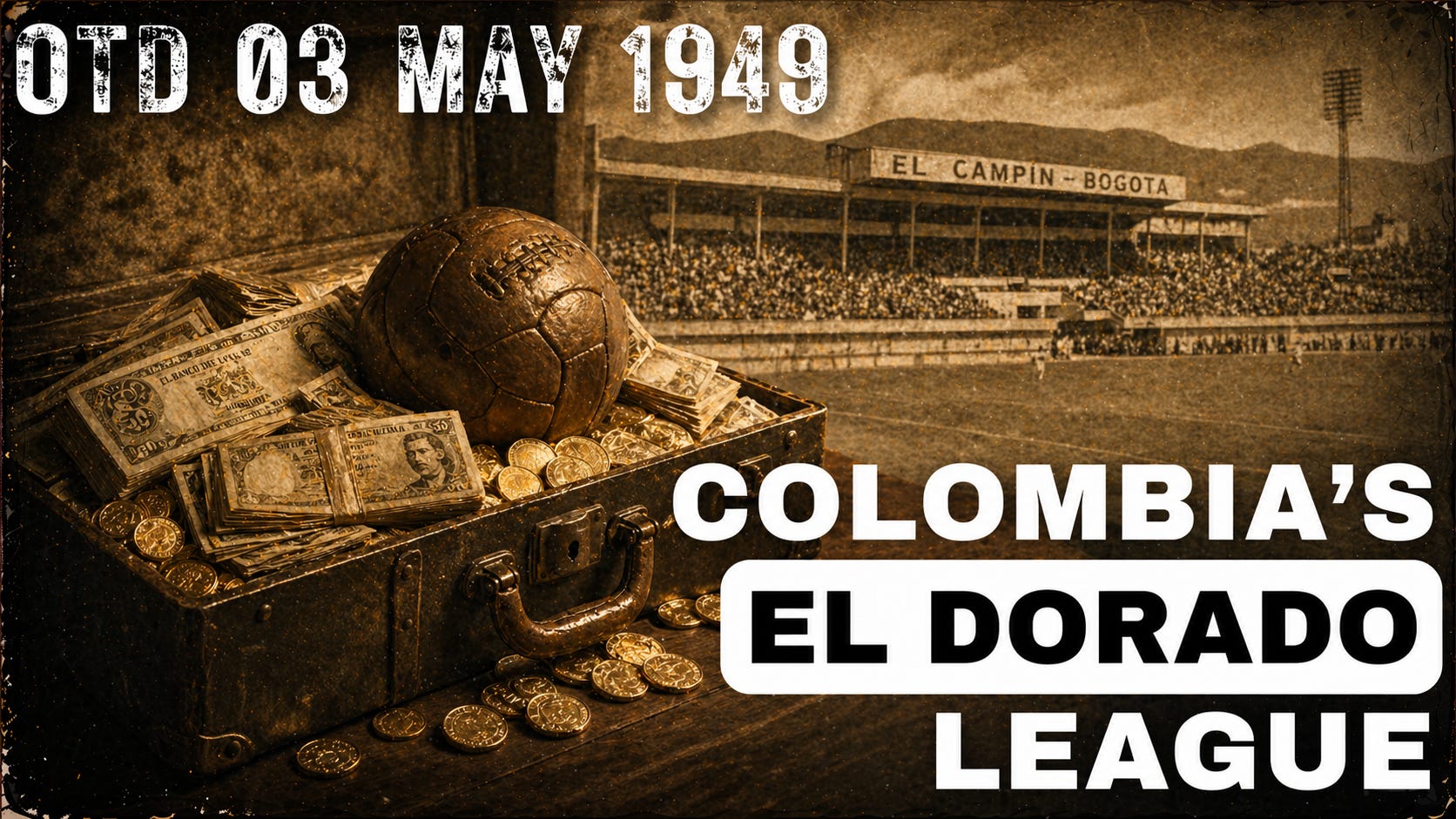
Today’s story begins with a strike ending.
Not in Colombia, at least not yet. In Uruguay. The professional footballers’ strike that had lasted more than 200 days is lifted on 3 May 1949. Across the River Plate, in Argentina, another player strike is reaching its breaking point.
On the surface, this looks like the end of a labour crisis. But football history often turns at the point where a settlement solves one problem and opens another.
Because while Argentina and Uruguay were trying to put their leagues back together, Colombian football was watching.
And Colombian football had money. It had ambition. It had political chaos around it. And soon, it would have Adolfo Pedernera, Néstor Rossi, Alfredo Di Stéfano, and one of the strangest, richest, most rebellious leagues football has ever seen.
This is the origin of El Dorado.
Colombia in 1948 was a country in upheaval. Jorge Eliécer Gaitán, the great Liberal leader, was assassinated in April. Bogotá exploded. The country slid into La Violencia. In that atmosphere, football became more than sport — it became distraction, outlet, spectacle, and, for the government, a useful national project.
Colombia’s first professional league season was played in 1948. Santa Fe became the first champion. Then, in 1949, the country’s football federation Adefútbol and the league body Dimayor fell out over the South American Championship in Brazil. Adefútbol disaffiliated Dimayor. What was meant as punishment became liberation.
Because once Dimayor was outside the normal FIFA chain, Colombian clubs realised something extraordinary: they did not have to play by the same transfer rules. They did not have to ask the old club for permission. They did not have to respect the retain-and-transfer logic that tied players to institutions.
If a player was on strike in Argentina, unhappy in Uruguay, underpaid in England, or trapped in a system that restricted his movement — Colombia could offer him cash, freedom, and a new stage.
The first great symbol was Adolfo Pedernera. Not Di Stéfano. Pedernera.
That matters. Pedernera was not just a famous forward. He was the brain of River Plate’s La Máquina, one of the great teams of the 1940s. To bring him to Bogotá was not like importing a decorative veteran. It was like importing a football civilisation.
He arrived in June 1949. Thousands came to see him. Even before he played, he changed the economics of the thing. The press called him a phenomenon, an artist, the master of the pass. And then Pedernera went back to Argentina — and returned with Néstor Rossi and Alfredo Di Stéfano.
That is the dam breaking.
Millonarios won the 1949 title in a playoff against Deportivo Cali. The phrase that sticks from the period is cinco y baile — five and dance. Score five, then entertain. It captures the spectacle of the league. Colombian football was no longer only competition. It was theatre.
What followed turned the gold rush into football mythology. Argentinians came. Uruguayans came. Peruvians came. Even British players: Neil Franklin from Stoke, Charlie Mitten from Manchester United, others tempted by salaries that dwarfed what England’s old maximum-wage system allowed.
For a brief period, Colombian football was perhaps the most cosmopolitan league in the world.
And then came the response. FIFA and the South American authorities treated Colombia as a pirate-league problem. The settlement — the Lima Pact — set an end date for the rebellion. Foreign players already in Colombia could remain until 15 October 1954. After that, they were to be reinstated to their associations of origin.
The system closed the breach. El Dorado was brilliant but unsustainable.
But it had already changed the room.
It showed players that borders could be crossed. It showed clubs that money could move talent faster than tradition. It showed FIFA that the international transfer system needed enforcement.
And it gave Real Madrid the road to Alfredo Di Stéfano. Without Colombia, his path to Madrid is much harder to imagine. Without Colombia, the first great Real Madrid European dynasty may still happen — but not in the same way, not with the same myth.
El Dorado burned too hot to last. But football was never the same after it.
---
🎧 Also available on Apple Podcasts, Amazon Music, Overcast, iHeart, and YouTube.
📩 Got an episode idea? otd@17lawsguy.com
Yesterday: 2 May 2016 — The Night Leicester Won It.
Tomorrow: 4 May 1976 — Queens Park Rangers were fifteen minutes from being champions of England.