

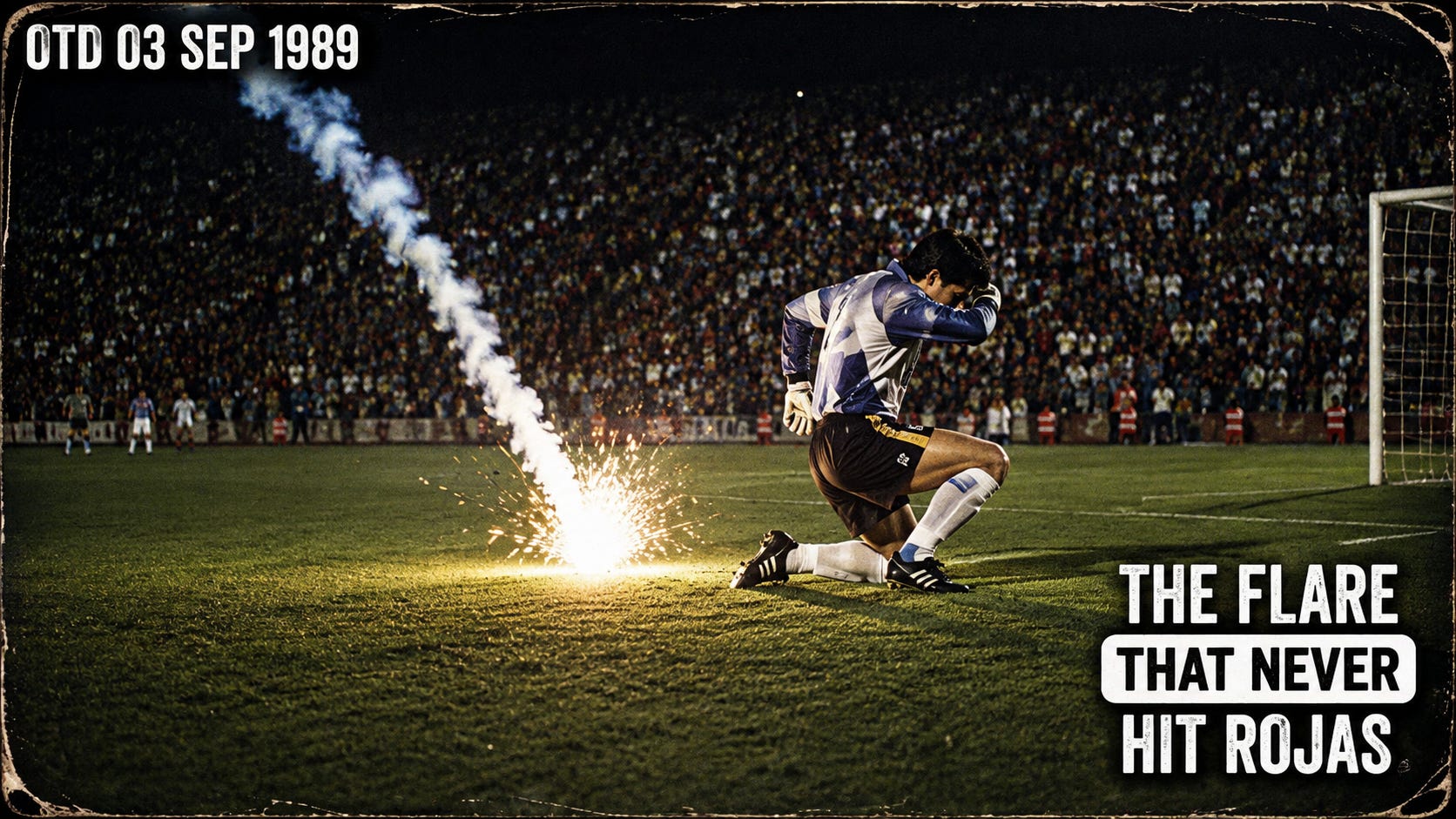
It is September 3, 1989, at the Maracanã, and Brazil are leading Chile 1-0 in a World Cup qualifier when a green signal flare arcs out of the crowd and lands beside the Chilean goalkeeper, Roberto Rojas. Rojas drops to the turf. When teammates reach him, blood is running down his face, and Chile leave the field, refusing to continue. For a few hours it looks as though a Brazilian spectator has just thrown Brazil out of the World Cup. Then the photographs arrive, and the story inverts completely. The flare never touched Rojas. The blood was real, the wound was real, and Roberto Rojas had done it to himself.
To understand why a goalkeeper would cut his own face, you have to feel the stakes. This was a three-team qualifying group, Brazil, Chile and Venezuela, under the old two-points-for-a-win system, and only one country would reach Italy. Brazil remain the only nation to have played at every World Cup, but they had not won one since 1970, and missing the tournament altogether would have been unthinkable. Only seven weeks earlier, Sebastião Lazaroni’s side had beaten Uruguay at this same Maracanã, Romário heading the winner, to lift Brazil’s first Copa América in forty years. Chile were dangerous too, built around Rojas, their captain and star, who knew Brazilian football intimately because he played for São Paulo.
The campaign had already turned poisonous. When the sides met in Santiago, Romário was sent off in the fourth minute, a Chilean followed, and objects rained from the stands. FIFA punished Chile by moving their next home qualifier out of the country, across the Andes to Mendoza. That detail matters, because it taught everyone a lesson they would soon misuse: crowd disorder could genuinely change the conditions, and even the outcome, of a World Cup qualifier. So the sides arrived in Rio level on points, but with Brazil holding the superior goal difference. A draw sent Brazil to Italy. Chile had to win.
More than 140,000 packed the Maracanã. Careca put Brazil ahead four minutes after half-time, which meant Chile now needed two goals and time was vanishing. Then, around the 69th minute, a young spectator threw a flare toward the pitch. It fell near Rojas, smoke erupted, and he went down clutching his head. When players lifted him, his forehead was bleeding, and Chile walked off saying their safety could not be guaranteed. The Argentine referee waited about twenty minutes. Chile did not return, the match was abandoned, and Brazil’s place was suddenly in doubt.
Chile demanded the match be annulled and replayed, and on its face the argument was not absurd. A dangerous object really had been thrown, and Brazil really did have a stadium-security problem. But the doctors found a cut with no burn consistent with a flare, and the footage showed the flare landing near Rojas, not on him. Eventually came one of football’s most extraordinary confessions. Rojas admitted he had carried a small scalpel blade onto the pitch, kept it by his shin guard in the first half and moved it near his glove at the interval. He said he had even asked the referee before kickoff what would happen if crowd trouble stopped the match. When the flare landed, he saw his chance, fell, and cut his own forehead. His motive, he said, was simple: a sporting advantage for Chile. No betting, no money. A World Cup place.
FIFA did not treat this as gamesmanship. It treated it as an attack on the competition. Brazil were awarded a 2-0 win and qualified, Rojas was banned for life, and after a fuller investigation Chile were fined, their federation president and team doctor were also banned for life, the coach and another official were suspended, and the country was barred from qualifying for the 1994 World Cup. One attempt to escape elimination cost Chile an entire second World Cup cycle.
It is worth being precise about the wrong Rojas was imitating, because a genuine protection against unsafe matches does exist. Only a few years later, when objects struck members of the Zimbabwe party during a qualifier in Cairo, FIFA ruled that the game had not been played under normal sporting conditions, erased Egypt’s win and ordered a neutral replay, from which Zimbabwe advanced. That is the real mechanism Rojas tried to trigger. The fraud lay in manufacturing the evidence to invoke it, and it did not erase the other wrongdoing: a flare had still been thrown, and Brazil were still punished over their stadium security.
The consequences reshaped a decade. Chile vanished from World Cup qualifying until the road to France 1998, when the Zamorano and Salas generation finally took them back. Brazil went to Italy, and four years later won the very World Cup whose qualifying Chile had been forbidden to enter. As for Rojas, the lifetime ban stood for more than a decade before FIFA lifted it in 2001, by which time he was working as a goalkeeping coach at São Paulo. The 1989 Maracanazo was not a famous defeat, like the one this stadium had witnessed in 1950. It was a famous deception.
---
🎧 Listen on Spotify, Apple Podcasts, Amazon Music, Overcast, iHeart, and YouTube.
📩 Got an episode idea? otd@17lawsguy.com
Yesterday: 2 September 1920, Belgium win an Olympic final that lasted 39 minutes.