

On 3 November 1976, Torino had a simple problem. They had lost the first leg of their European Cup tie against Borussia Mönchengladbach 2-1 at home, even though their own goalkeeper had not been beaten by a Borussia player.
Berti Vogts had put the West Germans ahead in Turin. Torino equalised when Hans-Jürgen Wittkamp diverted the ball into his own net. Then, with twelve minutes left, Hans Klinkhammer made it 2-1 to Mönchengladbach. For the Italian champions, the arithmetic of the return was unforgiving. Mönchengladbach had scored two away goals, which back then counted double in case of both clubs having scored the same amount of goals over the two ties. For Torino, a 1-0 win would thus not do. A 2-1 win would force extra time. In essence, Torino had to make the game happen and win by two.
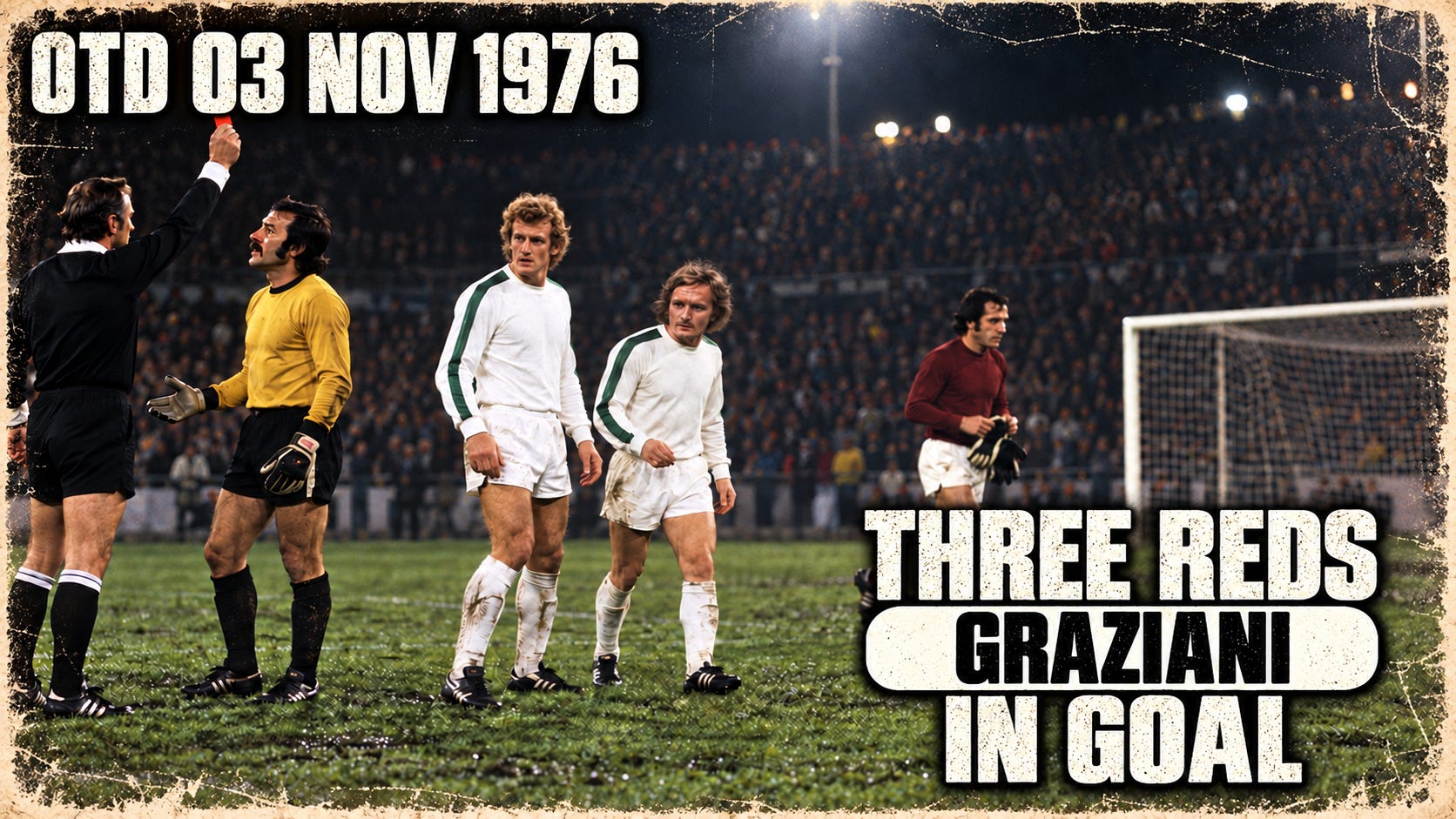
The return was staged at the Rheinstadion in Düsseldorf, not the smaller Bökelberg in Mönchengladbach - because the occasion demanded a larger venue. Sixty-five thousand watched a match that became less a contest of footballing systems than a test of emotional control. At the finish Torino had eight players. Goalkeeper Luciano Castellini had been sent off. So had Vittorio Caporale and Renato Zaccarelli. Francesco Graziani, one half of the Italian champions’ celebrated attacking pair, took the goalkeeper’s jersey for the final twenty minutes. Yet the score remained 0-0.
It is an image so strange that it can eclipse everything around it: a forward in goal, an Italian champion down to eight, a West German champion advancing without scoring at home despite overwhelming superiority. Yet the oddity matters because it places the match precisely at the summit of two football cultures. Mönchengladbach’s Fohlen were one of the great West German sides of the 1970s, the team that kept prising the Bundesliga away from Bayern Munich. Torino’s 1976 Scudetto was their first since the Superga disaster and remains their last. This was not an underdog being overwhelmed by an empire. It was a collision between two champions who both believed that Europe should confirm what they had done at home.
How Did We Get Here?
Borussia Mönchengladbach had begun the decade as a thrilling challenge to the established German order. Hennes Weisweiler’s young side won the Bundesliga in 1970 and 1971, then again in 1975, playing at a speed and freedom that earned the nickname Die Fohlen, the Foals. There was no need to make the nickname sentimental. This was a side with force as well as grace: 1974 World Cup winners, Berti Vogts at right-back, and Rainer Bonhof’s power from midfield, were enhanced by Herbert Wimmer’s industry, Jupp Heynckes’s finishing and the Danish winger Allan Simonsen’s control and imagination.
Their rise ran alongside Bayern’s, not behind it. Bayern had Beckenbauer, Gerd Müller and Sepp Maier, the European Cup and the 1974 World Cup’s core. Gladbach offered another answer to the question of what West German football could be. Between 1970 and 1977 the club won five Bundesliga titles, two under Weisweiler and the final two under Udo Lattek, Bayern’s former manager. By autumn 1976 Lattek had inherited not a fading counterculture but a championship side with a habit of thinking itself equal to anyone.
The European Cup was the one prize Gladbach still wanted most. They had reached the 1973 UEFA Cup final and lost to Liverpool. They had won the UEFA Cup in 1975. But the champion clubs’ competition was a different altar. It admitted only league winners, so every tie had the compressed feel of a domestic summit meeting. No one could retreat to the consolation of a league table. Lose over 180 minutes and the European season disappeared.
Torino entered the competition with an even heavier history. The Grande Torino of the 1940s had been the most dominant team Italy had known, winning five successive titles before the Superga air disaster of 1949 killed the players, staff and journalists returning from Lisbon. Every later Torino side lived in the shadow of that loss. The 1976 title did not erase it. It gave the city a modern team to love on its own terms.
Luigi Radice’s side was not a museum piece. He arrived in 1975 with a modern, aggressive idea of collective football: pressure high up the pitch, running, flexibility and a willingness to attack. Torino had Paolino Pulici, the Serie A top scorer with 21 goals in the title season, and Graziani, his quick and intelligent partner. Claudio Sala supplied craft; Renato Zaccarelli, Patrizio Sala, Roberto Salvadori and Castellini gave the side its spine. Torino finished two points ahead of Juventus to win a seventh Scudetto, their first after Superga.
The title race did not end the rivalry with Juventus. It intensified it. In 1976-77 Torino were again strong enough to make Juventus work for every point. The domestic calendar therefore made Europe complicated. To a club chasing a second title, midweek travel and European recovery were not distractions exactly, but they were a second obligation added to a season already defined by the pressure of keeping pace with the neighbours.
The first leg at the Stadio Comunale on 20 October showed how thin the margin was. Vogts put Gladbach ahead after 28 minutes. Torino levelled through Wittkamp’s own goal in the 64th. The match appeared to be settling into an uncomfortable but manageable draw until Klinkhammer scored in the 78th minute. Mönchengladbach had two away goals and a 2-1 victory.
That first-leg score explains the ferocity of the return more accurately than any cliché about German and Italian styles. Torino could not simply preserve shape. They needed a goal. Gladbach did not need to attack recklessly, but a side containing Heynckes, Simonsen and Bonhof could never be reduced to passive survival. The match was set up as a question of nerve.
It was also a different age of European football. There was no squad rotation of the modern kind, no group phase to repair a bad night and no elite competition designed to guarantee the biggest clubs multiple home fixtures. The European Cup was an elimination tournament. The champions of West Germany and Italy could meet in the round of 16 and one of them would be gone before winter had properly arrived.
From the opening, Torino sought a route back. Gladbach’s selection made clear that Lattek trusted his champions: Wolfgang Kneib in goal; Vogts, Hans-Jürgen Wittkamp, Frank Schäffer and Rainer Bonhof around the defensive structure; Wimmer and Uli Stielike in midfield; Simonsen and Heynckes in attack. Radice had Castellini behind Caporale, Roberto Mozzini, Salvadori, Danova and Zaccarelli, with Pulici and Graziani carrying the scoring burden.
The intensity quickly became the story. Caporale was sent off late in the first half after his second yellow. Zaccarelli followed in the second half. Also after two yellow cards. Each dismissal made Torino’s task harder and the temperature higher. Then Castellini went in the 70th minute. Straight red after scything Del’Haye, who had come on as a substitute only a few minutes prior. A goalkeeper’s red card in the era before substitutes were used with today’s freedom was not merely a personnel problem. It was a theatrical and tactical rupture. Graziani, a forward required to find the goal that would rescue the tie, had to go into it instead.
For the final stretch, Torino played with eight outfield and goalkeeper roles reduced to their most improvised form. The arithmetic was grotesque: eleven against eight, with no result to show for Torino’s increasing desperation. Yet Gladbach did not turn the match into humiliation. They did what experienced European teams do when an opponent has collapsed in numbers but not in pride. They protected the tie. The whistle left the return leg 0-0 and the aggregate 2-1 to Borussia.
Italian accounts have long described Belgian referee Alfred Delcourt’s performance as scandalous, pointing to the three dismissals, five additional yellow cards, and the absence of comparable sanctions for Gladbach. That is part of Torino’s memory of the night and should not be erased. But the historical fact is simpler than the grievance: the tie was not reversed, the score stood and Mönchengladbach advanced. For the neutral, the enduring image is neither an officiating thesis nor an administrative decision. It is Graziani, a striker, standing in goal because Europe had stripped Torino of every ordinary option.
So What?
In the quarterfinals, Lattek’s side beat Club Brugge. In the semi-finals, Borussia eliminated Valeriy Lobanovskyi’s Dynamo Kyiv, the side with Oleg Blokhin and widely admired as Europe’s most sophisticated collective after its 1975 Cup Winners’ Cup triumph – and after they had eliminated reigning Cup holders (for the 3rd consecutive year!), Bayern, in the quarterfinals. That sent Gladbach to Rome for the European Cup final against Liverpool.
The final was another meeting of heavyweights. Liverpool won 3-1 on 25 May 1977, starting the European Cup dynasty on Merseyside and which would define the next decade. For Gladbach, it was the closest the club came to the trophy. That should not make 1976-77 a failure. They won the Bundesliga again, completing three consecutive German titles from 1975 to 1977, and Simonsen would win the Ballon d’Or later that year. In 1979, Borussia added another UEFA Cup. But their European Cup final remains the high-water mark of the Fohlen era.
Torino’s 1976-77 domestic campaign confirms why the European elimination was painful rather than embarrassing. They finished second in Serie A with 50 points, only one behind Juventus, after an exceptional season. In other words, the team that left Düsseldorf reduced to eight was not exposed as a pretender. It was still one of Italy’s finest sides, held off the title only by the smallest of margins. The European Cup had given it no latitude for a single bad evening.
The longer arc is harsher. Mönchengladbach did not remain a permanent European superclub. Their last Bundesliga title came in 1977. The talent eventually moved, aged or was replaced by players who could not hold the same economic ground against Bayern and the growing concentration of money elsewhere. The 1979 UEFA Cup was a last major continental triumph. They would return to the Champions League in later decades, but the regular assumption that Gladbach belonged among Europe’s last four had gone.
Torino’s fall from the 1976 summit is even starker. They have never won another Serie A championship. They won Coppa Italia in 1993 and had an extraordinary 1992 UEFA Cup run, losing the final to Ajax, but they have spent much of the modern era living between ambition, financial fragility and the inescapable scale of Juventus across the city. That is why the Radice side still has such emotional force. It is not merely the last champion. It is the last time Torino could look at Italian football from above.
Three red cards in a major European tie are rare enough to become part of a match’s name, but it would be careless to call Torino’s a unique UEFA record. Another famous European Cup second leg had already ended eleven against eight: Celtic against Atlético Madrid in 1974, when three Atlético players were sent off in Glasgow. In both ties, a team that needed a result found its path narrowed by its own loss of discipline, and the scoreless return became inseparable from the dismissals.
There are other examples of decisive European nights bent by mass disorder. The 1970 European Cup semi-final between Leeds United and Celtic was distorted by crowd trouble and the political temperature around a replay. Atlético’s 1974 resistance at Celtic became a lasting parable of dark arts. Chelsea’s 2012 semi-final in Barcelona turned when John Terry’s red card forced an hour of survival, though the team still progressed. These are not equivalents in detail. The point is that knockout football magnifies every dismissal because there is no later league fixture in which to recover the points. A red card changes not just a match but the available history of a club’s season.
What made Düsseldorf peculiar was the accumulation. Caporale’s dismissal made Torino anxious. Zaccarelli’s made their task almost absurd. Castellini’s transformed the visual logic of the game, placing Graziani in goal. No modern broadcast producer would need to explain why viewers should stay with an 0-0. The sight itself supplied the stakes.
The rules have changed around such scenes. A team can still finish with eight under the Laws of the Game; fewer than seven players means the match cannot continue. Modern substitutions, deeper benches, video review and different disciplinary procedures alter the context, but not the basic peril. A sending-off remains a subtraction from a carefully built plan. In a two-leg tie, it can also distort the game beyond recognition.
For Gladbach, the night is a footnote to the journey to Rome. For Torino, it is a wound remembered through the word vergogna, shame, directed at the referee by supporters and writers who felt their champions had been cheated of a fair chance. Both memories are real. But the larger story is more generous than either grievance or victory lap. Two champions met at the point where their domestic success demanded European proof. One had just enough experience and control to survive. The other played itself out of men before it could play itself back into the tie.
Three Things to Take Away
1. Borussia Mönchengladbach won the first leg in Turin 2-1, with Berti Vogts and Hans Klinkhammer scoring either side of Hans-Jürgen Wittkamp’s own goal. Torino therefore needed a result in Düsseldorf.
2. The return finished 0-0, but Torino ended with eight players after red cards for Vittorio Caporale, Renato Zaccarelli and goalkeeper Luciano Castellini. Striker Francesco Graziani took over in goal.
3. Gladbach went on to the 1977 European Cup final, where Liverpool won 3-1. Torino finished second in Serie A by one point and has never again won the Scudetto.
On This Day
On 3 November 1976, the European champions of Italy came to Düsseldorf needing one goal. By the final whistle, Torino had eight men, Graziani in goal and no route back. Borussia Mönchengladbach’s 0-0 was enough.
Have a football memory, a correction or a story that belongs here? Write to otd@17lawsguy.com.
Yesterday: The Free-Kick That Made Harry Kane - 02 November 2014.