

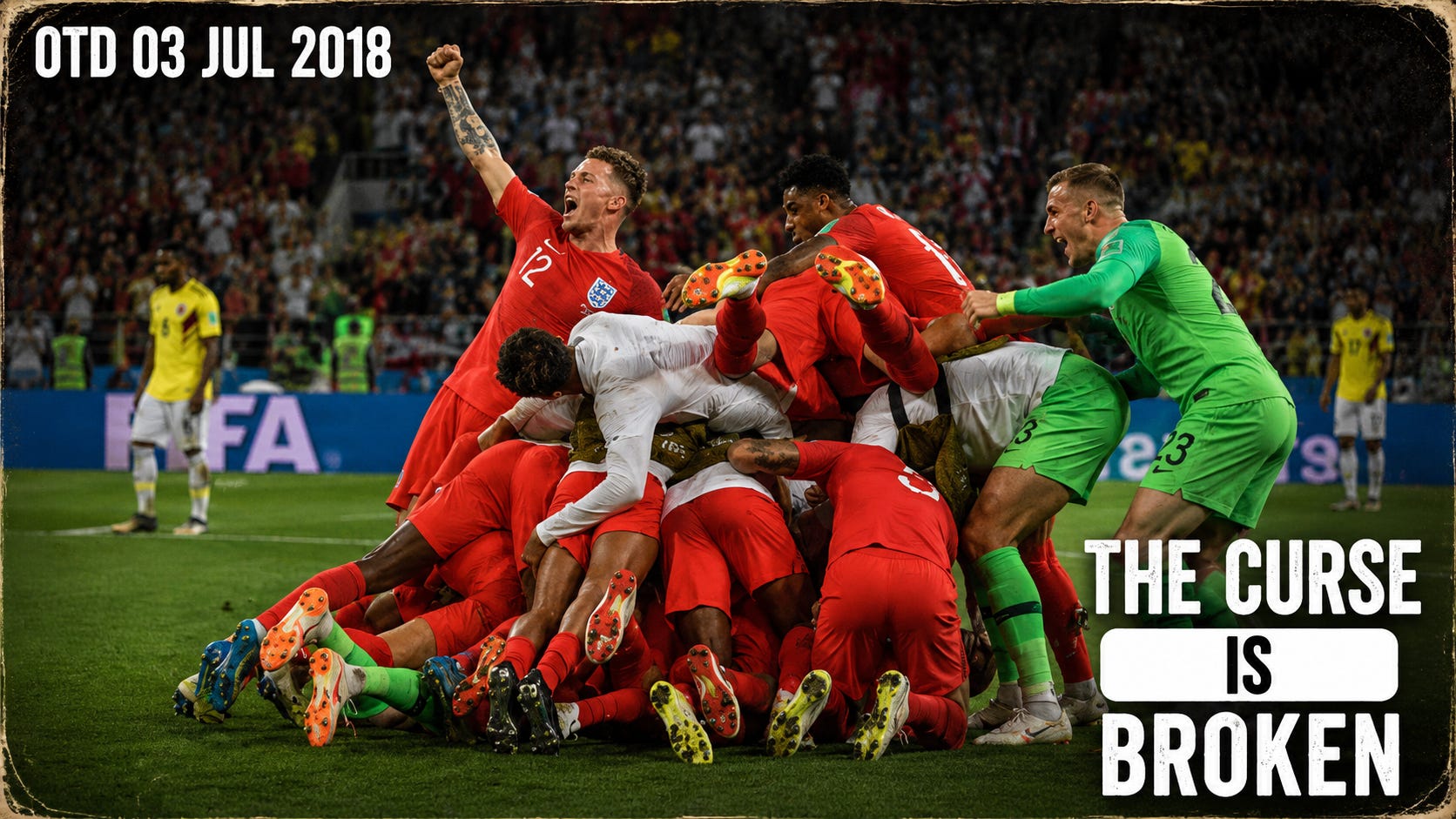
It is 3 July 2018, at the Spartak Stadium in Moscow. Colombia against England, a World Cup round of 16, one-one after extra time, and now a penalty shootout. For almost thirty years, this exact situation has been England’s private nightmare. Not a rival. The shootout itself. And tonight, at last, they win one. Jordan Pickford saves, Eric Dier scores, and a national trauma finally cracks.
The dread was earned. It began in Turin in 1990 and never really left: Euro 96, France 98, Euro 2004, the 2006 World Cup, Euro 2012, a steady drumbeat of misses and eliminations. Somewhere along the way it stopped being bad luck and became identity. England did not simply lose shootouts. They expected to. The long walk from the halfway line had beaten them before the ball was placed, and that expectation was the real opponent.
The man asked to break it understood it from the inside. Gareth Southgate had taken the walk himself in 1996 and missed the kick that sent England out. So his England prepared differently, treating the shootout not as a lottery to be feared but as a skill to be rehearsed: practiced kicks, studied goalkeepers, breathing, routine, ownership. The aim was to turn the moment from a panic into a decision.
Against Colombia it first went exactly as the old script demanded. The match was tense and bad-tempered, Harry Kane’s penalty cancelled out by Yerry Mina’s late header, and when Jordan Henderson’s kick was saved in the shootout, Colombia led and the familiar ending loomed. Then it bent the other way. Uribe struck the bar. Kieran Trippier scored. Pickford, who had done his homework on the takers, threw out a hand to save from Carlos Bacca. And up walked Eric Dier, not Kane, not a glamour name, to slide in the winner.
England won four-three, and the headline that had written itself for decades had to be torn up. It felt like a locked door swinging open, because Southgate had beaten a story as much as a team.
The wider truth is that a shootout is not the lottery people call it. A lottery is random. This is skill under extraordinary compression: the ball still, the goal huge, one keeper to beat, and yet the target seems to shrink with every step. The pressure is not shared equally either. The goalkeeper is expected to fail and can only become a hero, while the taker is expected to score and can only avoid disaster. That asymmetry is what makes the walk so lonely, and what makes some shootouts into permanent mythology.
The curse was not cured that night. England would lose the Euro 2020 final the same way three years later. But it stopped being the whole story. By Euro 2024 they were winning shootouts without flinching, no longer beaten before they began. Even the great penalty superpowers learn that nothing is permanent, in either direction.
🎙️ THE PODCAST GOES DEEPER. The full episode has: how football moved from replays and coin tosses to the shootout, the ritual and Laws that govern it, England’s full history of penalty heartbreak from 1990 to 2012, the Colombia match in detail, the shootouts that became legend from Panenka to Istanbul, and how England’s psychology finally changed. That is the 10-minute version.
---
🎧 Listen on Spotify, Apple Podcasts, Amazon Music, Overcast, iHeart, and YouTube.
📩 Got an episode idea? otd@17lawsguy.com
Yesterday: 2 July 2010, Suárez’s handball that paid off.
Tomorrow: 4 July 1954, Das Wunder von Bern.