

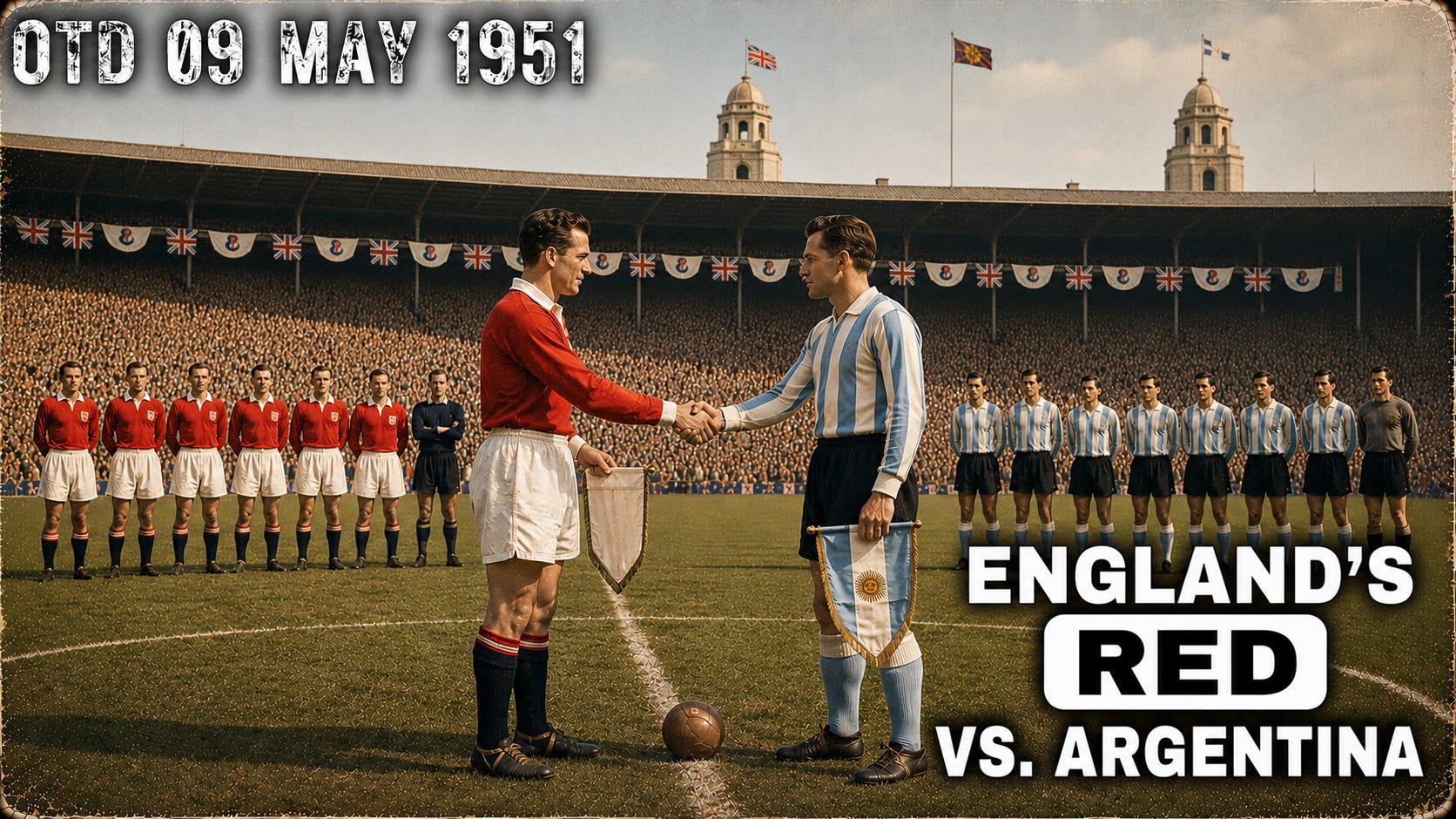
It is 9 May 1951. Wembley. England against Argentina.
A Festival of Britain international, played before almost 100,000 people, with England in red shirts and Argentina in sky blue and white.
It is the first official meeting between these two future World Champions. It is the first time England play a non-British national team at Wembley. And for more than an hour, it looks like Argentina are going to spoil the party.
Then, in the final stretch, England rescue it. England 2, Argentina 1. A Festival match becomes the first chapter in one of international football’s most intense rivalries.
Britain in 1951 is still living in the shadow of war. Austerity. Bombsites. Rationing. The Festival of Britain is designed as a tonic to the nation — not a traditional world fair, not a grand imperial exhibition, but a domestic celebration: to show Britain to itself as modern, inventive and alive. The South Bank gives London the Skylon, the Dome of Discovery, the Royal Festival Hall. Across the country there are exhibitions, arts festivals, science displays, music, film, design — and sport.
Football becomes part of that national stage. The FA builds a Soccer Festival around it. PSV go to Huddersfield. Crvena Zvezda go to Preston. Saarbrücken go to Liverpool. Rapid Vienna, Borussia Dortmund, Dinamo Zagreb, Anderlecht — clubs from across Europe come to play British sides.
But England against Argentina is the centerpiece.
Why Argentina? Argentina were one of the great names of the world game. They had dominated South American football in the mid-1940s. They had not gone to the 1950 World Cup, which made them slightly mysterious to British eyes, but not less glamorous.
And England did need this match. The previous summer, England had gone to their first World Cup in Brazil and suffered the humiliation of losing 1-0 to the United States in Belo Horizonte. For a country that still thought of itself as football’s natural reference point, that result was a wound. Wembley had remained essentially a Home Nations stage. Now Argentina were coming to the Empire Stadium.
There is one striking detail before kick-off. England do not wear white. They wear red because the referee decides the usual England white does not contrast clearly enough with Argentina’s sky blue and white stripes. So this is also the first time England wear red at Wembley.
The match is not gentle. Argentina are technically sharp, compact and clever. Their coach is Guillermo Stábile, the top scorer at the first World Cup in 1930. Their goalkeeper Miguel Rugilo — “Tarzan” to the Argentine public — is at the back. Their attack includes Mario Boyé, Norberto Méndez, Rubén Bravo, Ángel Labruna and Félix Loustau.
England have Walter Winterbottom as manager and Billy Wright as captain. Bert Williams in goal. Alf Ramsey at right-back. Tom Finney, Stan Mortensen and Jackie Milburn lead the attack.
Argentina score after eighteen minutes. Boyé heads in from close range. Wembley is stunned.
England push back. Milburn hits the post. Rugilo makes saves, sometimes brilliantly, sometimes theatrically. Argentina draw England into pressure, then block the central route. England have plenty of the ball, plenty of urgency, but not enough incision.
At half-time, Argentina lead 1-0. The longer the second half goes on, the more dangerous the occasion becomes. England are not just losing a friendly. They are losing a Festival showcase, at Wembley, against the first overseas national team to play them there.
Then, with around ten minutes left, the pressure finally tells. Tom Finney’s corner. Mortensen stoops in and heads England level. One-one.
Now Wembley changes. Four minutes from the end, Alf Ramsey’s free kick is worked into the danger area. Mortensen helps it on, and Jackie Milburn finishes from close range.
Two-one England. England have escaped.
The 1951 game is not yet the great rivalry as we know it. There is no Falklands shadow. No Hand of God. No Beckham red card. No Rattín controversy.
But the ingredients are already there. English directness against Argentine technique. Wembley authority against South American confidence. The self-declared home of football against one of football’s great rival civilizations.
Then the later matches add layers. 1962 in Chile: England 3-1. 1966 at Wembley: England 1-0 after Rattín is sent off. 1986 in Mexico City: Maradona gives the rivalry its defining contradiction — Hand of God and Goal of the Century in the same match, four years after the Falklands. 1998: Owen’s wonder goal, Beckham’s red card, Argentina win on penalties. 2002: Beckham’s revenge penalty.
So the 1951 match matters because it is the first meeting, but also because it shows how much meaning can gather around a football fixture before anyone knows it is becoming history.
A Festival match. A red-shirted England. A late Wembley rescue. And the opening scene of a rivalry that will become about style, temper, politics, memory, pain and pride.
---
🎧 Also available on Apple Podcasts, Amazon Music, Overcast, iHeart, and YouTube.
📩 Got an episode idea? otd@17lawsguy.com
Yesterday: 8 May 1954 — The Birth of Asian Football’s Home.
Tomorrow: 10 May 1987 — Naples crowned by Diego.