

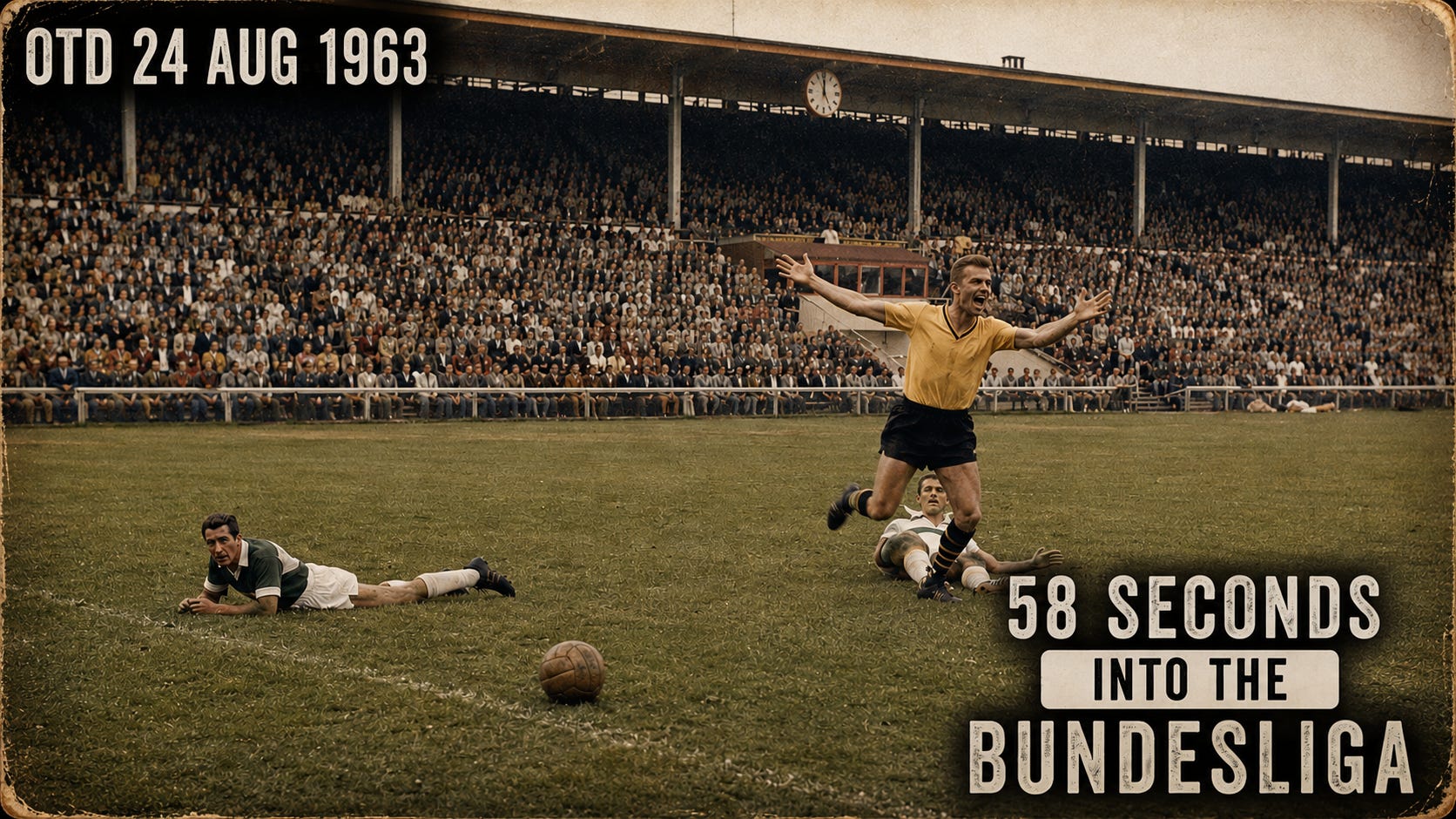
It is August 24, 1963, in Bremen, and the new Bundesliga is not quite behaving. Kickoff is set for 5pm, but referee Alfred Ott blows his whistle at 4:58, and 58 seconds later Lothar Emmerich races down the left, crosses, and Friedhelm “Timo” Konietzka scores the first goal in Bundesliga history. By the time 5pm formally arrives, Germany’s new national league already has a scorer. Nobody even captures it properly: the cameraman is not ready, the photographers are waiting behind the wrong goal. The competition West German football had argued about for decades had begun almost faster than anyone could document it.
The argument was the whole point. For years West Germany had resisted what England, Italy and Spain already had, a single national top division, preferring regional Oberligen that fed a national championship playoff. Franz Kremer of 1. FC Köln campaigned relentlessly for reform, Sepp Herberger wanted the country’s best players testing one another every week, and Hermann Neuberger supplied the political skill. On July 28, 1962, in Dortmund, the DFB delegates finally voted 103 to 26 for one table, one champion, one national division. Then came the hard part. 46 clubs applied for 16 places, judged on results, finances, stadiums and regional balance: five from the West, five from the South, three from the North, two from the Southwest and one from West Berlin. Bayern Munich were left out. So were Borussia Mönchengladbach and a long line of furious applicants. It was not yet open professionalism either. The new Lizenzspieler could earn more without proving he held another job, but wages and transfer fees stayed capped. Germany had built an elite league without quite admitting it had embraced the professional game.
Thirteen months after the vote, 16 clubs were ready, and eight matches kicked off on the same Saturday. In Bremen, after Konietzka’s early strike, Werder recovered to win 3-2, with Sepp Piontek, later the architect of Danish Dynamite and mourned when he died in February 2026, in their defense. Across the country, the class of 1954 passed on the torch. Max Morlock, 38, scored Nürnberg’s first Bundesliga goal in Berlin. Helmut Rahn, whose strike had won the 1954 World Cup, scored as Meidericher SV won 4-1. Hans Schäfer captained Köln, though it was 19-year-old Wolfgang Overath who opened a 2-0 win. Frankfurt produced the first Bundesliga penalty, and Uwe Seeler, quiet at Münster that day, would finish the season as its first 30-goal top scorer. Eight games, 22 goals, and 327,000 spectators: the first answer to everyone who had warned that a national league would empty the grounds. It did not.
Köln then showed exactly why Kremer had fought so hard. Already better organized, better equipped and better trained than most German clubs, and blessed with Schäfer, Overath and Christian Müller, they lost only twice in 30 matches and finished six points clear of Meidericher SV as the first Bundesliga champions. You might expect a dynasty. Instead the opposite arrived: the first seven seasons produced seven different champions, Köln, Werder Bremen, 1860 Munich, Eintracht Braunschweig, Nürnberg, Bayern Munich and Borussia Mönchengladbach, with nobody defending the title until Gladbach in 1971. And here is the irony, because Bayern and Gladbach had not even been invited in 1963. Both arrived in 1965, and German football reshaped itself around them, Gladbach as the thrilling young challenger, Bayern becoming Bayern.
The reformers’ other goal arrived too. West German football grew stronger abroad. Borussia Dortmund won the Cup Winners’ Cup in 1966, Bayern won three straight European Cups from 1974, Gladbach collected UEFA Cups, and Helmut Schön built national teams around players facing elite opposition every weekend. West Germany won EURO 1972 and the 1974 World Cup, the 1972 side drawing heavily on Bayern and Gladbach, which was more or less exactly what Herberger had promised: concentrate the elite, raise the weekly standard, lift the national team. East of the border, a separate football world ran inside the DDR-Oberliga, sometimes in uncanny parallel. In 1974 Bayern became European champions, Magdeburg won the Cup Winners’ Cup, and East Germany beat West Germany 1-0 at a World Cup the West would go on to win. Reunification eventually joined the two, Hansa Rostock and Dynamo Dresden entering an expanded 20-team Bundesliga for 1991-92 before it settled back to 18.
Then came dominance nobody in 1963 could have pictured. By 2026 Bayern Munich hold 34 Bundesliga titles, including 11 in a row from 2013, broken by Leverkusen in 2024 before Bayern won again in 2025 and 2026. The league became far less balanced than its opening year suggested. But the real achievement was never the identity of the champion. Before August 24, West Germany had regional leagues and a playoff. After it, there was one permanent weekly stage, one table, one national conversation, tying clubs, players, coaches and supporters together every Saturday. Sixteen clubs had finally stopped arguing about the Bundesliga, and played it.
---
🎧 Listen on Spotify, Apple Podcasts, Amazon Music, Overcast, iHeart, and YouTube.
📩 Got an episode idea? otd@17lawsguy.com
Yesterday: 23 August 1930, three names, one stadium.
Tomorrow: 25 August 1928, English football tries a radical idea: numbers on the backs of shirts.