

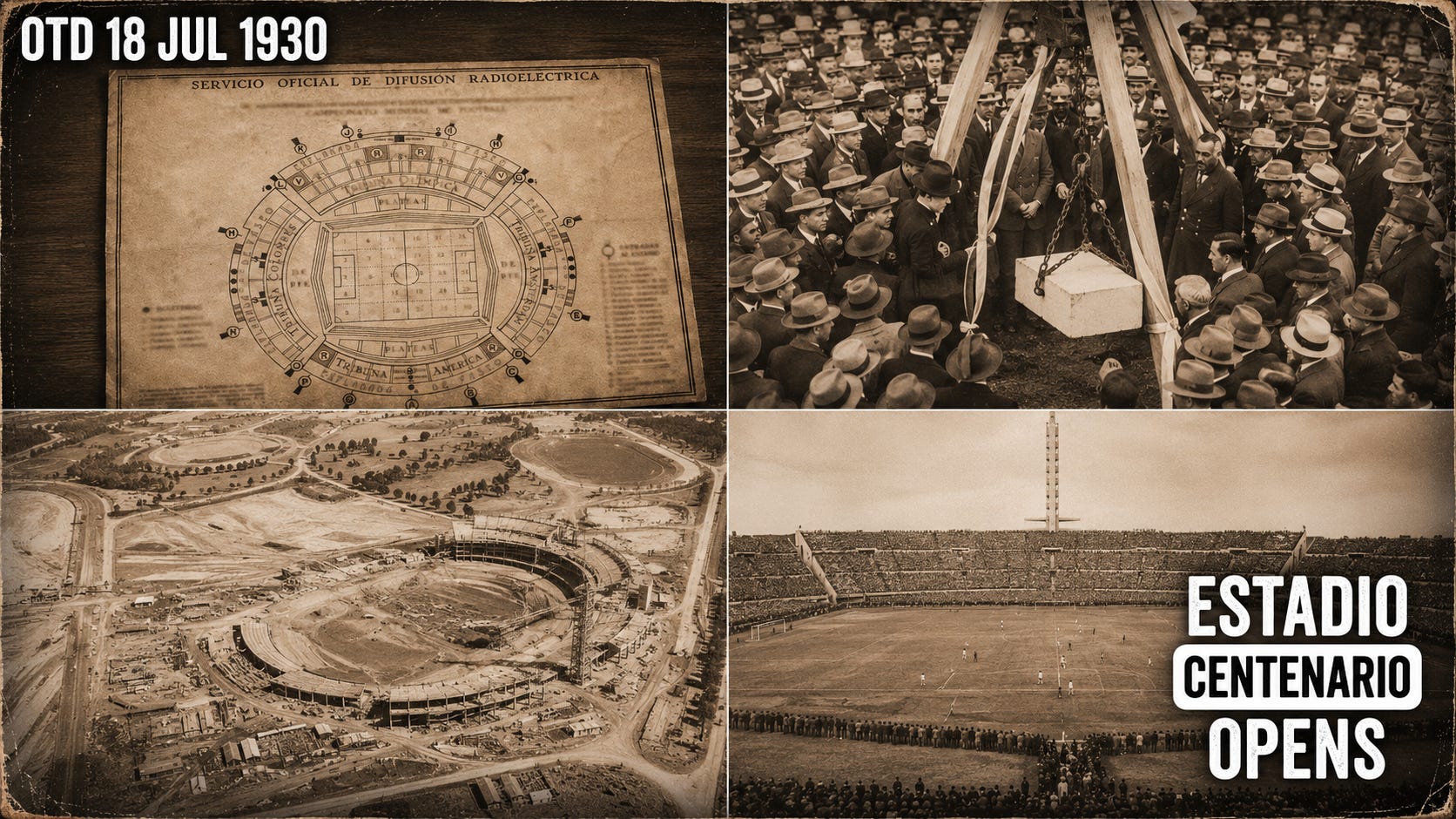
It is July 18, 1930. Montevideo. A national holiday: the centenary of Uruguay’s first constitution. And on this day, a stadium opens. The Estadio Centenario, built for the first World Cup and for a hundred-year national celebration, because one small country wanted to show the world two things at once: we are a nation, and we are a football nation.
Uruguay against Peru is the match. Uruguay win 1-0, and Héctor Castro scores. But the main character is the stadium: concrete still fresh, work barely finished, a giant bowl that missed the start of the tournament but was ready for the date that mattered most.
By 1930, Uruguay had become one of the strongest football nations on earth. The game arrived in the late 1800s through British influence, ports, railways, and the Río de la Plata corridor between Montevideo and Buenos Aires. In 1916, while Europe was deep inside the First World War, CONMEBOL was founded and the South American Championship began. Then Uruguay went global: Olympic gold in Paris in 1924, when Europe first fully understood that South American football was not exotic but elite, and gold again in Amsterdam in 1928. So when FIFA decided in 1928 to create its own world championship, Uruguay made the perfect pitch: double Olympic champions, centenary year, a supportive government, help with travel costs, and a promise. Not an old club ground. A national stage.
Then the race began. The site was in what is now Parque Batlle, and the architect, Juan Antonio Scasso, designed with the land rather than on top of it, carving the bowl into a natural depression. The cornerstone was laid in July 1929. About 160,000 cubic meters of earth were moved; around 1,100 laborers worked three shifts a day; concrete work began in early 1930. The deadline was brutal: the World Cup started July 13, the centenary was July 18, and Montevideo winter did not care about FIFA. Rain slowed everything. The Centenario missed the opening matches, so Pocitos and the Gran Parque Central filled in.
But Uruguay themselves waited, for July 18, for the national holiday. And the stadium was ready enough. Not polished. Open. The turf laid, the stands risen, the Tower of Tributes watching over it, and the floor dried only the day before with heaters and electric stoves. The first great World Cup stadium entered history still drying.
The match itself is pressure, not parade. Almost 58,000 people, nervous and demanding, watch Peru resist. Then, in the second half, Héctor Castro scores. El Divino Manco, the one-armed divine, who had lost part of his right arm in a teenage accident, scores the first goal in the history of the Estadio Centenario. Uruguay 1, Peru 0. The stadium opens. The host nation wins. The building breathes.
What the Centenario gives the World Cup is scale. Pocitos and Parque Central gave the tournament its beginning; the Centenario gives it architecture, a stage that looks like the ambition. It hosts both semi-finals and then the final, Uruguay 4-2 Argentina, the Río de la Plata rivalry inside the new national monument. First World Cup, first World Cup final, first great World Cup stadium, all tied to the same concrete bowl.
And then it becomes what great stadiums become: a memory machine. The entire 1942 South American Championship. Nacional against Peñarol, again and again. The first Copa Libertadores match in 1960, and the first Intercontinental Cup match the same year. The Battle of Montevideo in 1967. The Mundialito in 1981, Uruguay beating Brazil 2-1 once more. In 1983, FIFA declared it a Historic Monument of World Football, the only building of its kind. In November 2026, the Copa Libertadores final comes to Montevideo. And in 2030, the centenary World Cup is planned to open at the Centenario: one hundred years after the first World Cup, two hundred after the constitution. Not because Uruguay is the biggest market. Because origin matters.
🎙️ THE PODCAST GOES DEEPER. The full episode has Scasso’s construction race, the stadium’s century of firsts, and the road to the 2030 centenary opener. That’s the 10-minute version.
---
🎧 Listen on Spotify, Apple Podcasts, Amazon Music, Overcast, iHeart, and YouTube.
📩 Got an episode idea? otd@17lawsguy.com
Yesterday: 17 July 1994, Baggio’s penalty and the first World Cup decided from the spot.
Tomorrow: 19 July 1966, two sensations: Eusébio’s Portugal knock out Brazil, and North Korea knock out Italy.
It is obvious: Argentina got robbed in the final of 2026 as in the finals of 1990 and 2014. FIFA favoured Spain with a better calendar (one more day of rest) and also Spain had BIG help from the referee
https://ezequieldoiny.substack.com/p/it-is-obvious-argentina-got-robbed?utm_source=share&utm_medium=android&r=8t2s5