

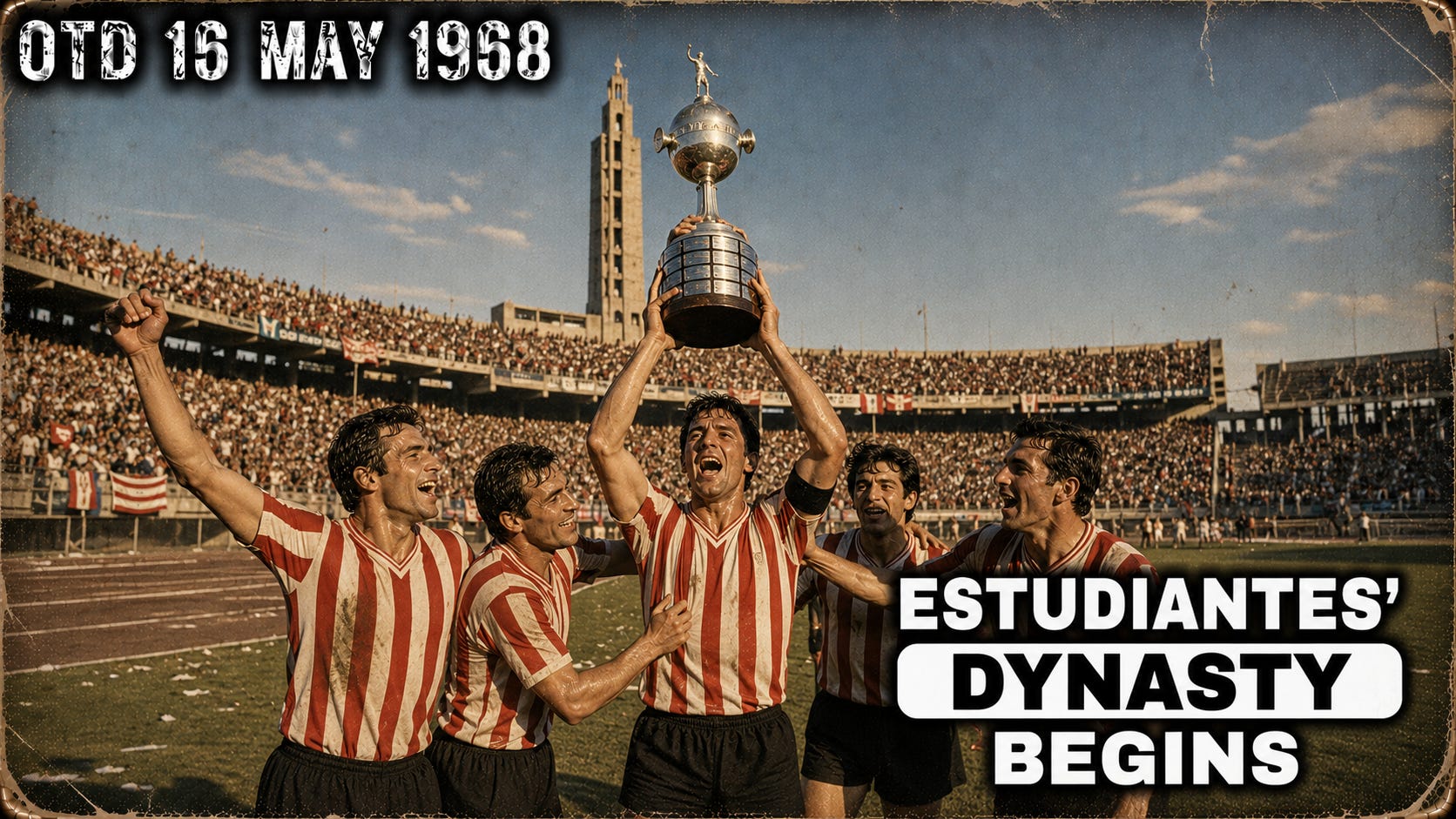
It is 16 May 1968. Estadio Centenario, Montevideo. Estudiantes de La Plata against Palmeiras. A playoff to decide the Copa Libertadores.
And Estudiantes, a club that only a year earlier had never been champion of professional Argentina, win 2-0.
Felipe Ribaudo scores early. Juan Ramón Verón seals it late.
Estudiantes are champions of South America.
Not Boca. Not River. Not Independiente. Not Racing. Not San Lorenzo.
Estudiantes.
And this is not a one-off shock. It is the beginning of a dynasty: three straight Libertadores, an Intercontinental Cup, and one of the most fascinating — and controversial — teams South America has ever produced.
For decades, Argentina’s professional game had been owned by the so-called Big Five: Boca Juniors, River Plate, Independiente, Racing Club and San Lorenzo. From the start of professionalism in 1931, they monopolized the league title. They were the institutions, the crowds, the power, the mythology.
Estudiantes were not in that room. They were from La Plata, founded in 1905, red and white, “El Pincha.” They had won an amateur-era title in 1913 and produced good sides, good players, and strong local identity. But in the professional era, before the late 1960s, they were not supposed to rule Argentina — let alone the continent.
Then Argentine football changed its structure. In 1967, the league was split into two championships: the Metropolitano in the first half of the year and the Nacional in the second. Estudiantes, under Osvaldo Zubeldía, made the new format their opportunity.
Zubeldía is central here. He was not building romantic football. He was building prepared football. Film study. Set pieces. Offside traps. Physical conditioning. Tactical discipline. Psychological pressure. Every detail mattered. Every throw-in mattered. Every corner mattered. Every weakness in the opponent was to be found and used.
This was football as engineering.
And the squad fitted him. Alberto Poletti in goal. Oscar Malbernat, the captain. Ramón Aguirre Suárez. Raúl Madero. Carlos Pachamé. Carlos Bilardo, the future World Cup-winning coach of Argentina. Eduardo Flores. Felipe Ribaudo. Marcos Conigliaro. And Juan Ramón Verón, “La Bruja” — the Witch — the player who gave the side magic inside all that structure.
In the 1967 Metropolitano final, Estudiantes met Racing — the reigning Copa Libertadores holders, the side that had just won the Intercontinental Cup against Celtic. Estudiantes won 3-0. Madero. Verón. Ribaudo. The first professional Argentine league title won by a club outside the Big Five.
In the 1968 Copa Libertadores, the path was not soft. They were grouped with Independiente — winners of the Libertadores in 1964 and 1965 — plus Deportivo Cali and Millonarios. They beat Independiente twice. In the second phase, they met Independiente again. In the semi-final, they met Racing. The champions of South America and the world.
Estudiantes won the first leg 3-0 in La Plata. Racing won 2-0 in Avellaneda. A playoff ended 1-1. Estudiantes advanced on goal difference.
Their path ran through both Independiente and Racing. Not one power, but two.
Then came Palmeiras. First leg, La Plata, 2 May 1968: Palmeiras led through Servílio. Then, very late, Verón equalized in the 83rd. Eduardo Flores scored in the 87th. 2-1 Estudiantes. Second leg, São Paulo, Pacaembu, 7 May: Palmeiras won 3-1. Level on points.
The neutral-venue playoff was at the Centenario in Montevideo — the stadium of the first World Cup final, the theatre of South American football memory.
Ribaudo scored in the 13th minute. Then Estudiantes did what Zubeldía teams do. They managed the match. They closed space. They frustrated. They competed at the edge of the law and sometimes beyond the edge of taste. But they were not merely destructive. They were intelligent. They knew where the game was. They knew what the score required.
And in the 82nd minute, Verón made it 2-0.
Estudiantes were champions of America.
A small club, unknown to many on the continent just months earlier, had beaten Independiente, Racing and Palmeiras. That is not luck. That is a football program announcing itself.
It was not a fluke. Estudiantes followed the 1968 Libertadores by beating Manchester United in the Intercontinental Cup. They won 1-0 in Buenos Aires, then drew 1-1 at Old Trafford. Verón scored there too, with a header that silenced the European champions.
That goal at Old Trafford became part of the Verón family mythology. Decades later, Juan Ramón’s son, Juan Sebastián Verón, would join Manchester United. Not because football law required it. But as football poetry, it felt almost compulsory: the son of the Witch arriving at the club his father had wounded.
Then Estudiantes kept winning. In 1969, Nacional of Uruguay. In 1970, Peñarol. Three in a row.
And there is the necessary balance. Zubeldía’s Estudiantes modernized preparation. They influenced Carlos Bilardo, and through Bilardo you can draw a line to Argentina’s 1986 World Cup victory. But they also helped give South American club football one of its darker reputations: intimidation, provocation, gamesmanship, and violence as tools of survival. The Intercontinental Cup had already been poisoned by Racing and Celtic in 1967. Estudiantes and Milan in 1969 took the problem even further.
They tried to win a fourth straight Libertadores in 1971. In the semi-final group, Barcelona of Guayaquil came to La Plata and beat them 1-0 through Juan Manuel Basurco — El Padre Bazurko, the footballing priest. It was Estudiantes’ first home defeat in the Libertadores during that great run.
They still reached the final. But Nacional beat them in a playoff in Lima.
The tetracampeonato was gone. And with it, the era began to close.
Then came the long wait. Estudiantes would win Argentine titles again. Bilardo himself would return them to the championship in 1982. But the Libertadores? That disappeared for thirty-nine years. Until 2009. And at the centre of that resurrection was Juan Sebastián Verón — La Brujita, the little witch — carrying the bloodline of 1968 back to the continental throne.
That is why 16 May 1968 matters. It is not just Estudiantes’ first Libertadores. It is the day a club outside the old Argentine aristocracy became the most feared team in South America.
🎙️ The full episode (linked above) has more — including the deeper Zubeldía methodology, the controversial Milan Intercontinental Cup of 1969, the politics that led European clubs to refuse the competition, and the full arc to Estudiantes’ 2009 Libertadores resurrection with Juan Sebastián Verón. The whole arc is in the audio.
---
🎧 Also available on Apple Podcasts, Amazon Music, Overcast, iHeart, and YouTube.
📩 Got an episode idea? otd@17lawsguy.com
Yesterday: 15 May 1974 — Jinky Lost at Sea.
Tomorrow: 17 May 1989 — Atlético Nacional, Danubio, and a Libertadores semi-final stress-tested by narco power.