

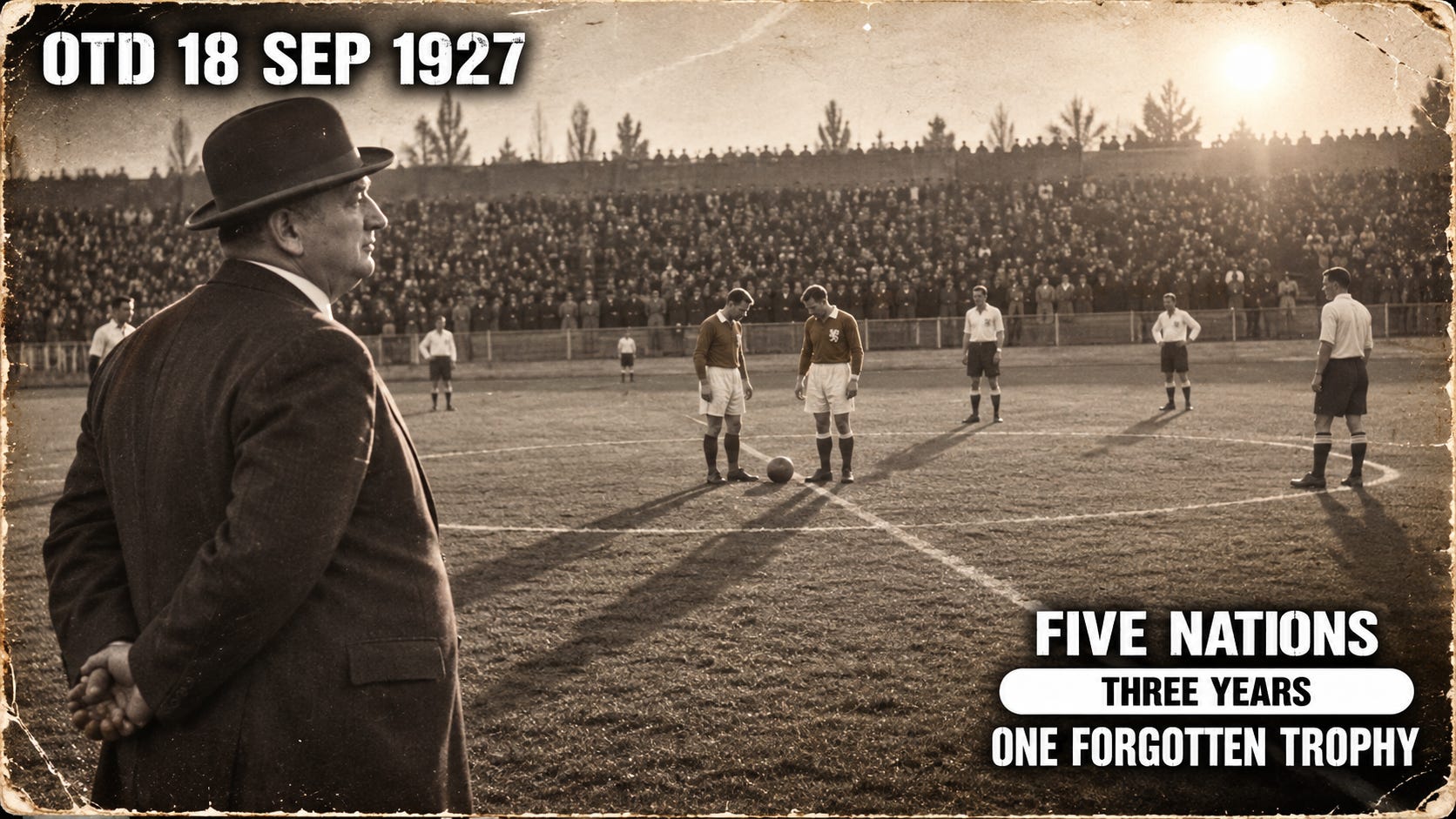
It is September 18, 1927, in Prague, and twenty-five thousand people have gathered at the vast Strahov Stadium for Czechoslovakia against Austria. František Podrazil scores after ten minutes, Josef Kratochvíl adds a penalty after the break, and Czechoslovakia win 2-0. It looks like just another international between neighbours. It is not. This is the opening game of the International European Cup: five national teams, home and away, a league table, and a trophy for the best team in the footballing heartland of the continent. Thirty-three years before the first UEFA European Championship, international football had created its first “Euro.”
How did we get here?
Europe in 1927 was still living with the consequences of the First World War. The Austro-Hungarian Empire had vanished, and Austria, Hungary and Czechoslovakia now existed as separate states with redrawn borders. But their football relationships had not been redrawn with them. Vienna, Budapest and Prague remained part of the same sporting conversation: coaches moved between them, players met in cafes, clubs toured across the new frontiers, and ideas about passing, movement and tactics travelled along the old railway lines of the empire. And while England still thought of itself as football’s teacher, Central Europe was building something different, organized professionalism. Austria introduced a professional league in 1924, Czechoslovakia followed in 1925, Hungary in 1926, and Italy was reorganizing its game around a national professional competition too. Professional football needed regular matches, reliable income and opponents who could draw crowds. Friendly internationals were no longer enough, and the leading nations wanted competition with continuity.
The central figure was Hugo Meisl, the Austrian administrator who did not see national teams as occasional collections of talented players but as continuous projects that needed repeated competition, selection, a tactical identity and a calendar. In November 1926, football officials meeting in Prague discussed a European cup for national teams, open regardless of whether players were amateur or professional. That distinction mattered enormously. The Olympic tournament was still international football’s greatest established competition, but Olympic amateurism was increasingly at odds with the reality of the sport, because several of Europe’s strongest football countries now paid their players and could therefore be excluded, weakened or forced into ever more artificial definitions of amateurism. Meisl’s answer was a proper European competition. In France, Henri Delaunay was thinking internationally too, though his ambitions pointed toward a worldwide FIFA competition rather than a regional one.
These ideas did not immediately produce a single unified tournament. They produced several overlapping experiments. The Mitropa Cup, also launched in 1927, let leading clubs from Central Europe play across national borders, giving club football frontiers to cross. The International Cup made the same regional idea work at national-team level. And elsewhere on the continent, regional bodies were creating their own meaningful competitions, from the Baltic Cup northward, while FIFA, the Olympic movement and the national federations argued about professionalism and control. The International Cup was the grandest of them. Its official French name was the Coupe Internationale Européenne, the European International Cup. But it was not open to all of Europe. Its five founders were Austria, Czechoslovakia, Hungary, Italy and Switzerland, four of them among the continent’s leading powers. England, Scotland, Wales and Ireland already had their Home Championship; France, Spain, Germany and the Scandinavian nations were absent. There was no UEFA, no qualifying tournament, no host country and no concentrated finals. Instead, the five teams formed a league, each playing every other home and away, two points for a win, twenty matches in all, and there was no rush: the first edition would take almost three years to complete, pausing for the 1928 Olympics along the way. That leisurely pace was the point. A tour of friendlies would have been forgotten by winter, but a standings table sat there across seasons, holding every result, from the opening day in Prague onward, until a champion finally emerged. The prize was a Bohemian crystal trophy donated by the Czechoslovak prime minister, Antonín Švehla, and it thus became known as the Švehla Cup.
So the experiment began in Prague, at four o’clock, on September 18, 1927. Austria were coached by Meisl, but this was not yet the Wunderteam of Matthias Sindelar that would enchant Europe in the early 1930s; the ideas were still developing, the masterpiece still being assembled. Czechoslovakia struck first through Podrazil in the tenth minute, led 1-0 at the interval, and ten minutes after the restart Kratochvíl converted his penalty. Czechoslovakia 2, Austria 0. The first goal in Europe’s first sustained international championship belonged to František Podrazil, and the first winners were Czechoslovakia. But neither would win the tournament. A week later Austria lost again, 5-3 in Hungary; Italy entered in October with a 2-2 draw against Czechoslovakia; and then the league stretched across seasons, pausing for the 1928 Olympic Games while players changed, teams developed and fortunes reversed. By the end of 1929, Austria and Czechoslovakia led on ten points with Italy and Hungary on nine, and it all came down to the final fixture on May 11, 1930: Hungary against Italy in Budapest, Italy needing to win, and Vittorio Pozzo’s team winning 5-0. After twenty matches and eighty-six goals, Italy were the first champions on eleven points, one ahead of Austria and Czechoslovakia.
So what?
The first thing is that it gave international football something friendlies never could: a table, and a table creates memory. A defeat in September still mattered two years later, a match now had consequences beyond the afternoon it was played, and national teams became continuing stories rather than temporary selections. This was no minor rehearsal by minor countries, either. It was sharpening the teams that would define the next decade. Italy went on to win the World Cups of 1934 and 1938; Austria developed into Meisl’s Wunderteam and won the next International Cup; Czechoslovakia reached the 1934 World Cup final; Hungary reached the 1938 final. Later editions would gather the Magical Magyars of the 1950s and a Czechoslovak generation bound for the 1962 World Cup final. This forgotten league kept assembling some of the best national teams on earth.
The second thing is that it made professionalism part of international competition. The Olympics claimed universality, but its amateur rules were increasingly incompatible with Europe’s most advanced football cultures. The International Cup put sporting strength above amateur status and simply let the best play the best. And the third thing is that it helped build a shared Central European football world. The five countries were rivals, but their football developed through contact: managers studied opponents, players grew familiar with different systems, and the club and national competitions reinforced one another. The Mitropa Cup was a professional laboratory below; the International Cup was another above.
So was this really the first European Championship? Yes and no. Yes, because it was the first sustained multinational league for leading senior national teams on the European continent, its very name called it a European International Cup, and it awarded a trophy to the best team in the strongest organized region of European football. But no, because it was not genuinely pan-European: membership was limited, most of the continent had no route in, it had no connection to a UEFA that would not exist until 1954, and today’s European Championship did not formally descend from it. Delaunay’s pan-European idea followed a separate institutional road, and the first UEFA European Nations’ Cup began in 1958, with its final tournament held in France in 1960. The timing is striking, because the Central European International Cup staged its own last matches in 1960, the very year the UEFA competition crowned its first champion. One version of Europe ended as another began. The old tournament was regional, slow and centred on football’s Danubian heart; the new one belonged to a continent-wide governing body. Yet the older competition had already proved the essential idea: European national teams could meet in an organized competition, across several seasons, with points, standings and a championship at stake. The modern Euro did not appear from nowhere. It arrived after three decades in which Europe had already been practising.
Three things to take away
First, on September 18, 1927, Czechoslovakia’s 2-0 win over Austria opened the first Central European International Cup. Podrazil and Kratochvíl scored in Prague; Italy, three years later, took the trophy.
Second, it was not the UEFA European Championship, but it was Europe’s first sustained championship league for leading senior national teams. Points, standings, home and away, and a trophy for the best in the region.
Third, it belonged to the same Central European revolution as the Mitropa Cup. Professional leagues, regular international competition and tactical exchange were pulling football’s centre of ideas away from Britain and toward Vienna, Prague, Budapest and, increasingly, Italy.
On this day in 1927, Podrazil and Kratochvíl scored in Prague, Czechoslovakia won the match, and Italy eventually won the trophy. Thirty-three years before UEFA crowned its first European champion, Europe’s original international championship had already begun.
---
📩 Got an idea to an OTD story? otd@17lawsguy.com
Yesterday: 17 September 1969, Feyenoord score twelve away goals at home against KR Reykjavík.
Tomorrow: 19 September 1926, San Siro opens with a nine-goal match, and the president who built it loses the derby.
A very wonderful article and a great narration, it is wonderful that there is someone who talks about the past and knows its importance