

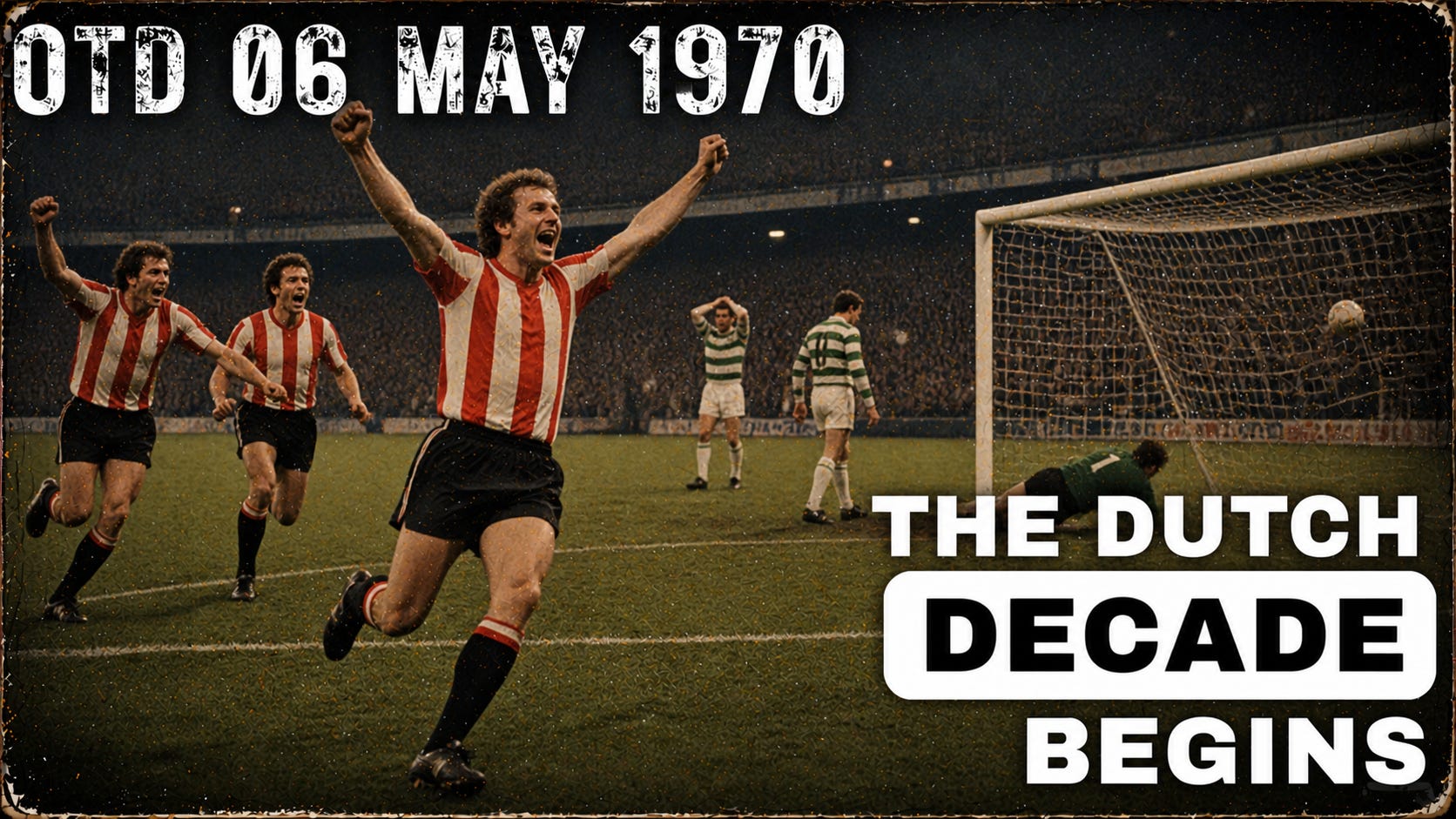
It is 6 May 1970. San Siro, Milan. Celtic against Feyenoord.
And if you know football history mostly through the bright orange shirt of the Netherlands in 1974, or through Cruyff’s Ajax winning three straight European Cups, this night can feel like the prologue.
But it is more than that.
Because before Ajax conquer Europe, before Total Football becomes a phrase everyone thinks they understand, before the Dutch national team make the world dizzy in West Germany, there is Feyenoord.
Red and white. Rotterdam. Ernst Happel. Rinus Israël. Willem van Hanegem. Ove Kindvall. And against Celtic, one of Europe’s great sides, Feyenoord become the first Dutch club to win the European Cup.
The trophy goes to the Netherlands for the first time. And Dutch football, almost overnight, stops being a promise and becomes a power.
Europe before 1970 had a clear geography of power. Real Madrid had dominated the beginning so completely that the European Cup almost looked designed for them: five straight titles from 1956 to 1960. Then Benfica took over with Eusébio. Then Italy: Milan, then Inter, then Milan again. England and Scotland had broken through too — Celtic in 1967, Manchester United in 1968.
And the Netherlands? The Netherlands were coming.
Ajax had already announced that something was changing. In 1969, they became the first Dutch club to reach the European Cup final. Rinus Michels was the coach. Johan Cruyff was the face of the future. But Milan beat them 4-1 in Madrid. The system that would become Total Football had reached the stage and been taught a lesson by old European authority.
So one year later, when Feyenoord reached the final, the story was not yet Dutch superiority. It was Dutch possibility.
Feyenoord’s path was not soft. They demolished KR Reykjavík, then eliminated the holders AC Milan, then ASK Vorwärts Berlin, then Legia Warsaw. Their manager was Ernst Happel — the Austrian who gave the side steel as well as intelligence. Happel was not Rinus Michels. He was sharper, colder, more pragmatic. His famous instruction: enough talking, play football. But under him, Feyenoord were tactically mature. Compact when they needed to be, technical in midfield, physically strong, ruthless when the moment arrived.
And the players mattered. Rinus Israël, captain. Willem van Hanegem, brilliant left foot, deep intelligence, one of the great Dutch midfielders. Wim Jansen, the link player. Coen Moulijn, club symbol. And Kindvall, the Swedish striker, already a phenomenon in Rotterdam.
This was not Ajax’s story with different shirts. This was Rotterdam’s own road to Europe.
Then there was Celtic. They were a measuring stick. Three years earlier, in Lisbon, Jock Stein’s Celtic had beaten Inter and become the first British club to win the European Cup. The Lisbon Lions were not merely champions. They were proof that an attacking, local, brilliantly coached side could defeat Italian defensive authority on the biggest stage.
By 1970, Celtic were back. The semi-final made them look like giants again. They beat Don Revie’s Leeds in what became known as the Battle of Britain — at Elland Road, then again at Hampden Park in front of 136,505 people, still one of the most astonishing attendances in European club football history.
So Celtic arrived in Milan with status. They had done this before. They had beaten Inter. They had beaten Leeds. Many assumed Feyenoord were next.
But finals punish assumptions.
The match began with Celtic looking for the old script. Gemmell, scorer in Lisbon, scored again in Milan. For a few moments, it felt like Celtic history was repeating itself: the full-back with the cannon shot, the big European night, the green-and-white machine.
But Feyenoord did not flinch. Almost immediately, Israël headed them level.
That goal changed the emotional structure of the final. Celtic no longer had a lead to manage. Feyenoord now knew they could hurt them. As the match settled, the Dutch side grew stronger. Van Hanegem began to impose rhythm. Feyenoord’s extra control in midfield began to matter. Ninety minutes passed. Still 1-1.
Extra time. And this is where the symbolic shift became physical. Celtic looked increasingly exhausted. Feyenoord kept finding legs, angles, and belief.
Then came the Kindvall moment. A long free kick. A defensive misjudgment. A striker alert to the one second that mattered. Kindvall lifted it over Williams.
2-1 Feyenoord. There was still time to play, but the future had already moved.
What happened next is the part most people miss.
Feyenoord won in 1970. Ajax won in 1971. Ajax won again in 1972. Ajax won again in 1973. For four straight seasons, the European Cup belonged to the Netherlands.
Feyenoord made the breakthrough. Ajax turned it into doctrine. The Dutch national team carried the idea into 1974, where the Oranje did not win the tournament but still changed how football imagined space, pressing, rotation and identity.
The lazy version of the story is: Ajax invented Total Football, Cruyff embodied it, everyone else watched. The better version is that Dutch football in the late 1960s and early 1970s was a wider ecosystem. Feyenoord had already shown that Dutch football could survive the practical demands of Europe — pressure, physicality, hostile venues, extra time, great opponents.
Without Feyenoord, the Dutch takeover begins differently.
And Celtic? For Celtic, Milan became the great missed second crown. They reached European Cup semi-finals again in 1972 and 1974. But they never returned to a European Cup final. Lisbon remained the summit. Milan became the fork in the road.
In 1967, Celtic had helped destroy the idea that Italian defensive orthodoxy was untouchable. In 1970, Feyenoord helped show that the next tactical age might belong somewhere else entirely.
Maybe that is the real historical weight of 6 May 1970. It is not just the first Dutch European Cup. It is the handover between eras. From Latin and British authority to northern European movement. From the old map to the new one. From Celtic’s Lisbon dream to the Dutch decade.
---
🎧 Also available on Apple Podcasts, Amazon Music, Overcast, iHeart, and YouTube.
📩 Got an episode idea? otd@17lawsguy.com
Yesterday: 5 May 1918 — The First Coupe de France Final.