

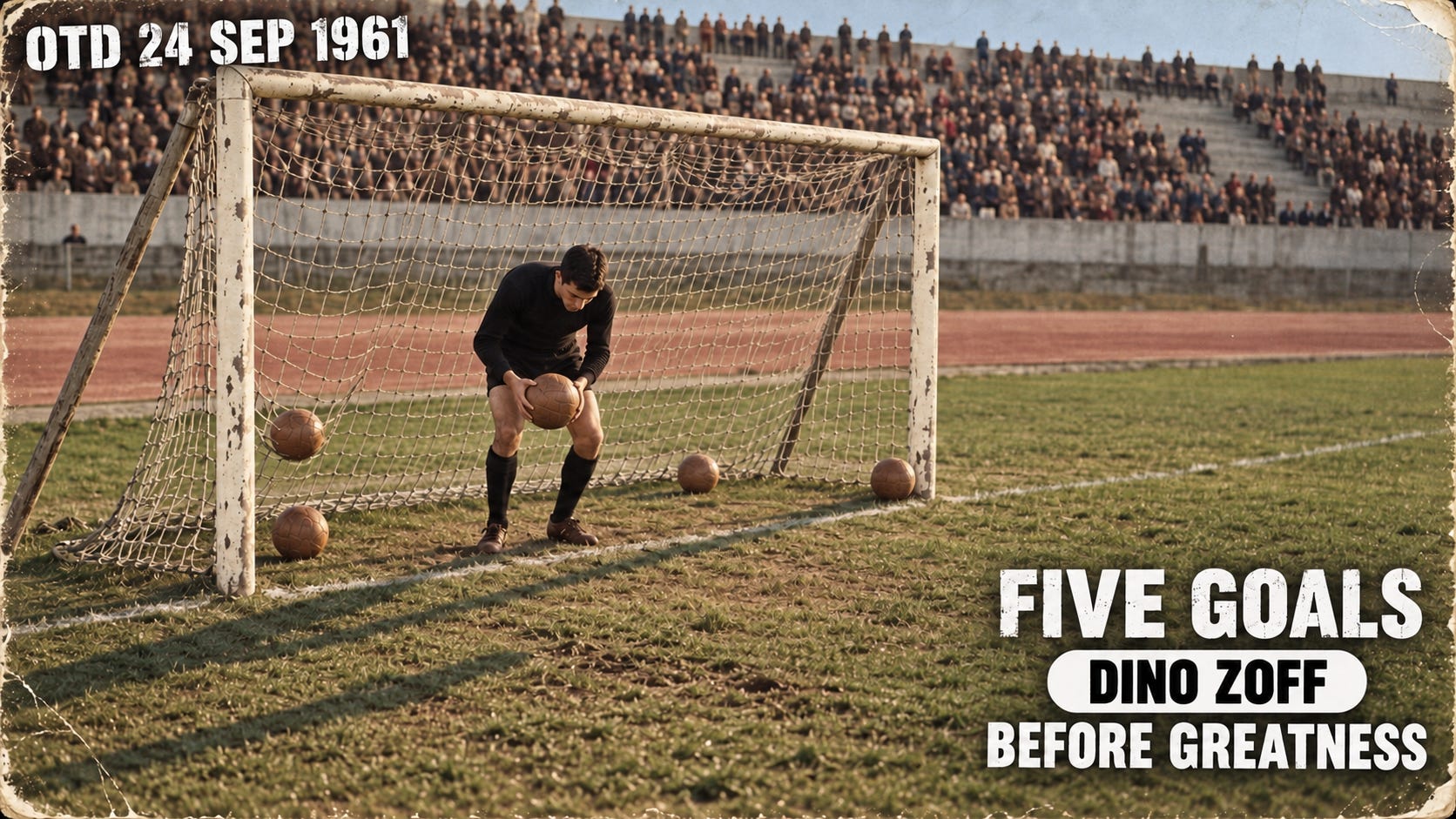
It is September 24, 1961, and Udinese hand a nineteen-year-old goalkeeper his Serie A debut away at Fiorentina. By the end of the afternoon, Fiorentina have put five past him. Five goals, one game, an unusually blunt introduction to the profession of preventing them. His name is Dino Zoff. In time, opponents will spend whole months trying and failing to score against him; he will conquer Europe, captain Italy to a World Cup, and then lead another Italian generation from the touchline. But on this day, his top-flight career begins with a 5-2 defeat, and football’s first glimpse of him could hardly have been more misleading.
How did we get here?
Zoff grew up in a farming family in Mariano del Friuli, in the northeast of Italy, playing local football and working as a mechanic. At fourteen he had trials with Inter and with Juventus, and both clubs turned him away for being too small. He grew. Udinese took him on, and in September 1961 they needed help: four defeats in their first five league games persuaded the coach, Luigi Bonizzoni, to change his goalkeeper for the trip to Florence. It was no gentle assignment. Fiorentina had won the inaugural European Cup Winners’ Cup only months earlier. Yet Udinese scored first, through Bruno Sassi after eight minutes, before the afternoon turned. Aurelio Milani scored twice, Kurt Hamrin made it three before halftime, Lars Jonsson added a fourth after the interval, Luis Pentrelli pulled one back, and Hamrin completed the scoring. Fiorentina five, Udinese two.
Five goals conceded does not mean five goalkeeping mistakes, and Udinese’s own retrospective places Zoff among those least responsible. It did not save him. Bonizzoni restored Franco Dinelli, and Zoff went back to the youth side to wait until the final three league matches of the season for another chance. For a young goalkeeper, that wait is a particular kind of difficulty. There is only one place in the team. An outfield player can be tried in a different position, or fitted in alongside a more experienced colleague, but a goalkeeper usually has to displace somebody. And once he has been dropped, he cannot show his improvement in the one place where the verdict was reached, a league match; the next opportunity depends entirely on somebody deciding to trust him again.
By the time Zoff returned, Udinese were relegated. With him back in goal they beat Palermo, won away at Juventus and drew with Bologna, four appearances in a first Serie A season whose opening scoreline had told almost none of the truth. Regular football in Serie B followed, but another coach lost confidence in him, and Udinese sold him to Mantova in 1963. Four seasons there, then Napoli. Only at twenty-six did he make his Italy debut, against Bulgaria in April 1968, and within weeks he was a European champion, Italy surviving the Soviet Union on the toss of a coin and then beating Yugoslavia in a replayed final. Zoff won that trophy on his fourth international appearance. Even that did not make him untouchable: Enrico Albertosi kept goal when Italy reached the 1970 World Cup final. His defining decade still lay ahead.
Juventus signed him in 1972, at thirty, and eleven seasons followed in which he played all 330 of their league matches. Every single one. For a club competing for the championship, availability alone is never enough; the manager has to keep believing you are the best choice. So Zoff’s run measured two things at once, a body that held up and a standard of performance that kept earning selection. The teenager who once waited months for a recall had become the one position Juventus barely needed to reconsider. Then, late in 1972, the door shut behind him. Fiorentina, of all clubs, scored against Juventus that December, and afterward Zoff went 903 Serie A minutes without conceding, a league record later surpassed by Sebastiano Rossi and then Gianluigi Buffon. Alongside it ran a second, separate clock: 1,142 minutes without conceding for Italy between 1972 and 1974, more than nineteen hours of international football.
That distinction is worth keeping clear, because the two are often blurred into one. They were separate sequences in separate competitions, and the international run included friendlies as well as competitive games. It was not nineteen unbroken hours of World Cup football, nor a single run through every Juventus and Italy fixture. What it was, instead, is sustained excellence in two settings simultaneously: week after week with his club, then, with the national side, picking up where he had left off. Club forwards could not beat him; international forwards could not beat him; changing shirts did not seem to help them very much. Haiti’s Emmanuel Sanon finally ended the international sequence at the 1974 World Cup, a tournament Italy left in the group stage. Nor did Zoff glide from there to glory. At the 1978 World Cup, Arie Haan beat him from distance as the Netherlands won, and years later Zoff still remembered the criticism over that goal. He was thirty-six, another World Cup was four years off, and it would have been easy to read the result as proof that his best was behind him.
Enzo Bearzot kept trusting him, and Zoff would later say he thought himself a better goalkeeper at forty than he had been at twenty-six, experience meaning, for him, sharper judgement rather than a longer list of caps. So it proved. At the 1982 World Cup, with Paolo Rossi scoring a hat-trick against Brazil, it was Zoff who preserved the win, stopping Oscar’s late header on the line when Brazil needed only a draw. Italy went on to lift the trophy, and Zoff lifted it as captain at forty, fourteen years after his first European title. The five goals of 1961 had led, by the longest possible route, to the top of the world.
So what?
Where does all of that put him among the greatest goalkeepers? Firmly in the highest company. In the IFFHS poll of twentieth-century goalkeepers he finished third, behind Lev Yashin and Gordon Banks and ahead of Sepp Maier. That is a historical judgement rather than a mathematical answer, and it predates the mature careers of Buffon, Iker Casillas and Manuel Neuer. But it establishes something important: Zoff’s reputation was never the sentimental reward for an old captain winning one last trophy. In 1973, he finished second to Johan Cruyff in the Ballon d’Or voting, his standing already immense nine years before that night in Madrid. Recognition on that scale has always been rare for goalkeepers. Yashin had won the award in 1963, and precious few have come near it since, because the goalkeeper’s best work so often consists of preventing the very moment that would have made someone else famous.
Greatness needs more than an awards ballot, though, so it is worth comparing the honors squarely. Zoff won six Italian championships, two Italian Cups and the 1977 UEFA Cup with Juventus, on top of his World Cup and European Championship. But he never won the European Cup; Juventus lost the finals of 1973 and 1983, to Ajax and to Hamburg. Sepp Maier also won the World Cup and the European Championship, and added three straight European Cups with Bayern. Casillas captained Spain through a European Championship, a World Cup and another European Championship, and won three Champions Leagues with Real Madrid. Zoff’s international double places him in an extraordinary group; it does not place him there alone. The closest Italian comparison is Buffon, another Juventus institution and World Cup winner whose career stretched far past the usual retirement age, and who pushed the Serie A shutout record on to 973 minutes in 2016, yet never won the European Championship medal that Zoff had. Neither fact, on its own, settles which of them was better.
And ranking across eras carries its own problem, because the job itself keeps changing. Neuer’s case rests partly on how far beyond his penalty area he could operate, letting his team defend with its outfielders pushed forward, a role he displayed on the largest stage at the 2014 World Cup. Zoff played his entire career before the 1992 change that stopped a goalkeeper from handling a ball deliberately kicked back to him by a teammate, a rule that transformed both the pressure on the position and the value of playing with the feet. We cannot fairly rank them by pretending the description of the job never moved. We can ask how completely each mastered the demands of his own time, and what he made possible for the team in front of him. On that test Zoff’s claim rests on the whole combination: exceptional peaks, extraordinary continuity, success for club and country, and calm authority under pressure. He could make goalkeeping look undramatic, the positioning and the judgement quietly removing the need for the spectacular save.
After he retired, that authority found new forms. He coached Italy’s Olympic side, then Juventus, and in 1990 won both the Italian Cup and the UEFA Cup as their manager, the European final coming, once again, against Fiorentina, the club that had scored five on his debut now on the losing side of his triumph. Famous players are often given the chance to coach because of who they were; winning a European competition requires them to do something with it. He went on to Lazio as coach and, in a separate spell, as club president, and in 1998 he took charge of Italy, bringing them to the final of the 2000 European Championship. That tournament joined Italy’s goalkeeping generations neatly: Buffon broke his hand before the finals, Francesco Toldo stepped in, and against the Netherlands in the semifinal Toldo saved a penalty in normal time and two more in the shootout, the man once famous for keeping Italy alive with his hands now watching another goalkeeper do exactly that. In the final, Italy led France until stoppage time, when Sylvain Wiltord equalized and David Trezeguet ended it with a golden goal. Zoff came within seconds of being crowned European champion as both player and manager. Hold that lead and he is the coach who conquered Europe thirty-two years after doing it in goal; concede, and the night belongs to France’s escape. The work that took Italy there does not vanish because of the ending, just as five goals conceded were incomplete evidence about a debutant.
Three things to take away
First, five goals on debut did not define Zoff. His development needed time, games and further chances, and the first scoreline told almost nothing about what he would become.
Second, his place among the greats rests on far more than winning at forty. The parallel shutout records, the domestic dominance and the European title were all in place long before 1982, and his second-place finish in the 1973 Ballon d’Or proves it.
Third, his influence continued long after he stopped making saves. Through management he won a European trophy, a domestic cup double and took Italy to within seconds of another continental title.
On this day in 1961, Dino Zoff conceded five on his Serie A debut. Football had met one of its greatest goalkeepers. It would simply take a while to recognize him.
---
📩 Got an idea to an OTD story? otd@17lawsguy.com
Yesterday: 23 September 1973, Selección Fantasma. The Team Argentina Forgot.