

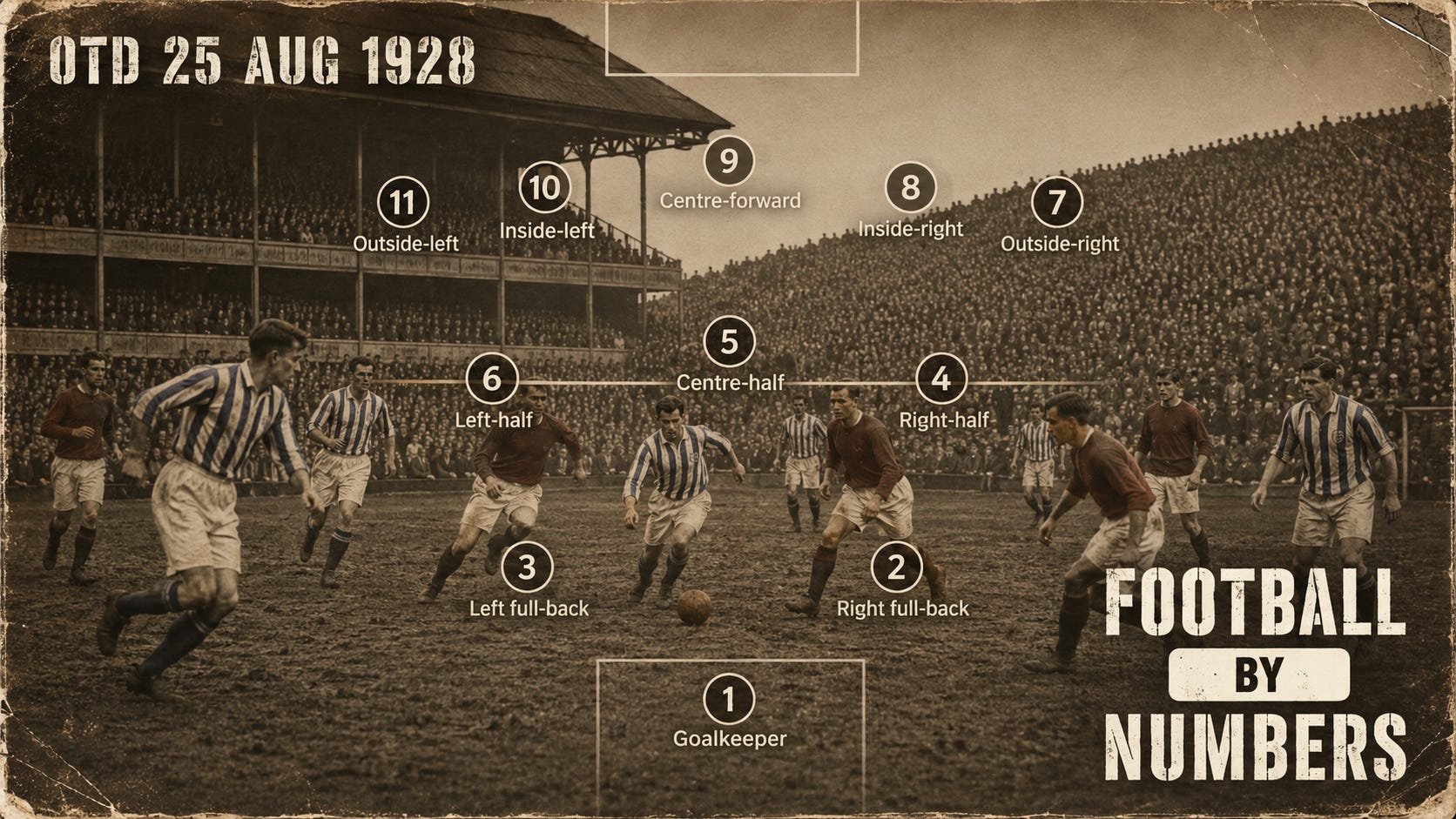
It is August 25, 1928, at Hillsborough, where The Wednesday will beat Arsenal 3-2 to open the English First Division season, and there is something odd on the players’ backs. Numbers. Down in London, Chelsea’s outfield players carry them too in a 4-0 win over Swansea Town. Today a footballer without a number would look strange; in 1928 the number was the strange part. For the first time in Football League matches, a spectator could read a shirt and work out exactly who was who. Football had discovered counting.
The story usually gets told as Herbert Chapman’s invention, and it needs rescuing from him. Chapman helped bring numbers into English league football, but he did not invent them. The trail runs back through other codes. Rugby was experimenting with numbers in the 19th century, and when New Zealand’s rugby team toured Australia in 1897 the players wore them, for the simplest of reasons: buy a scorecard, match the number to the name, and the stranger on the pitch was no longer just that bloke over there. Association football seems to have borrowed the idea. Modern research has found numbered association teams in Australia and New Zealand as early as 1904, with a 1905 photograph showing numbers on both teams. Those early numbers did not mean what they mean now: in one 1904 lineup, number 1 was the outside-right and the goalkeeper wore 11. American football was doing the same at almost the same time, Drake and Iowa State numbered in 1905, though some coaches disliked it for making stars easy to scout and seeming to celebrate individuals.
The idea then spread. In 1922 Australia and New Zealand met in Dunedin in what appears to be the first full international with both national teams numbered. In 1923 Third Lanark wore numbers touring Argentina, and in 1924 Vesper Buick wore them in a United States cup final. By the time English football reached its supposedly revolutionary moment, the rest of the world had been leaving clues for years. Even Chelsea had got there early, trialing numbers in a 1927 practice match, their manager David Calderhead explaining that he simply wanted spectators to recognize young players they did not know.
Which brings us back to Chapman. He arrived at Arsenal in 1925 and became one of football’s great modernizers, thinking about the game not just as eleven against eleven but as something people watched and listened to. There is even a tempting thread: his future assistant Tom Whittaker had toured Australia with Arsenal in 1925 and would have seen numbered footballers there. Did he carry the idea home? We cannot prove it. But on August 25, 1928, Arsenal appeared numbered at Hillsborough and Chelsea did the same at Stamford Bridge, and suddenly the basic grammar of football numbering was visible. From the old 2-3-5 formation it mapped straight down the team, 1 the goalkeeper through to 11 the outside-left. The results barely mattered; what mattered was that supporters could now credit the right man. The press noticed at once, one paper calling the numbered jerseys a success come to stay.
Eventually, yes, but slowly. Numbers got a bigger stage at the 1933 FA Cup final, where Everton wore 1 to 11 and Manchester City 12 to 22, a help to anyone high in the stands or describing 22 moving bodies on the radio. Still the resistance held, and only in 1939 did the Football League make numbered shirts standard, more than a decade after 1928.
And then something unexpected happened. A number meant to tell us who a player was began telling us what he was. Formations changed, the 2-3-5 vanished, but the numbers moved with the positions. The center-half dropped into defense and 5 became the center-back, worn eventually by Franz Beckenbauer as the majestic libero, so tied to him that Bayern Munich have now retired it. The 1 stayed with goalkeepers from Lev Yashin to Manuel Neuer. The 9 became the pure goalscorer, the “proper number 9” we still demand. The 7 became speed and glamour, above all at Manchester United, from George Best to Cristiano Ronaldo, who turned a shirt number into the trademark CR7. And the 10 became football’s creative inheritance, from Pelé through Maradona to Messi, though the most famous 10 got it by accident: at the 1958 World Cup, Brazil failed to submit their squad numbers, the organizers allocated them, and a 17-year-old reserve named Pelé was handed 10. He scored six goals, Brazil became champions, and 10 was never ordinary again. Johan Cruyff’s 14 was an accident too, a spare grabbed after injury in 1970 and kept forever.
Numbers even became things clubs retire in tribute, from Baresi’s 6 to Cruyff’s 14 to Beckenbauer’s 5, and Manchester City withdrew Marc-Vivien Foé’s 23 after his death in 2003. Argentina once tried to retire the number 10 itself for Maradona before the 2002 World Cup; FIFA said no, and Ariel Ortega wore it instead. There is a neat circle in all of it. When English club football moved to permanent squad numbers in the early 1990s, a landmark moment came in the 1993 League Cup final, between Arsenal and Sheffield Wednesday, the very two clubs on the Hillsborough pitch 65 years earlier. By then the number no longer told you where a player played. It told you who he was, and sometimes who he believed himself to be.
---
🎧 Listen on Spotify, Apple Podcasts, Amazon Music, Overcast, iHeart, and YouTube.
📩 Got an episode idea? otd@17lawsguy.com
Yesterday: 24 August 1963, the Bundesliga kicks off.
Tomorrow: 26 August 2005, Australia launches a brand-new national league and finally makes one that lasts.