

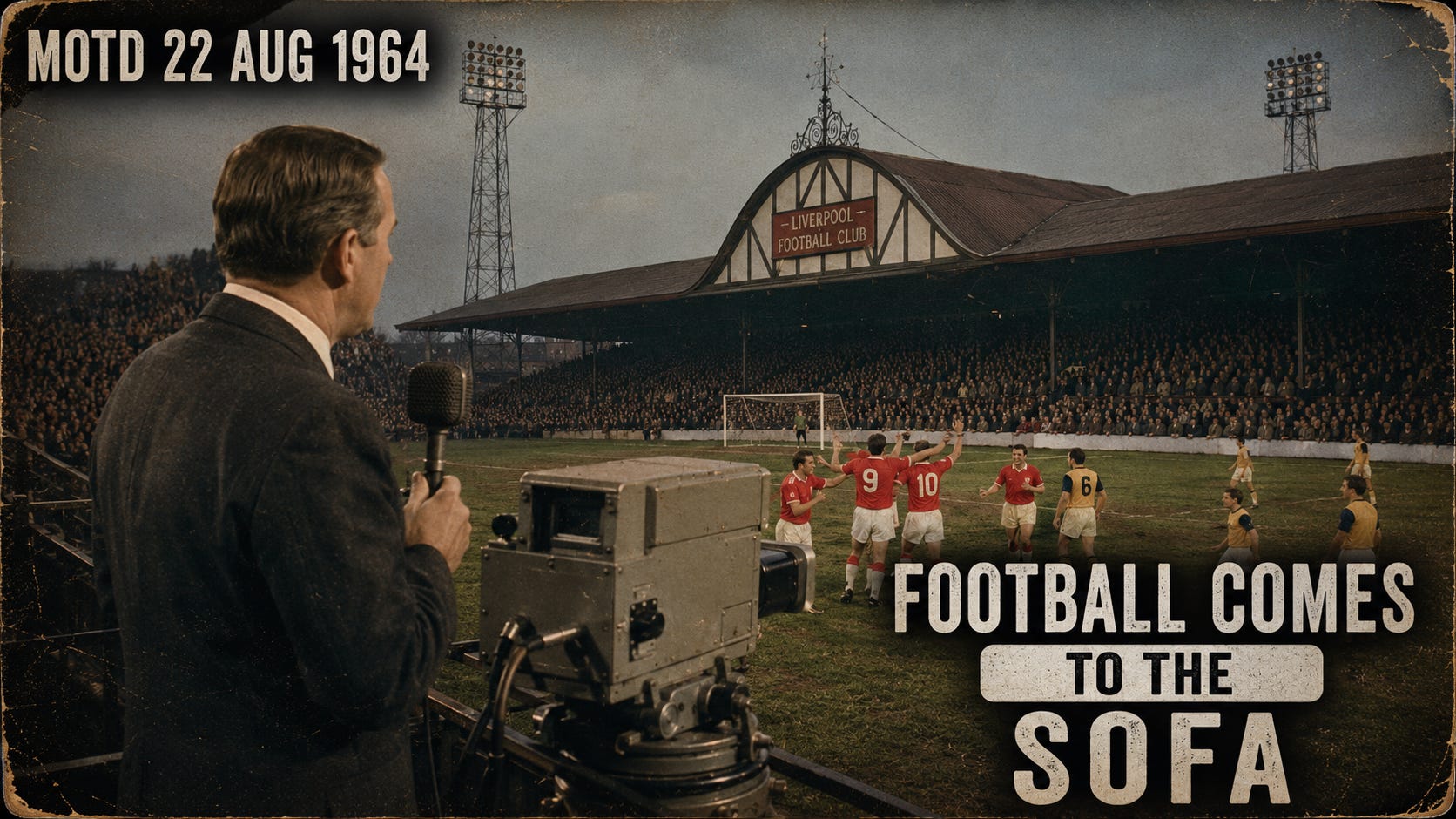
It is ten o’clock at night on August 22, 1964, and on the four-month-old channel BBC2, Kenneth Wolstenholme looks into the camera and says, “Welcome to Match of the Day.” Behind him is Anfield, where earlier that afternoon 47,620 people had watched Liverpool beat Arsenal 3-2. Tonight only about twenty thousand are watching on television, and none of them are in Liverpool itself, because BBC2 does not yet reach the city. The famous theme tune is missing too; Barry Stoller will not write it until 1970. But with that greeting, football’s long journey from the stadium to the living room took one of its most important steps.
When association football emerged in the 1860s, there were only two ways to consume it: go to the match, or read about it afterward. Newspapers became part of the game’s expansion, carrying the reputations of clubs and players far beyond the people who had stood beside the pitch, and by the late Victorian era football and the press were growing into mass entertainment together. Then sound arrived. In January 1927 the BBC broadcast live commentary of a league match from Highbury for the first time, printing a numbered diagram of the pitch in the Radio Times so listeners could follow which square held the ball. Football could now happen in London and exist simultaneously inside a home miles away, and with that came the anxiety that would haunt the game for decades: if people can follow the match at home, why would they buy a ticket?
Television made the question more frightening still. The BBC televised football before the Second World War, from a staged Arsenal practice match in 1937 to a live England-Scotland game and an FA Cup final in 1938, but the war shut British television down and the relationship afterward developed cautiously. Big occasions were tolerated; regular league football was another matter. The BBC showed tiny filmed highlights inside Sports Special from 1955, and when ITV tried a genuinely radical live-league deal in 1960, it effectively lasted a single match before clubs like Arsenal and Tottenham refused the cameras and the experiment collapsed. Football remained convinced that television would empty the terraces.
Technology kept moving anyway. By 1962 regional ITV companies were producing local highlights, and videotape meant the game no longer had to wait for film to be processed. Then, in April 1964, Britain gained a new channel, BBC2, broadcasting on a sharper 625-line system with electronic cameras, videotape editing, and something just as valuable, space in the schedule. The new head of BBC Sport, Bryan Cowgill, believed television would help football rather than harm it, and he had to convince the fiercely protective Football League secretary, Alan Hardaker. There was a deadline in the background too: England would host the World Cup in 1966, and the BBC needed crews who knew how to televise football, so Match of the Day could double as their training ground.
Even with agreement, the League stayed nervous. The identity of the filmed match was kept secret until four in the afternoon, once supporters were already inside grounds, so nobody could stay home knowing Liverpool-Arsenal would be on television, and at the last moment the League moved the broadcast from its planned early-evening slot to ten at night. The production itself was frantic. The editor, Alec Weeks, later recalled only six editing machines in the whole of Television Centre and described the process as butchery; one early cut was so abrupt that the Liverpool captain, Ron Yeats, seemed to take a throw-in and then head his own throw. Fortunately the football was superb. Roger Hunt scored the first goal ever shown on Match of the Day, Gordon Wallace added a second, Arsenal fought back to 2-2, and Wallace won it near the end, prompting Wolstenholme to suggest it might be called the match of the century rather than the match of the day.
The suspicion did not vanish, and in 1965 several clubs tried to stop the programme returning, forcing a compromise that fixed it after ten at night with the featured game kept secret. Then came 1966. England won the World Cup, football television exploded, and Match of the Day moved to BBC1 where nearly the whole country could see it. Colour, replays and a parade of famous voices followed, along with Barry Stoller’s theme in 1970, and the idea travelled abroad, to West Germany’s Sportschau, Italy’s Novantesimo Minuto and France’s Téléfoot. English football itself began to travel too. From late 1969, Danish, Norwegian and Swedish television pooled money to buy live English league matches, and a generation of Scandinavians - myself included - grew up supporting English clubs they lived hundreds of miles from, their loyalties shaped by the fixtures they could actually see, initially a curious diet of Midlands clubs the giants only visited.
The value of the pictures then began to explode, through the rights wars of the 1980s, the arrival of Sky and the Premier League in 1992, and on to today’s enormous deals. And the century-old fear that nobody would come? The 2025-26 Premier League recorded its highest total attendance in history while being broadcast in 189 countries to an estimated 1.9 billion followers. Television did not replace the stadium. It made the stadium globally visible.
---
🎧 Listen on Spotify, Apple Podcasts, Amazon Music, Overcast, iHeart, and YouTube.
📩 Got an episode idea? otd@17lawsguy.com
Yesterday: 21 August 1965, the substitute arrives.
Tomorrow: 23 August 1930, Brussels opens a stadium the world will later know by three different names.
Could these early pioneers have ever imagined what I am doing now, sat in a pub watching live as multiple screens show matches from three different divisions that all kicked off at 12.30pm? And all the grounds appear to be pretty much full.