

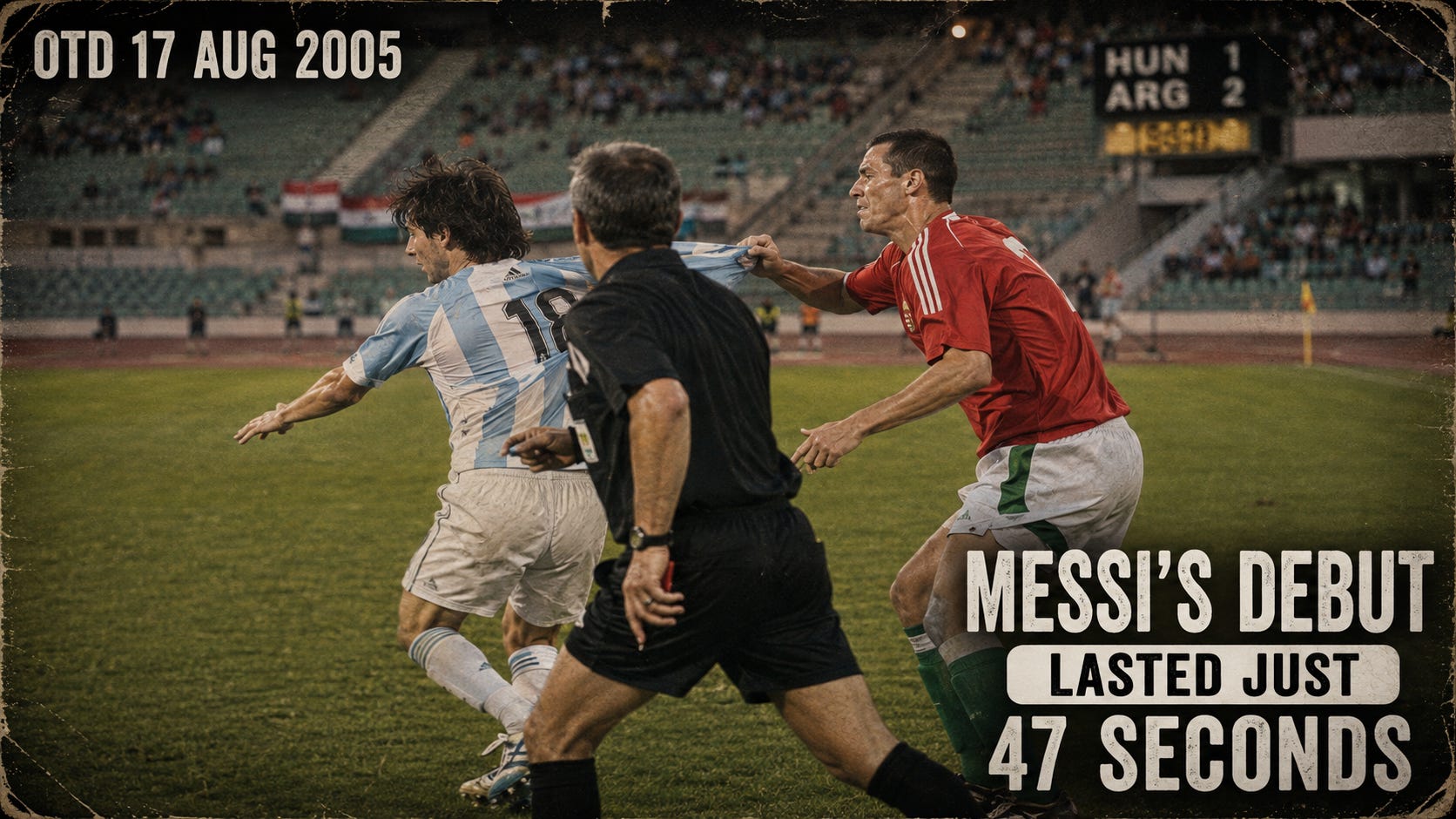
Budapest, August 17, 2005. Argentina lead Hungary 2-1, and with just over an hour gone José Pékerman decides the moment has come. Lisandro López walks off. An eighteen-year-old from Rosario walks on, wearing number 18, not the number 10 that already carries the weight of a nation. His name is Lionel Messi, and this is his senior debut for Argentina.
It lasts 47 seconds. Messi takes the ball, turns, and accelerates, doing the thing he will spend the next two decades doing to defenders. Hungary’s Vilmos Vanczák grabs a fistful of his shirt. Messi swings an arm back to free himself, catches Vanczák, and the German referee Markus Merk reaches for red. Forty-seven seconds after coming on, the most anticipated teenager in world football is walking back off, dismissed on his international debut. He would later admit the night was nothing like the one he had dreamed about.
What makes that disaster almost a footnote is the weight the boy was already carrying, and the number he was not yet allowed to wear. Argentina’s 10 is not simply a squad number; it is an inheritance. It became one almost by accident, when the 1978 squad were handed shirts alphabetically and Mario Kempes happened to receive the 10 before scoring his country to a first World Cup. Diego Maradona took it next and turned an accident into a myth. Then came Ariel Ortega, then Juan Román Riquelme, each asked to do the same impossible thing: take the ball and invent something. Messi arrived into that lineage as another small, left-footed genius, and the comparisons to Maradona had begun long before Budapest.
His route there was improbable. As a boy at Newell’s Old Boys he was so small that a growth-hormone deficiency threatened his career before it started. When Barcelona invited him for a trial at 13 he stood barely four and a half feet tall, and some inside the club wondered whether an expensive medical gamble on a tiny Argentine was worth it. Carles Rexach thought it was, and famously scribbled Barcelona’s commitment onto a napkin in December 2000. The family moved to Catalonia, and the boy began proving everyone right, racing through the youth teams, reaching the first team at 16, and then, in the summer of 2005, dominating the Under-20 World Cup so completely that he took both the Golden Ball and the Golden Boot and left as a world champion. He was still 18 when Pékerman called him up.
There was even a strange symmetry to the opponent. Maradona had also made his Argentina debut against Hungary, coming on in the sixty-second minute back in 1977. Twenty-eight years later Messi came on in the sixty-third, against the same country, and lasted less than a minute.
The recovery is the part that beggars belief. His first Argentina goal arrived the following March, and at the 2006 World Cup he came off the bench to assist and score in a 6-0 win. In 2009, with Maradona now his coach, the inheritance became literal: Riquelme was gone, and the number 10 passed to Messi for good. At Barcelona he became almost impossible to describe, a blur of league titles and Champions Leagues and Ballons d’Or. Argentina, though, stayed cruel. A World Cup final lost to Germany in 2014. Two Copa America finals lost in a row. In 2016 he missed a penalty in a shootout and announced he was finished with the national team, at twenty-nine.
He came back, and the story turned. Copa America at last in 2021, at the Maracana, against Brazil. Then Qatar in 2022, where a shock defeat to Saudi Arabia threatened collapse before Messi dragged Argentina all the way to the trophy that had defined his entire adult life. Then Copa America again in 2024. And then, at thirty-nine, one more World Cup in 2026, where he produced eight goals and four assists and carried Argentina to another final. Spain beat them 1-0 after extra time, but Messi left the tournament having rewritten the record book once more: thirty-four World Cup appearances and twenty-one World Cup goals, more than anyone in history, and a third World Cup final to his name.
It is a career that began, internationally, with a red card after forty-seven seconds, and ended among the handful of names where the argument stops being about who was great and becomes about how you compare greatness across eras at all. Kempes, Maradona, Ortega, Riquelme, Messi. Every era ends, and sooner or later the shirt will pass again. The only open question is whether Argentina’s next great number 10 is already playing, or has not yet been born.
---
🎧 Listen on Spotify, Apple Podcasts, Amazon Music, Overcast, iHeart, and YouTube.
📩 Got an episode idea? otd@17lawsguy.com
Yesterday: 16 August 1936, the tackle that ended in a police station.
Tomorrow: 18 August 2004, Brazil visit Haiti for O Jogo da Paz, the Game of Peace.