

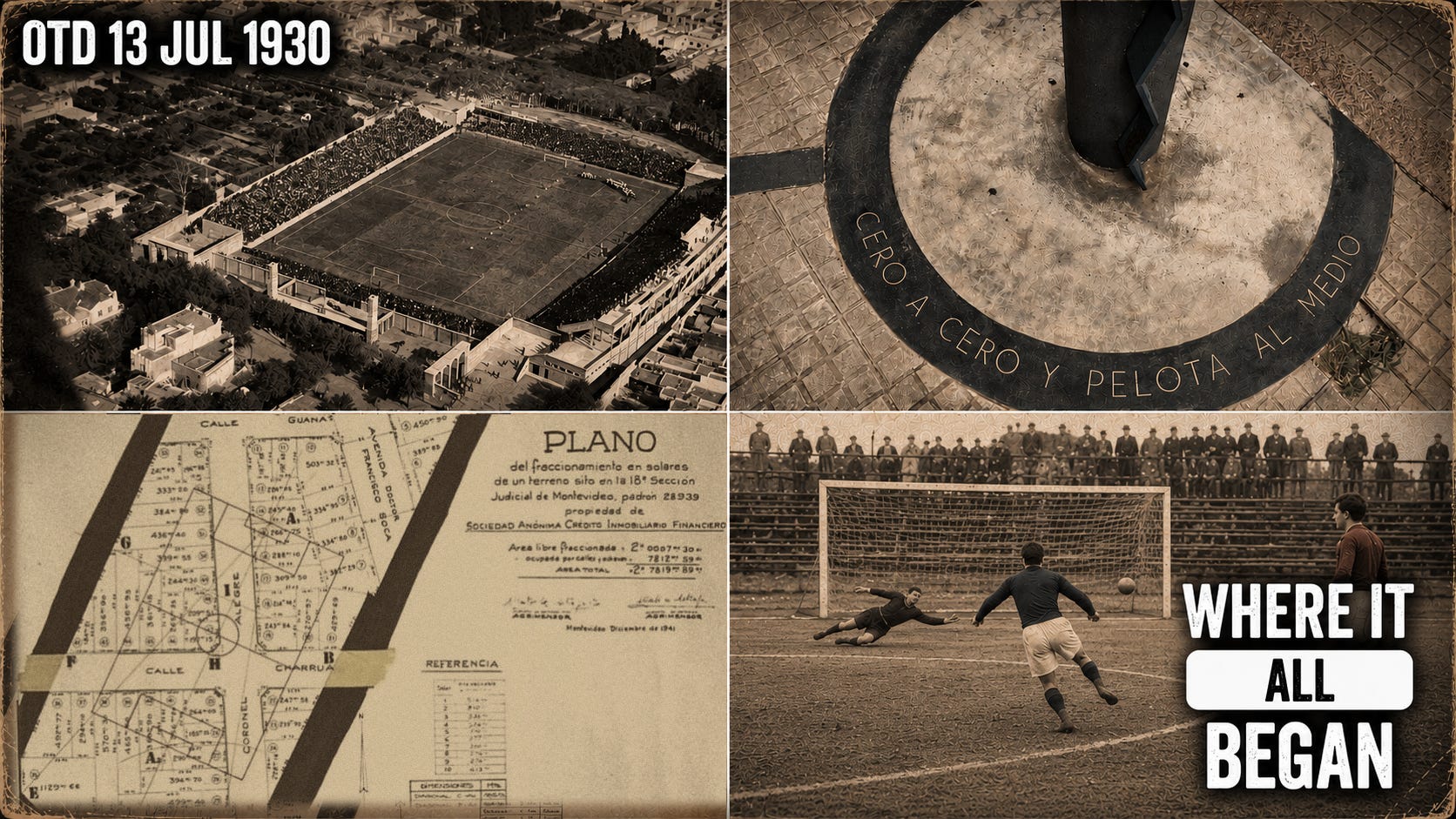
It is July 13, 1930. Montevideo. Estadio Pocitos, Peñarol’s small ground, in the cold of a South American winter. France against Mexico. Attendance: 4,444.
And this is where it begins. The first World Cup match.
One footnote: France against Mexico is one of two matches kicking off that afternoon. Across the city, the United States are playing Belgium at the Gran Parque Central, where Jules Rimet himself attends the official opening. But Pocitos is where the football makes history first.
Nineteenth minute. Ernest Libérati crosses from the right. Lucien Laurent meets it on the volley.
France 1, Mexico 0. The first goal in World Cup history. The first scorer. The first assist, if we allow a 1930 fact some modern language. There is no choreographed celebration, no corner-flag camera, no replay. Laurent later said the players congratulated each other, but not the way players celebrate now.
Getting to this kick-off took years of argument. International football already existed; the Olympics had become its closest thing to a world championship, and Uruguay had won gold in 1924 and 1928. But Olympic football belonged to the amateur movement, and the game was going professional. Jules Rimet, FIFA’s French president, wanted a world championship that belonged to football itself. In May 1928, at the FIFA Congress in Amsterdam, the idea became formal. Uruguay, double Olympic champions celebrating the centenary of their constitution, offered a great stadium and help with travel costs. They got the first World Cup.
Europe hesitated anyway. July meant winter in Montevideo, and weeks away by ship, and the Great Depression was biting. No England, no Italy, no Spain, no Germany. Only four European teams crossed the Atlantic: France, Belgium, Romania, and Yugoslavia. Laurent worked for Peugeot; other French players could not get time off or refused to go. Romania traveled only after King Carol personally intervened to protect players’ jobs. Thirteen teams in all, no qualifiers, a tournament assembled through invitation, persuasion, and willingness.
Even the venue is a compromise. The Estadio Centenario is not finished, beaten by rain and winter delays, so the opening matches move to club grounds. Uruguay themselves wait until July 18 to inaugurate the Centenario.
At Pocitos, France keep scoring. Marcel Langiller makes it 2-0. André Maschinot adds a third before half-time. When goalkeeper Alex Thépot is hurt in a collision, there are no substitutions, so midfielder Augustin Chantrel goes in goal: the World Cup’s first injury crisis, in its first match. Juan Carreño scores Mexico’s first World Cup goal in the seventieth minute, Maschinot strikes again late, and it ends France 4, Mexico 1. First winners. First beaten team. Maschinot, the first player to score twice in a World Cup match.
The opening win is France’s peak; they lose to Argentina and Chile and go home after the group. Mexico lose all three. Pocitos does not decide the tournament. It starts it.
And the line from that cold afternoon keeps running. 1950 and the Maracanã. Pelé in 1958. Wembley in 1966. Maradona in 1986, Zidane in 1998, Messi in 2022. This summer, the World Cup passed 50 million total spectators, and Enzo Fernández’s winner against Egypt became goal number 3,000. Goal number one: Lucien Laurent, Pocitos, 1930. Ninety-six years of goals between them.
In 2030, the centenary World Cup opens at the Estadio Centenario in Montevideo. Pocitos itself is gone, demolished and absorbed into the city. But researchers found where the old pitch had stood, and there are markers now: the center line in the pavement, a circle for the center spot, and a concrete arch where Laurent scored.
The first World Cup stadium disappeared. The first goal still has a quiet place.
🎙️ THE PODCAST GOES DEEPER. The full episode has the FIFA-Olympic fight over amateurism, the SS Conte Verde’s Atlantic crossing, and the lopsided 13-team format. That’s the 10-minute version.
---
🎧 Listen on Spotify, Apple Podcasts, Amazon Music, Overcast, iHeart, and YouTube.
📩 Got an episode idea? otd@17lawsguy.com
Yesterday: 12 July 1998, France 3, Brazil 0, and Ronaldo’s lost afternoon.
Tomorrow: 14 July 1989, Oscar Ruggeri sent off against Uruguay, six days after being sent off against Uruguay.