

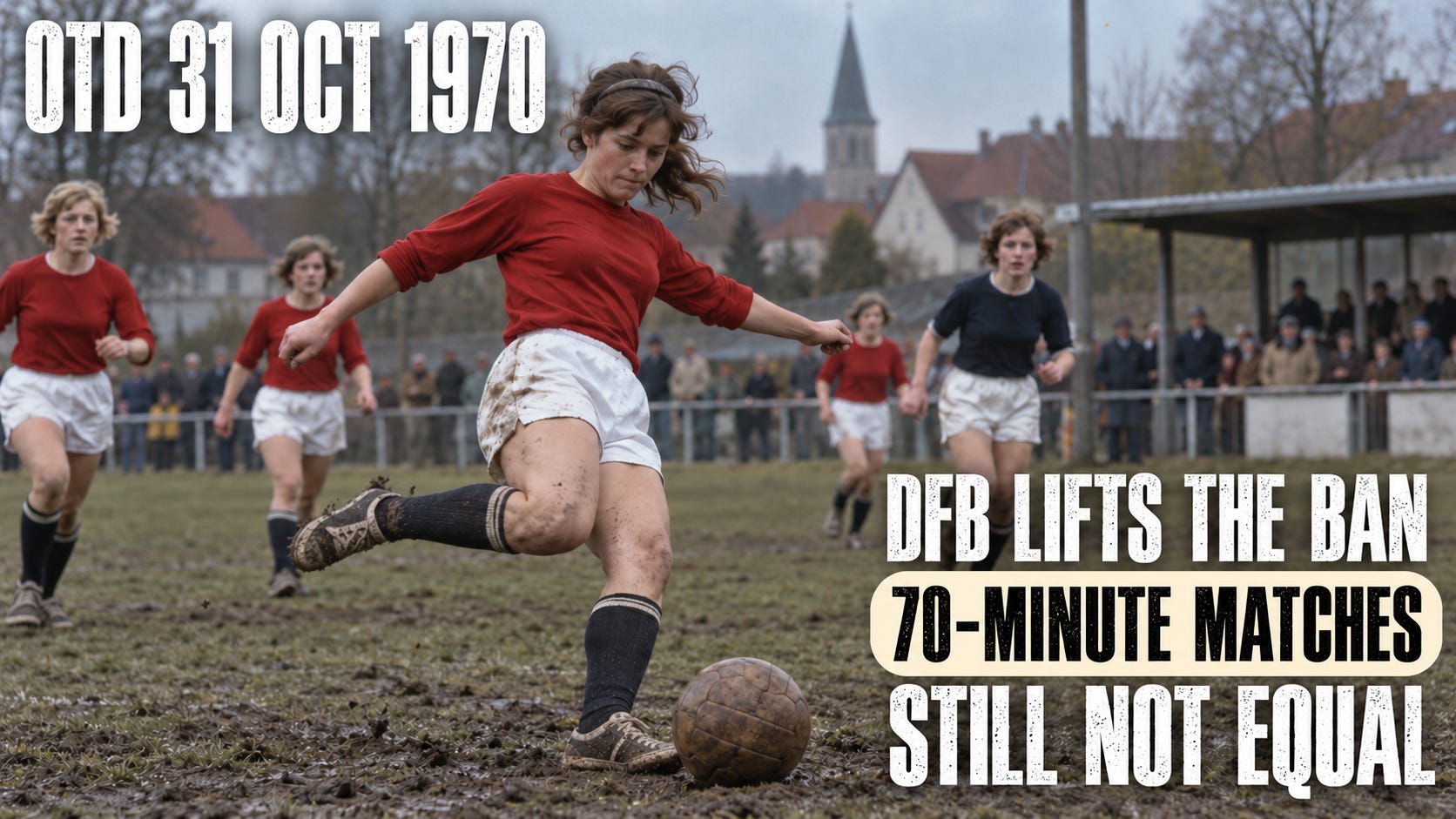
On 31 October 1970, at its congress in Travemünde on the Baltic coast, the German Football Association did something both overdue and revealing. It lifted the ban that, since 1955, had forbidden its member clubs to form women’s teams or stage women’s matches.
The vote was historic. The conditions were absurd. Women were permitted to play, but not for 90 minutes. They were assigned a smaller, lighter ball; barred from wearing studs; required to take a six-month winter break; and initially placed in a game governed by a different set of physical assumptions from men’s football. The ban had ended. The paternalism had not.
That contradiction is the entire story. Germany did not suddenly discover that women could play football in 1970. Women had played it before the DFB ban, during the ban, and beyond Germany. They had filled major grounds, toured internationally, built independent structures and staged their own world tournaments. What happened in Travemünde was that one of Europe’s largest football institutions stopped trying to keep them out of its own house.
The result would become extraordinary. Within two decades, Germany had a women’s national team, a national league and a first European title. Later came eight European Championships, two World Cups, Olympic gold, continental club success and a referee pathway that would send Bibiana Steinhaus into the men’s Bundesliga. But none of that makes the 1970 decision less uncomfortable. It makes its starting point more important.
How Did We Get Here?
Women’s football was not a late twentieth-century invention waiting for enlightened administrators to create it. It was already a public sport in the late nineteenth and early twentieth centuries. In Britain, a North versus South women’s match at Crouch End in 1895 drew around 10,000. During the First World War, women working in factories formed teams, played charity matches and attracted crowds that made their commercial and social potential impossible to miss.
The most famous were Preston’s Dick, Kerr Ladies. They played their first match on Christmas Day 1917, toured France, raised money for wounded servicemen and became celebrities rather than curiosities. Their Boxing Day 1920 meeting with St Helens at Goodison Park drew at least 46,000 people, with some contemporary estimates reaching 53,000. Lily Parr was a star. The audience was real. So was the standard.
That is why the bans that followed should never be treated as a natural pause in a sport that had not yet developed. They were interventions. In December 1921, England’s Football Association declared football unsuitable for women and barred women’s matches from the grounds of affiliated clubs. The stated language mixed medicine, morality and aesthetic discomfort. The practical effect was to remove access to the stadiums, networks and legitimacy controlled by the men’s game.
Versions of the same argument travelled. France’s women had organized internationals and club competitions around the First World War, then lost official recognition under Vichy before their federation returned in 1970. Elsewhere, national associations discouraged or prohibited women’s play, while clubs, municipal fields and independent organizations kept it alive. The details varied. The belief beneath them did not: football’s authorities had decided that a game women were demonstrably playing was not theirs to govern.
West Germany arrived late to this repression, which makes the timing especially striking. In 1954, the men won the World Cup in Bern and German football acquired a new national confidence. In 1955, the DFB’s congress forbade its clubs to create women’s departments or arrange women’s games. The explanation was nakedly misogynistic: football was said to damage women’s bodies and souls; the physical contest was said to make female grace disappear; public display was said to offend propriety.
It was an extraordinary position for an organization that had been founded to organize football, not to determine who was fit to enjoy it. And it never extinguished the appetite it was meant to suppress. Women played unofficially. Teams attached themselves loosely to clubs, used spare grounds or formed separate associations. In 1956, an independent German women’s body organized an international match. The DFB’s prohibition was binding on its member clubs, but it could not erase women’s football from the country.
The 1960s made containment progressively harder. Women’s teams multiplied. Some sought places within DFB clubs; others organized outside them. The political and cultural climate changed too. West German society was arguing more openly about authority, gender and the limits of old institutions. The pressure was not produced by one speech at Travemünde. It was created by women who kept playing and by officials who recognized that refusing to accommodate a growing movement risked losing it altogether.
Internationally, football was also moving. Scandinavia had become an important nursery, with Denmark particularly strong. In 1970, an unofficial women’s world tournament in Italy was won by BK Femina, the Copenhagen club side representing Denmark. The following year, Denmark won again in Mexico, where the final against the hosts drew a crowd reported at around 110,000 at the Azteca. The word “unofficial” should not be mistaken for insignificant. These were proof-of-concept events staged because FIFA and many national associations had not yet provided an official stage.
The contrast with the men’s game in West Germany was sharp. Only seven years earlier, the DFB had voted through the Bundesliga and begun reshaping the male professional structure we recently explored. Men’s football was centralizing, commercializing and preparing for a new national league. Women were asking for permission to play in the first place. The disparity was not about a lack of footballing interest. It was about whose football the institution considered worthy of investment.
At Travemünde, the delegates reversed the 1955 resolution by all but two votes. The wording was simple: the old decision not to permit women’s football matches was rescinded, and the DFB executive was instructed to prepare rules. The rules supplied the sting. Matches were limited to 70 minutes. The ball was smaller and lighter. Studs were prohibited. A long winter break was compulsory. The regulations did not merely make entry cautious; they treated women’s bodies as a problem to be managed.
Yet the repeal still mattered because it opened the federation’s machinery: clubs, leagues, coaching, referees, insurance, grounds and eventually international recognition. The point of 31 October was not that equality had arrived. It was that exclusion had lost its official warrant.
So What?
German women did not wait long to show what access could build. A first DFB championship followed in 1971. The DFB Cup arrived in 1981. On 10 November 1982, West Germany played its first official women’s international, beating Switzerland 5-1 in Koblenz. Gero Bisanz, whose work in coach education connected the women’s game to a wider national coaching culture, became the first national coach and helped establish a deliberately coherent system rather than a collection of isolated sides.
Even then, equal rules did not arrive overnight. The special restrictions were eased in stages, and women did not play the standard two 45-minute halves in Germany until 1993. That delay matters. The repeal is best understood as a door being unlocked, not as the room suddenly becoming equal. The women who played through the 1970s had to win recognition twice: first the right to be organized, then the right not to be organized as a medically diminished version of football.
The first great public breakthrough came at the 1989 European Championship, hosted by West Germany. Germany beat Norway 4-1 in the final in Osnabrück before a sell-out crowd of 22,000. Heidi Mohr, Doris Fitschen, Martina Voss and Silvia Neid became recognizable names. A Frauen-Bundesliga had been created for 1990-91, initially in two regional divisions before becoming a single national division in 1997. The infrastructure that the 1970 ban had denied women now had a route from club football to national-team success.
The results became almost implausible. Germany won the Women’s EURO in 1989, 1991, 1995, 1997, 2001, 2005, 2009 and 2013. It won the World Cup in 2003 and 2007, and Olympic gold in 2016. As was shown through Nia Künzer’s 2003 golden goal, the first world title was not an isolated flash of brilliance. It was the product of a system that had, slowly and unevenly, learned to take the women’s game seriously.
German clubs reinforced the point. The Frauen-Bundesliga produced the environments from which 1. FFC Frankfurt, Turbine Potsdam and VfL Wolfsburg became European forces. German clubs have won nine UEFA women’s club titles, more than any other country. The league’s 2025-26 expansion to 14 teams and record attendance figures are evidence of a market that is still growing, not a museum display of former dominance.
The pipeline also matters beyond players. Hannelore Ratzeburg began playing in the first years after repeal and became one of the key administrators who built women’s football inside the DFB and UEFA. Germany’s most visible refereeing landmark came in 2017, when Bibiana Steinhaus became the first woman to referee a Bundesliga match. That is not the same story as Rebecca Welch’s Premier League appointment. But it rests on the same principle: the ultimate standard for a referee is competence, preparation and match control, not gender. A healthy pathway makes the word “first” temporary.
Germany is not finished with that work. Its current FF27 strategy is built around a 25 percent increase in active female players, coaches and referees, while raising women’s representation in DFB leadership. The national side remains among the global elite, though its 2023 World Cup group-stage exit showed that no historic power has a permanent claim on the future. Germany’s women are an established giant, not an institution entitled to stand still.
The youth evidence is encouraging but also a reminder of why the pathway cannot be taken for granted. Germany won a record ninth UEFA Women’s Under-17 EURO in 2026, while the senior league’s expansion and rising crowds created more visible destinations for young players. But a pipeline is not a trophy cabinet. It depends on local teams, coaches, safe places to play, officials who are supported, and the opportunity to stay in football when adolescence makes participation most fragile. Those are the mundane conditions from which another national team, another referee or another coach eventually emerges.
The wider international map tells a related but not identical story. England’s FA lifted its ground ban in 1971 after half a century, and the independent Women’s Football Association carried the game until the FA took direct responsibility in 1993. England eventually converted its infrastructure and the energy of the WSL era into the 2022 European Championship and a World Cup final the following year. Scandinavia’s early openness helped create Danish, Swedish and Norwegian sides that mattered well before the men’s establishment caught up. Norway became world champion in 1995; Sweden has remained a perennial contender.
France recognized the women’s game in 1970 and developed a powerful domestic league, although its national side has often had to fight the gap between talent and major-tournament reward. Japan used a different route, coupling schools, clubs and technical development to win the 2011 World Cup. China, whose women had a state-supported platform before the first FIFA World Cup in 1991, reached the 1999 final. The United States built its remarkable depth through schools, colleges and Title IX. None of these routes was identical. All required an institutional decision to treat girls and women as footballers rather than exceptions.
UEFA’s intervention was consequential. In 1971, it urged national associations to take responsibility for women’s football. A European national-team competition began in 1982. The first final tournament arrived in 1984; the modern UEFA Women’s EURO has grown from there into a major event. FIFA’s Women’s World Cup finally began in China in 1991, with its unusual 80-minute matches. The common lesson is uncomfortable: the game kept demonstrating its value, while the official game repeatedly arrived late to what players had already built.
So the DFB decision deserves neither uncomplicated celebration nor retrospective scorn alone. It was a concession to persistence, and it came with rules that exposed the assumptions still governing the concession. But it also gave German women access to the same institutional levers that make football durable: regular competition, qualified coaching, national selection, youth development and a credible route to officiating and leadership.
That is the measure of 31 October 1970. Not that Germany generously invented women’s football. It did not. Germany stopped banning it, then discovered that the players it had tried to exclude could help build one of the most successful football systems in the world.
Three Things to Take Away
1. On 31 October 1970, the DFB repealed its 1955 ban on women’s football. The repeal still imposed 70-minute matches, a smaller ball, no studs and a long winter break.
2. Women’s football had never disappeared. From Dick, Kerr Ladies to independent German teams and Denmark’s BK Femina, players built crowds, clubs and international competition before the major authorities embraced them.
3. Germany turned access into infrastructure: an official national team in 1982, a Frauen-Bundesliga from 1990-91, eight European titles, two World Cups, Olympic gold and a pathway reaching referees such as Bibiana Steinhaus.
On This Day
On 31 October 1970, the DFB lifted its 15-year prohibition on women’s football at its Travemünde congress. It let women into German football’s official structure, while revealing how far equality still had to travel.
Have a football memory, a correction or a story that belongs here? Write to otd@17lawsguy.com.
Yesterday: Luxembourg Knocked Out the Dutch in Rotterdam - 30 October 1963.
Good overview of the growth of women's football in Germany. I always think the timing of the German ban was bizarre but when they did lift it, they did at least support it much better than in other parts of Europe. Which is why they have such a full trophy cabinet.
All your pieces are so enjoyable and well written.