

For Nick, whose encouragement means a great deal, and whose heart beats for Belgium.
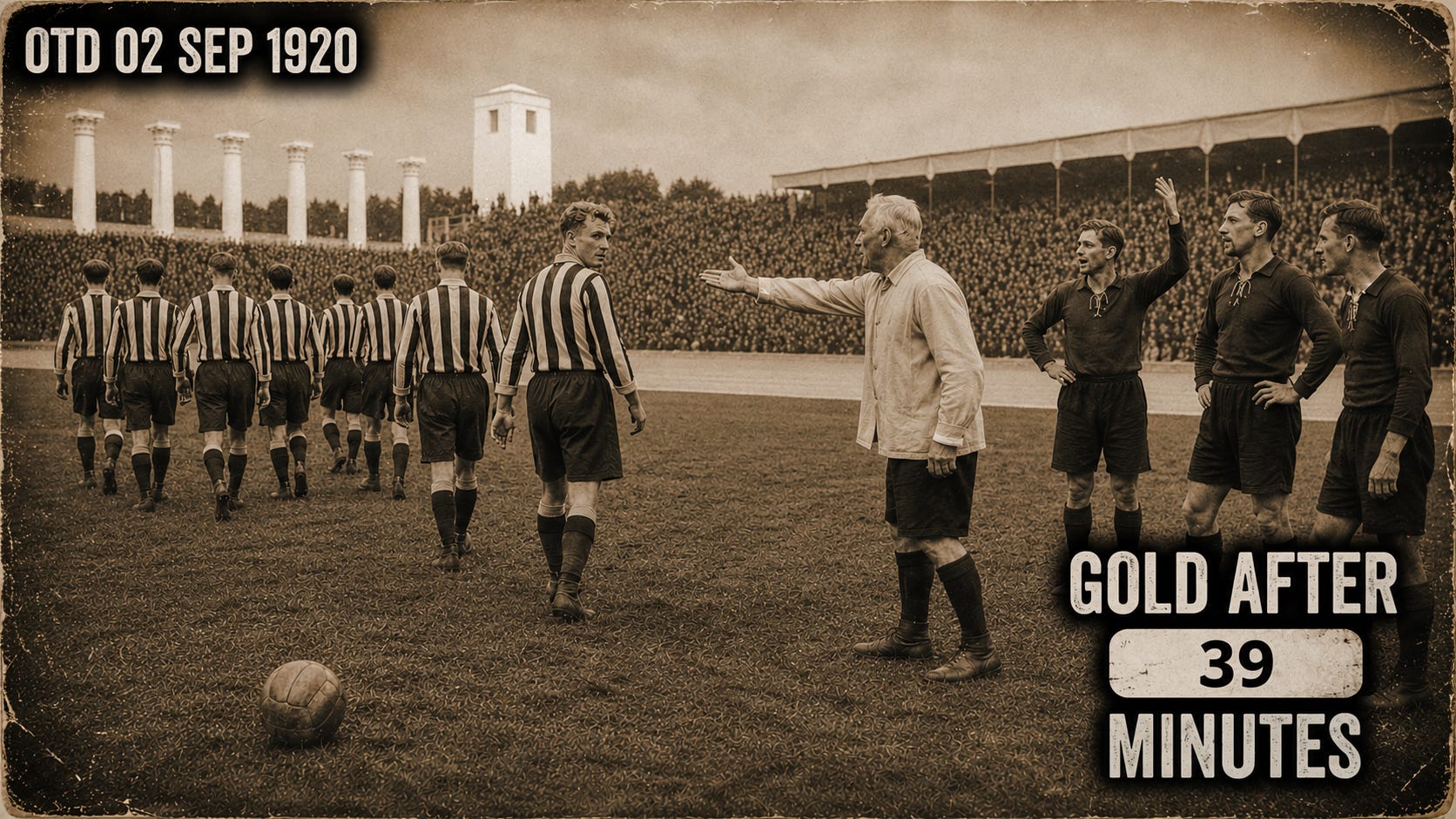
It is September 2, 1920, at the Olympic Stadium in Antwerp, and Belgium are thirty-nine minutes away from the only major international title in their football history. They lead Czechoslovakia 2-0 in the Olympic final when a Czechoslovak defender, Karel Steiner, is sent off. His captain, Karel Pešek, has had enough, and leads his team off the pitch. They refuse to come back. The biggest international football final yet staged is over before half-time.
To understand why it fell apart, you have to look past the football. The Armistice that ended the First World War was less than two years old. Belgium had been invaded, occupied and devastated, and Europe was rebuilding its cities and economies while the influenza pandemic we remember as the Spanish flu overlapped the aftermath of the war. Simply holding an Olympic Games mattered. In April 1919 the IOC chose Antwerp in what Pierre de Coubertin called a unanimous tribute to Belgium, and Count Henri de Baillet-Latour led organizers who had barely a year to prepare.
Football’s own house was in disorder. The FIFA president Daniel Burley Woolfall had died in 1918, and in 1920 the four British associations walked out of FIFA after it refused their demand to isolate the associations of the former enemy powers. There was a second, slower-burning quarrel about amateurism, over whether a player could be compensated for wages lost while representing his country, which Britain despised as broken-time payment. Into this walked Jules Rimet, president of the French federation and newly placed in acting charge of FIFA, who used Antwerp to float an idea almost nobody was ready for: a world championship every four years.
This was not a modern tournament. The IOC had decided that only countries represented within its own movement could send athletes, a device that also kept Germany, Austria, Hungary, Bulgaria and Turkey out. Fourteen teams played, and the football produced shocks at once. Great Britain, gold medallists in 1908 and 1912, lost 3-1 to Norway. Spain played the first official international in their history against Denmark and won 1-0, with a nineteen-year-old named Ricardo Zamora in goal. And Czechoslovakia, a country proclaimed only in 1918, tore through the draw, beating Yugoslavia 7-0, Norway 4-0 and France 4-1. A new state, yes, but no footballing novices.
Belgium had their own momentum, beating Spain 3-1, with Robert Coppée scoring all three, and then the Netherlands 3-0. This was a genuinely postwar side: Émile Hanse and Louis Van Hege had played wartime football for the Front Wanderers, a military team that raised money for wounded soldiers and refugees. By the day of the final, a packed and overwhelmingly Belgian crowd filled the stadium. The referee was a piece of history in his own right: John Lewis, one of the founders of Blackburn Rovers, a three-time FA Cup final referee and the man who had handled the 1908 Olympic final, now sixty-five years old.
The match turned early and never recovered. In the sixth minute Lewis awarded Belgium a penalty after a scramble around the Czechoslovak goal, though later accounts disagree about what exactly happened first, and Coppée scored. Around the half-hour Henri Larnoe made it 2-0. Then, in the thirty-ninth minute, Steiner was sent off, Coppée was carried off badly hurt, and Czechoslovakia snapped. Pešek led his players from the field, Lewis asked them to return, they refused, and he had no choice but to abandon the match.
The Belgians assumed they had won gold. Not quite yet. Czechoslovakia protested, objecting to the English linesmen, accusing Lewis of bias, and claiming that Belgian soldiers around the pitch had created an atmosphere of intimidation. The next day the tournament’s Jury of Appeal heard the case, rejected it, confirmed Belgium as 2-0 winners and disqualified Czechoslovakia. Gold went to Belgium.
That left an awkward question: who takes silver, when the losing finalist has just been expelled? Antwerp used a strange contraption called the Bergvall system, which resurrected earlier losers to sort out the minor medals. It churned back to life, Spain beating Sweden and then Italy, until Spain met the Netherlands and won 3-1. Gold Belgium, silver Spain, bronze the Netherlands. If you are wondering why Olympic football never used that exact system again, you have understood 1920.
By the Paris Games of 1924, FIFA was running Olympic football more directly, with a clean knockout and a bronze-medal match, and, crucially, South America finally arrived, Uruguay winning gold and strengthening Rimet’s case for a competition of FIFA’s own. Antwerp did not create the World Cup, but it sits squarely on the road toward it: international football restarting after a war, FIFA rebuilding itself, and the Olympic model showing both its power and its limits in the same fortnight.
As for Belgium, this remains the one. They reached the final of the 1980 European Championship and lost, finished fourth at the 1986 World Cup, and took third at the 2018 World Cup with a golden generation, but they have never matched that Antwerp gold. And one Czechoslovak deserves a closing word. Karel Pešek, who led his football team off the pitch, had already won a bronze medal in ice hockey at those same Antwerp Games.
---
🎧 Listen on Spotify, Apple Podcasts, Amazon Music, Overcast, iHeart, and YouTube.
📩 Got an episode idea? otd@17lawsguy.com
Yesterday: 1 September 1894, the game of three halves.
Tomorrow: 3 September 1989, a flare, a wound that was not what it seemed, and El Maracanazo.