

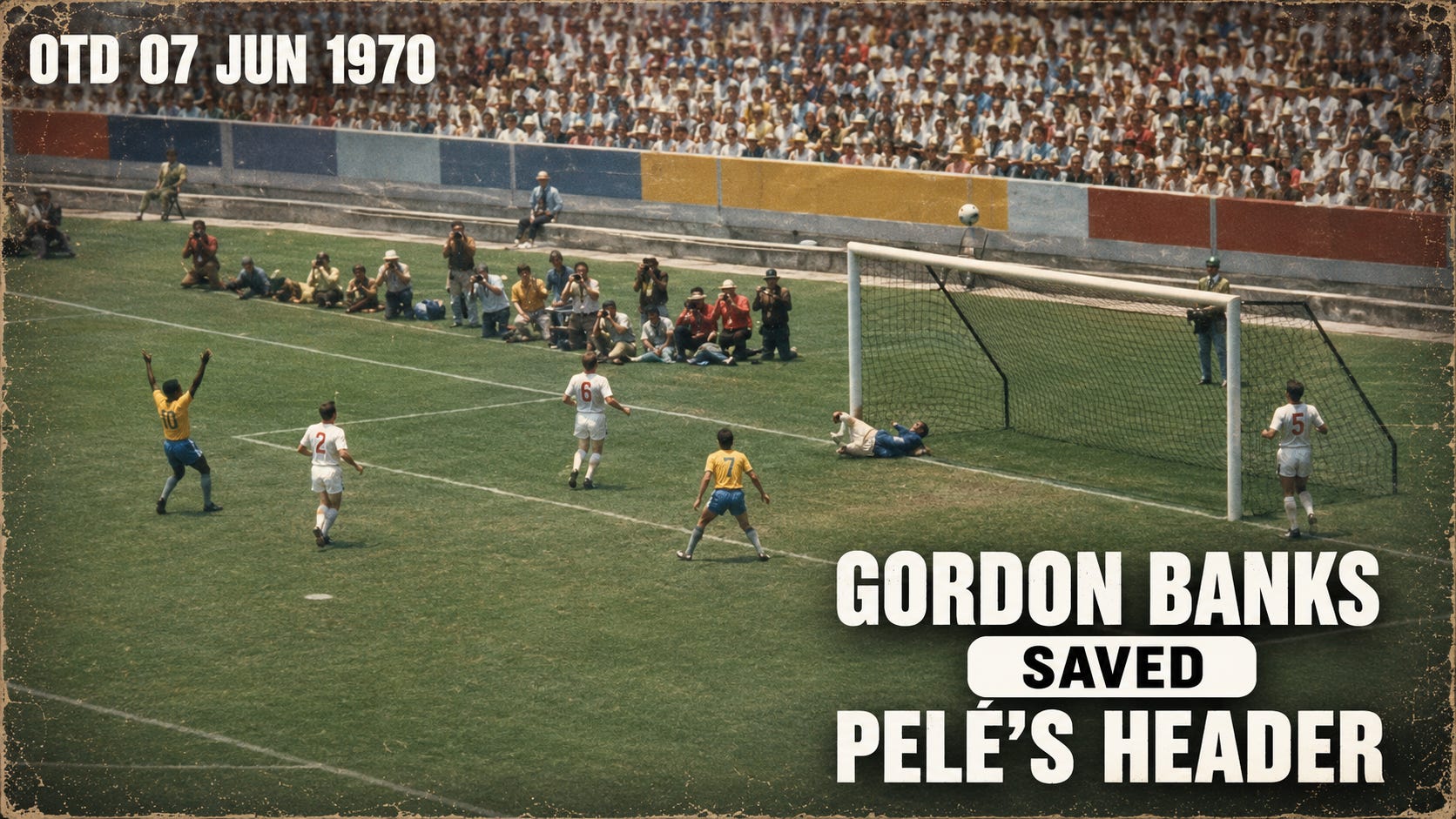
It is 7 June 1970, in Guadalajara. Estadio Jalisco. Brazil against England — the side many will call the greatest World Cup team ever assembled against the defending champions. Early in the first half, the ball comes from the Brazilian right. Pelé rises. The header is perfect. He shouts “Gol!” — because he thinks he has scored.
And then Gordon Banks appears. Not just as a goalkeeper. As an interruption of physics.
This is the story of the save that stopped Pelé.
Both teams arrived carrying a story. England were world champions — Wembley, 1966, Bobby Moore lifting the Jules Rimet Trophy. Brazil had left 1966 wounded: winners in 1958 and 1962, but kicked out of the group stage in England, Pelé injured and frustrated. So by 1970, England carried the burden of defending a crown, and Brazil the burden of restoring one. Brazil nearly botched the restoration off the pitch — João Saldanha, who’d won every qualifier, was removed months before the tournament under a military dictatorship that treated the national team as a state obsession. In came Mário Zagallo, who solved the famous ‘too many number tens’ problem (Pelé, Tostão, Rivellino, Gérson, Jairzinho) not by cutting them but by playing them and building structure around the intelligence.
When the two met on 7 June, both had already won their openers. It felt like a final before the final — played at noon, in Guadalajara heat, under a Mexican sun.
Then the save. Around the tenth minute, Carlos Alberto fed Jairzinho down the right; Jairzinho beat Terry Cooper and crossed — not floated, delivered. Pelé read it before everyone and headed it down, hard, toward Banks’s right-hand corner. This wasn’t a looping header. It bounced brutally a couple of yards in front of the line, which made it worse: a bouncing ball kicks up, changes height, forces the keeper to adjust in mid-air. Banks started near his left post. He had to travel across the goalmouth, dive back to his right, twist, reach with his right hand, and somehow lift the rising ball over the crossbar. Across. Down. Up. Behind. Over.
Pelé had already shouted goal. The crowd had already roared. Banks himself later said he didn’t even know at first whether he’d saved it. Then the ball was over the bar. Corner. Still 0-0. And Bobby Moore walked over with the most English compliment imaginable: “You’re getting old, Banksy. You used to hold on to them.” Even miracles are expected to be tidy.
England didn’t collapse — they played Brazil closer than almost anyone in that tournament, Moore producing his own legendary tackle on Jairzinho. But just before the hour, Tostão and Pelé combined and Jairzinho finished. Brazil 1, England 0. Not a rout. A classic.
So what makes the save, not the goal, the thing everyone remembers? Because a goal changes a score — but a save can change an imagination. And 1970 was the first World Cup broadcast globally in color. This save wasn’t just described in words the way pre-television saves had to be; it was seen, replayed, shared, mythologized. And it had the perfect opponent. The shot needed to be worthy of the save, and Pelé — maybe the greatest player ever — gave Banks that gift. Pelé said he thought he’d scored, then Banks appeared “like a blue phantom,” and called it one of the best saves he’d ever seen. When the greatest forward alive is stunned, the moment is sealed.
From there, Banks became a strange kind of immortal. Already a 1966 World Cup winner, eventually 73 caps, six times FIFA Goalkeeper of the Year — and yet he knew what people would always want to talk about. Not the medals. That save. Which is almost unfair, and also almost perfect, because goalkeeping is the loneliest art in football: the striker is forgiven a miss if he scores later, the defender survives by being invisible, but the keeper is remembered in flashes — the mistake, the fingertip, the impossible stop. Banks gave the position one of its defining images.
And then the tournament turned cruel. England reached the quarter-final — a rematch with West Germany — but Banks fell ill (the infamous stomach bug), Peter Bonetti deputized, England led 2-0, and lost 3-2. The holders were out, and English football has asked ‘what if Banks had played?’ ever since. There is no answer. Only the question. Brazil, meanwhile, made the 1970 run into scripture: six wins from six, 19 goals, Jairzinho scoring in every game, Pelé’s third title, Carlos Alberto’s final goal against Italy so perfect it looks choreographed.
The save endures because it isn’t only athletic — it’s symbolic. Pelé is the perfect attacker. The header is the perfect finish. Banks is beaten by logic. And then he refuses the logic.
🎙️ THE PODCAST GOES DEEPER. The full episode has what this post compresses: the 1966-to-1970 arc for both teams; the Saldanha-to-Zagallo upheaval; the Bogotá Bracelet affair around Bobby Moore; the save broken down beat by beat; Banks’s later illness and the West Germany defeat; and his remarkable post-crash career with one eye. That’s the 10-minute version.
---
🎧 Listen on Spotify, Apple Podcasts, Amazon Music, Overcast, iHeart, and YouTube.
📩 Got an episode idea? otd@17lawsguy.com
Yesterday: 6 June 1937 — Bologna Beat Chelsea and Made Europe Tremble.
Tomorrow: 8 June 1969 — the World Cup qualifier tied forever to the Football War.