

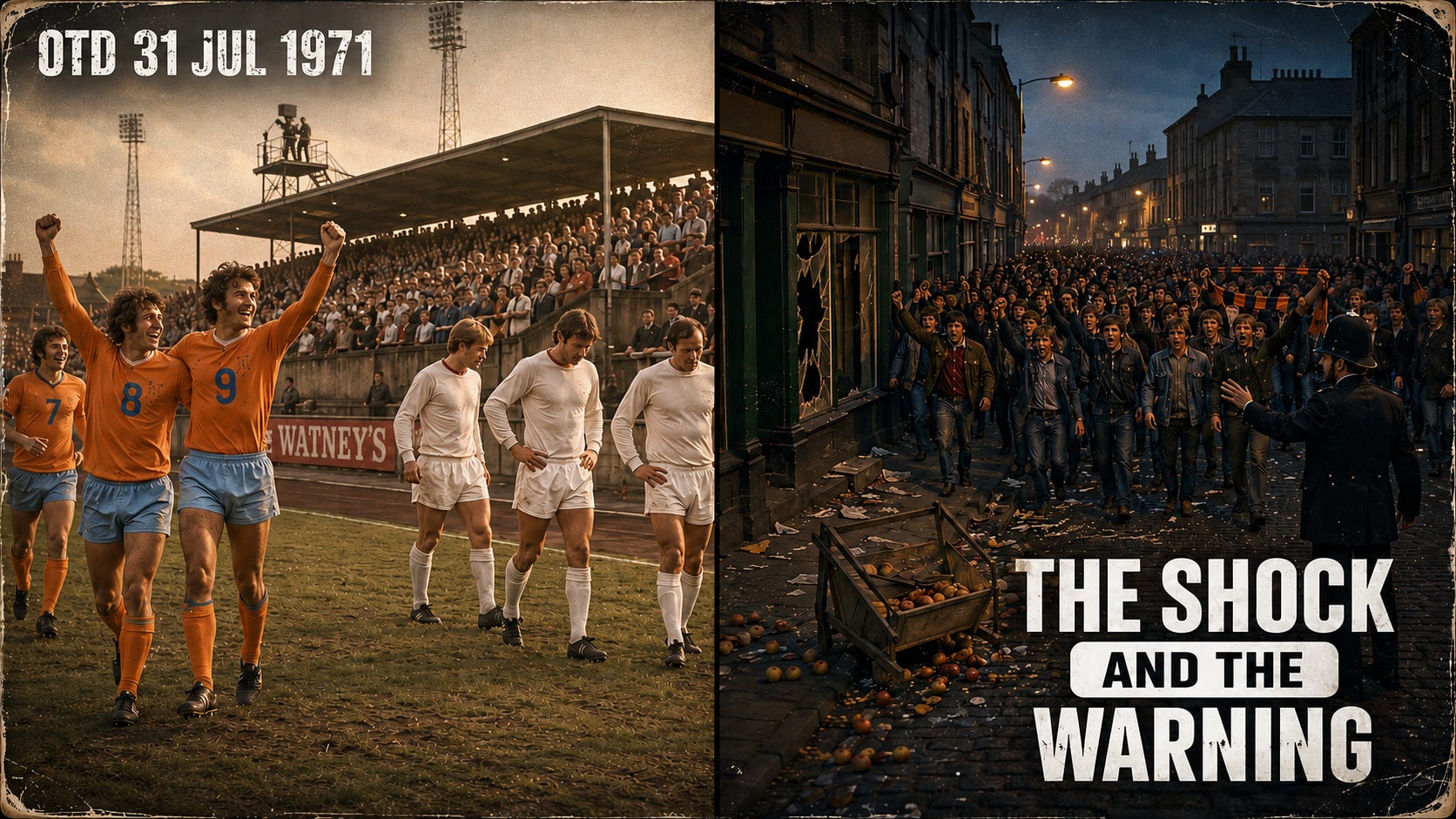
It is July 31, 1971. The Shay. Halifax Town against Manchester United. The Watney Cup, a pre-season tournament, a beer-sponsored experiment, and somehow a warning from the future. Halifax win 2-1, a Third Division club beats Manchester United, and the deeper story is uglier: United fans rampage through Halifax, dozens are arrested, and football is reminded that hooliganism is not an 1980s problem waiting to happen. It is already here.
For most of English football history, pre-season was not glamorous: conditioning, trialists, a bit of gate money, a bit of civic theater. Friendlies were not treated as hard competition. In England the hierarchy was League, FA Cup, and from 1960 the League Cup, with everything else lower. So by the late 1960s there was a gap, and television wanted football and sponsors wanted visibility, and somebody looked at the calendar and thought: what if we made friendlies matter?
Enter the Watney Mann Invitation Cup, named for the brewers, one of those very 1970s names that arrives with sideburns and a brown pub carpet. It began in 1970, short and sponsored, and that mattered: it is widely remembered as the first sponsored competition for Football League clubs. Eight teams, the highest scorers of the previous season who had not been promoted or reached Europe. And it experimented. Penalty shootouts instead of replays; in the 1970 semi-final, Manchester United beat Hull City in the first professional shootout, settling things by football rather than a coin toss. It also tried an offside law active only from the edge of the penalty area, meant to produce goals, though players proved creatures of habit and barely exploited it.
Then look at the 1971 opponents. Halifax Town, Third Division, a proud Yorkshire club with no glamour. And United were still United, Best, Charlton, Law, European champions three years earlier, but the shine was cracking. Busby had stepped away in 1969, the succession was an identity problem, and relegation was coming in 1974.
Almost 20,000 came to The Shay. Halifax were ready and United were not. Third minute: Bill Atkins scored. United won a penalty, Willie Morgan took it, and Alex Smith saved. Two minutes later Halifax got their own and Bob Wallace scored: 2-0. United had Best, Law, and Charlton, but names do not defend or press for you. Only in the 82nd minute did Best score from the spot. Too late. A Third Division team had beaten the biggest name in English football, and the Watney Cup had exactly the story it wanted.
But the day is not remembered only for the football, because United followers brought another story to town. Halifax is about thirty miles from Manchester, and they did not arrive like ordinary away supporters. Newspaper reports describe smashed shop windows, stores stormed, a bus stoned, and the Shay Hotel forced to close after more than a hundred supporters stormed in. Early reports said 42 arrests; by Monday the Daily Mirror reported 58 and fifteen hundred pounds of damage, with charges including possession of offensive weapons.
And this was not simply a reaction to Halifax. Old Trafford had already been ordered shut for the first two home league matches of the coming season after knives were thrown into an away section, so United’s first two home games of 1971-72 would be played at Anfield and at Stoke. This is 1971. Not Heysel. Not the 1980s. And English football could see the problem without knowing what to do about it. Four days later the disorder was raised in Parliament, and the answer was painfully mild: the minister deplored the violence and relied on the good sense of most fans. That is not nothing. But it is not a system, and that is the point.
The Watney Cup lasted only four seasons, but its ideas stayed: sponsorship, the penalty shootout, pre-season as product. The real warning of July 31, 1971 is that the English disease was already mobile, organized, and performative, using football as cover, while the response stayed too soft. Halifax is early in that long dark corridor: a giant-killing, and a town left to clean up after people who used football to break things.
🎙️ THE PODCAST GOES DEEPER. The full episode has the first professional penalty shootout, the offside experiment, and Old Trafford being shut for knife-throwing. That’s the 10-minute version.
---
🎧 Listen on Spotify, Apple Podcasts, Amazon Music, Overcast, iHeart, and YouTube.
📩 Got an episode idea? otd@17lawsguy.com
Yesterday: 30 July 1930, the first World Cup final.