

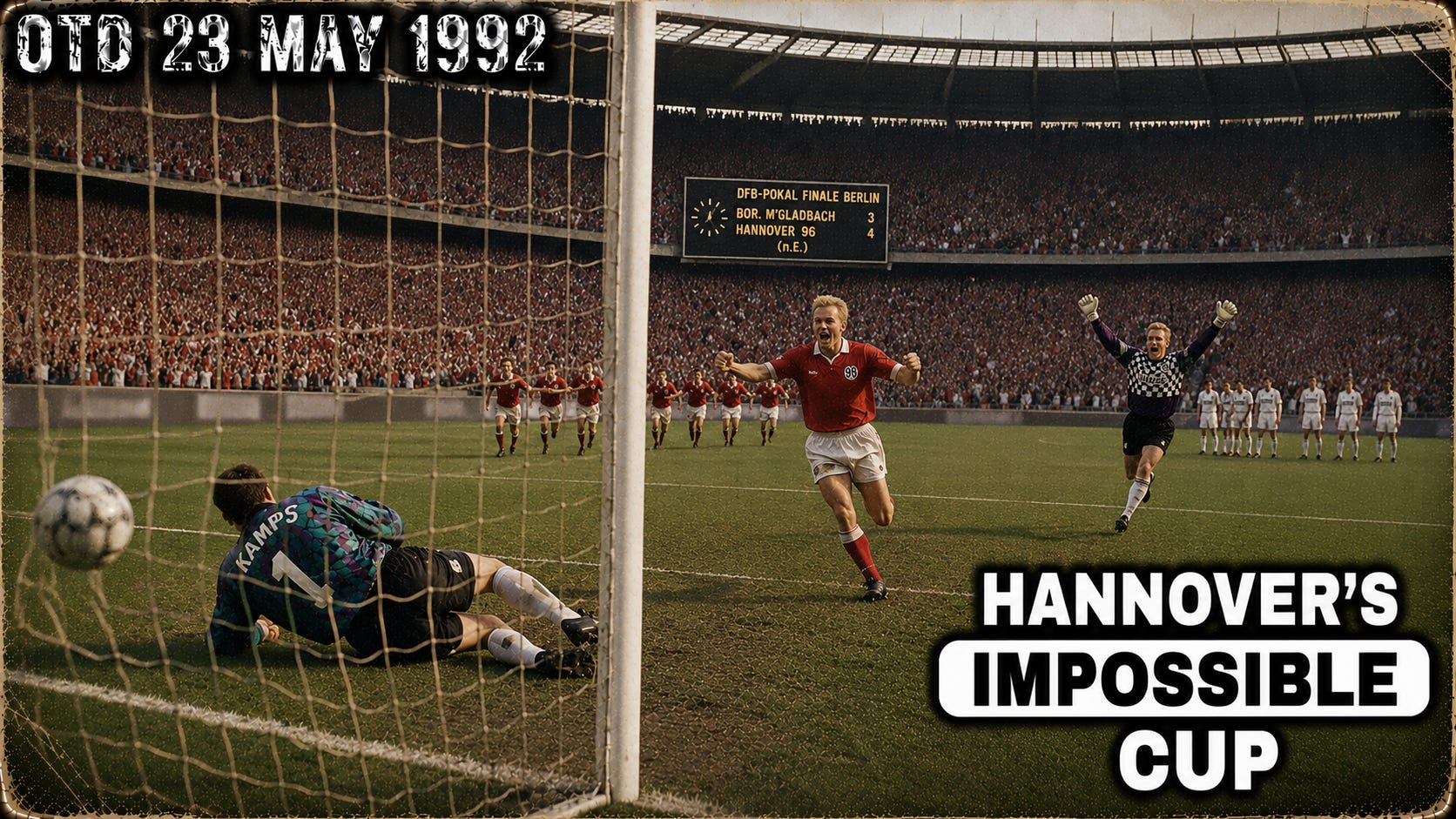
It is 23 May 1992. Berlin. Olympiastadion. DFB-Pokal final. Borussia Mönchengladbach against Hannover 96.
Gladbach are Bundesliga. Hannover are 2. Bundesliga.
The match goes ninety minutes without a goal. Then 120 minutes without a goal. Then penalties.
And when Danish defender Michael Schjønberg scores the decisive kick, Hannover have done something no club had done before — and no club has done since.
A second-division team has won the German Cup.
The 1991-92 DFB-Pokal was not a normal cup season. Germany had recently reunified. East German clubs were being integrated into the DFB structure. The tournament expanded to 88 teams and, for Hannover, that meant seven rounds from beginning to end. No shortcut.
They were not a fashionable team. A club with serious history — German champions in 1938 and 1954 (on this very day, May 23rd, actually) — but by 1992 they were in the second tier. Michael Lorkowski was the coach. Jörg Sievers was the goalkeeper. These were not household names. They were a team built for survival, work and opportunity.
Round one: NSC Marathon Berlin. Hannover won 7-0. A good start, but nothing that changed the national conversation.
Then the real cup began. Round two: VfL Bochum, from the Bundesliga. Hannover won 3-2 away.
Round three: Borussia Dortmund, away. And this is where the story became serious. Dortmund would finish second in the Bundesliga that season, level on points with Stuttgart. Ottmar Hitzfeld as coach. Chapuisat, Zorc, Povlsen, Reinhardt. At half-time, Dortmund led 2-0. Normal order was being restored.
Then Hannover turned the match upside down. Patrick Grün pulled one back. André Breitenreiter equalized. And in the 89th minute, Jörg-Uwe Klütz scored the winner. Dortmund 2, Hannover 3.
That is the result that announced the run.
Round four: Bayer Uerdingen, the class of the 2. Bundesliga Nord, who would win the division. In league play that season, Hannover never beat them. But in the cup, Hannover won 1-0.
Quarter-final: Karlsruher SC, Bundesliga. Again 1-0. Now it was no longer just romance. It was a pattern. Hannover could suffer, defend, wait, and take their moment.
Semi-final: Werder Bremen. Otto Rehhagel. Rune Bratseth. Wynton Rufer. And just a few weeks later, Bremen would win the European Cup Winners’ Cup. At the Niedersachsenstadion it was 0-0 after ninety minutes. In extra time, Michael Koch scored for Hannover; Bratseth equalized for Bremen. Penalties. And here Jörg Sievers began to become more than a goalkeeper. He saved from Marco Bode, then scored the decisive kick himself.
Hannover were going to Berlin.
Gladbach were not the great Fohlen side of the 1970s, but they still carried the name, the European memory, the expectation. Their cup run was controlled: four ties, four wins, no goals conceded until a semi-final shootout against Leverkusen that Uwe Kamps dominated.
So the final was set. Bundesliga Gladbach against second-division Hannover. And in Berlin it was tense, physical, cautious, exhausting. No goals in the first half. No goals in the second. No goals in extra time. The final would be decided from the spot.
Kastenmaier scored. Đelmaš scored. Criens scored. Wójcicki scored. Then Pflipsen stepped up for Gladbach — and Sievers saved. Hannover could lead, but Freund missed. Fach stepped up — Sievers saved again. Kretzschmar scored to put Hannover ahead. Neun had to score for Gladbach, and converted.
And then Michael Schjønberg walked forward. Danish international. Centre-back. Not the obvious protagonist when the competition began.
He scored.
Hannover won 4-3 on penalties. The second-division club had sensationally won the DFB-Pokal.
It was genuinely unique. Germany’s cup has produced underdog finalists — Hertha’s amateurs in 1993, Energie Cottbus in 1997, Union Berlin in 2001, Kaiserslautern as a second-division side in 2024, Arminia Bielefeld from the third division in 2025. But they all lost.
Hannover won. That is the difference between a fairy tale run and a trophy.
The win put Hannover into the 1992-93 Cup Winners’ Cup, where the draw was almost cruel: Werder Bremen again, this time as holders. Hannover went out on aggregate. But nobody could take Berlin away.
Jörg Sievers stayed a Hannover legend — hundreds of appearances, later a long-serving goalkeeping coach. Schjønberg’s career went on too: Denmark caps, Euro 1996, the 1998 World Cup, a Bundesliga title with Kaiserslautern in 1998.
The broader point: domestic cups are designed to make hierarchy nervous. England has Sunderland 1973, Southampton 1976, West Ham 1980. Italy has Napoli winning the Coppa Italia from Serie B in 1962. France has Guingamp from Ligue 2 in 2009. But in Germany, in the DFB-Pokal, Hannover 1992 stands alone.
Because the cup, at its purest, does not ask who is better across thirty-four league matches. It asks who survives today. And in 1991-92, Hannover survived seven times.
🎙️ The full episode (linked above) has more — including the full shootout sequence kick by kick, Sievers’ semi-final heroics, the post-reunification expansion of the cup, and the wider history of lower-division cup winners across Europe. The whole arc is in the audio.
---
🎧 Also available on Apple Podcasts, Amazon Music, Overcast, iHeart, and YouTube.
📩 Got an episode idea? otd@17lawsguy.com
Yesterday: 22 May 1963 — Catenaccio Conquers Europe.